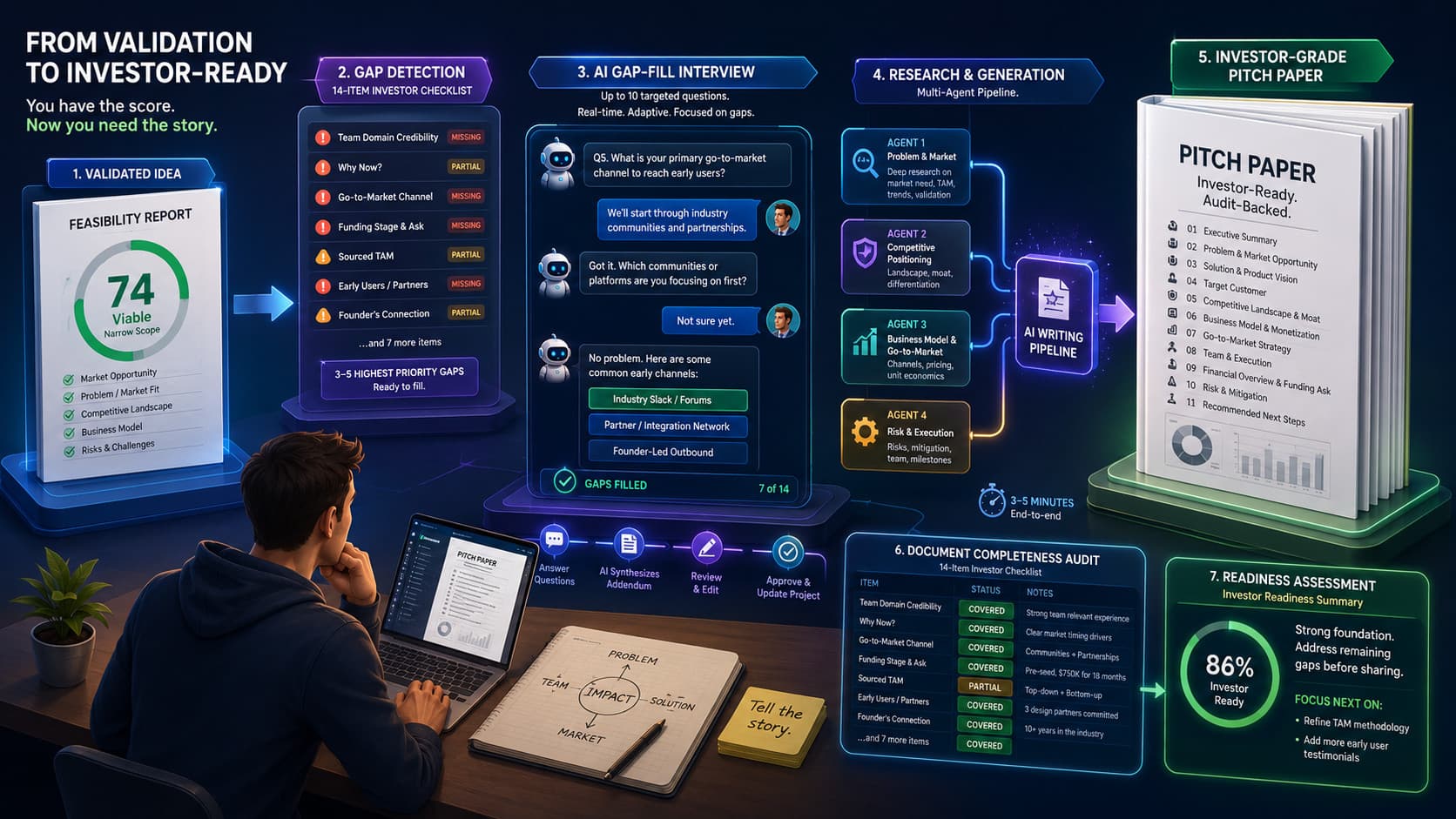
The meeting is booked for next Thursday. You have a Feasibility Report that scored your idea at 74, Viable, Narrow Scope, and you've spent two weeks tightening the differentiation story based on its recommendations. You believe in this. What you don't have is a clean document you'd hand to an investor without apology.
A feasibility report is not a pitch document. It was built to answer one question: is this idea worth pursuing? That question is settled. The investor is asking something different. They want to know why they should fund you, on this idea, right now. The framing, the evidence, the narrative structure all need to shift.
The Pitch Paper is built for that shift.
What investors actually need to see
The problem with most founder pitch documents isn't effort. Founders put real work into them. The problem is coverage. There are specific items investors expect to find, and most early-stage pitch materials are missing four or five of them without the founder knowing.
founderscore checks your existing Feasibility Report against a 14-item investor checklist before asking a single question. That checklist covers what most commonly trips up early-stage pitches: your team's domain credibility, the "why now" driver that makes this the right moment, your go-to-market channel (not just your target customer, but how you actually reach them), your funding stage and capital requirement, a sourced TAM figure, named early users or design partners, and the founder's personal connection to the problem.
A high feasibility score doesn't mean those items are covered. The research pipeline that generates your score is built to evaluate market viability, not to collect your founder story or your customer acquisition plan. Those gaps are real, and they're what will get you stuck in a follow-up email cycle after a promising first meeting.
How the gap-fill interview works
Before the first question, the AI reads your full Feasibility Report and surfaces the three to five highest-priority gaps. This is the ready-check. It's written in concrete terms specific to your project, not generic labels. If your report didn't establish founder domain credibility, the ready-check will say so plainly and explain why that matters for your archetype. You review it, confirm you're ready, and the interview begins.
The interview runs up to 10 questions, targeting only the gaps. It won't ask you to re-explain your competitive landscape or re-describe your feature set. It already has that from your report. What it's after is the context that lives in your head and hasn't made it into the documentation yet: the customer conversation that convinced you the pain is real, the specific channel where your early users cluster, the investor thesis your product fits, what you're raising and what you'll do with it.
Answers stream in real time, so there's no loading between questions. If you give a vague answer, the AI follows up. If you say you don't know, it offers two or three concrete options to help you think it through. The interview ends when the gaps are filled or at question 10, whichever comes first.
After the interview, the AI synthesizes your answers into an addendum: a structured summary of the new information you provided, ready to append to your project description. You review it, edit if needed, and approve. Approval updates your project description with the full context of this session and triggers pitch paper generation.
What gets generated
Generation runs in two stages. Four parallel research agents work through your Feasibility Report, extracting and deepening the evidence across four domains: problem and market, competitive positioning, business model and go-to-market, and risk and execution. That extraction feeds into the writing pipeline, which produces an 11-section pitch paper covering executive summary, problem and market opportunity, solution and product vision, target customer, competitive landscape and moat, business model and monetization, go-to-market strategy, team and execution, financial overview and funding ask, risk and mitigation, and recommended next steps.
After the paper is written, a separate audit agent checks it against the same 14-item checklist used at the start. The result is a Document Completeness Audit: a table showing the status of each gap item as Covered, Partial, or Missing, with notes on the assessment. Alongside that is a Readiness Assessment, an investor readiness summary with the specific gaps you still need to address before sharing.
The whole process takes three to five minutes from confirmation to completed document.
What you're trading off
If you go into an investor meeting with your Feasibility Report, you have strong evidence in a structure built for self-evaluation, not persuasion. The report is written for you. It's designed to surface problems and make you confront weak areas. That's exactly right for validation and exactly wrong for a first pitch.
If you build the pitch document manually, you pull from the report, write the narrative yourself, and assemble the sections from scratch. You'll produce something genuine. You'll also spend eight to twelve hours on it and still won't have a systematic audit telling you which investor checklist items you missed.
The Pitch Paper interview takes 15 to 20 minutes. The document that comes out is investor-grade, structured for persuasion, and audited against the checklist you'd otherwise have to know from memory. The Document Insights panel tells you exactly what's still missing after the first pass, so the next gap-fill interview is more targeted.
The trade is time against completeness. You give up some control over the initial narrative structure. You get a document you can share the same day, with a clear view of where it still needs work.
What to do before Thursday
Run the Feasibility Report if you haven't. The Pitch Paper interview requires a completed report for the project. It builds on the research already done, and without it, the gap detection has nothing to read.
If your report is ready, open the Pitch Paper interview from the gold coins icon on your project row. Review the ready-check carefully. The gaps it surfaces are the ones most likely to come up in the meeting. Answer the interview questions with specifics: name your actual early users, give a real number for what you're raising, explain the timing driver in one sentence. The more concrete your answers, the stronger the narrative that comes out.
After generation, open Document Insights before you share anything. The Readiness Assessment will tell you if there are still Partial or Missing items. A second gap-fill interview costs one credit and creates a new version with the additional context. Previous versions are preserved, so nothing gets overwritten.
You walk into Thursday with a PDF checked against what investors actually look for, not a strong feasibility score and a document you're quietly uncertain about.