You are eight months into a massive platform migration. The vendors have been selected, the cloud architecture configured, the security audits completed. Your deployment dashboard is green across the board. Leadership is excited. The project manager sends the final status update, and the collective exhale is almost audible. The code compiles. The system is live. The project, by every technical measure, is finished.
Except it is not finished. Not even close.
Somewhere on the fourth floor, a procurement analyst who has spent a decade mastering the legacy system opens the new interface for the first time. She cannot find the report she runs every Monday morning. The navigation is different. The terminology has changed. The shortcuts she built her professional reputation on no longer exist. She is not just confused. She is rattled. And across the building, hundreds of her colleagues are having the exact same experience at the exact same moment. Within an hour, the IT help desk is fielding more tickets than it received in the entire previous month.
This is the scenario that plays out with striking regularity across industries, from financial services to healthcare to manufacturing. Organizations pour enormous resources into selecting vendors, configuring systems, and testing infrastructure. They treat every technical milestone with appropriate gravity. Then they arrive at the one milestone that determines whether any of it actually works for the people using it, and they treat it like an administrative formality.
This is what happens when organizations treat enablement as the last item on the project checklist instead of one of the first. It is a pattern so common that it has become almost invisible, and it is quietly destroying the return on some of the largest technology investments companies make.
The IT Illusion of Completion
The root of the problem is a flaw in how we define “done.” Project managers often fall into what you might call the IT illusion of completion, the assumption that shipping code is the same thing as shipping value. When the software compiles in staging without crashing, when the deployment matrix shows all green, leadership checks out. Training gets categorized as a minor administrative task, bolted onto the final week of the timeline like an afterthought.
The reality is far messier. Modern development teams are sprinting and iterating right up to the final hour. The tech side almost always encounters friction along the way, an API compatibility issue, a security rewrite, an unexpected data migration challenge. But the overall project deadline rarely shifts to accommodate those delays. Instead, the final phases get squeezed. A planned four-week training window quietly shrinks to four frantic days. What was supposed to be a structured enablement program devolves into a mass email with a dense PDF attachment and a link to a recorded webinar.
This is the equivalent of tossing the user manual into the glove box of a new car instead of teaching someone how to drive. The car works perfectly. The driver does not. And nobody on the project team seems to notice that the definition of success never included the people who have to use the thing every day.
Learning Under Fire
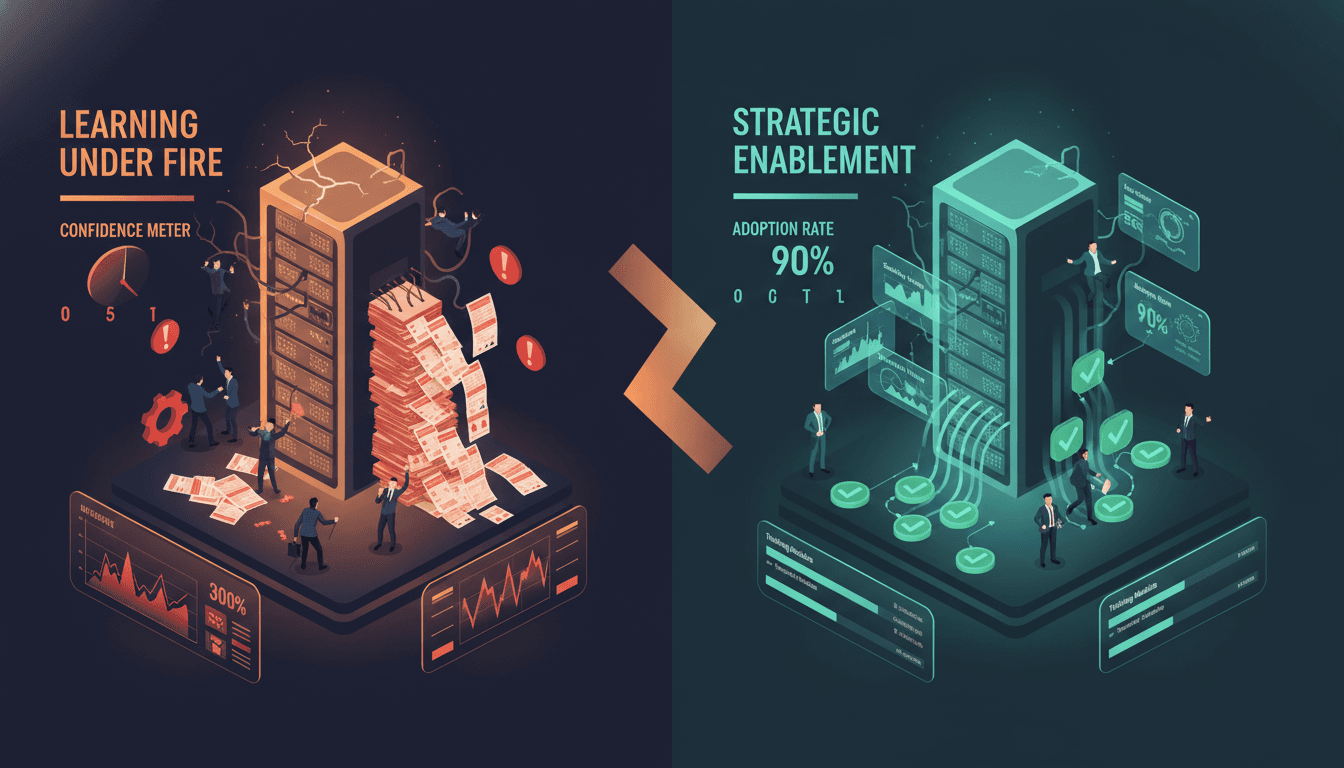
When deployment day arrives without adequate preparation, users are forced into a position that the industry sometimes describes as learning under fire. They are expected to perform their normal, high-pressure daily work inside an entirely unfamiliar system. The tools they spent years building muscle memory around have been abruptly replaced.
The cognitive load is enormous. You are asking someone to simultaneously learn a new system, maintain their normal output, and absorb procedural changes that touch every part of their workflow. Under that kind of duress, people do not methodically read documentation or work through training modules. They revert to ingrained habits, or they start guessing. And guessing inside an integrated enterprise system triggers a phenomenon known as cascade failure. Someone inputs a client asset incorrectly, bypassing a compliance tag. That corrupted data flows downstream. A colleague has to stop their own work, trace the routing logic backward, identify the original mistake, and manually correct it. The IT help desk gets flooded with support tickets that look like software bugs but are really just how-to questions from overwhelmed users. Four weeks of avoided launch delay gets traded for six months of reactive, chaotic troubleshooting.
The mechanical damage is visible and measurable. Error rates spike. Resolution times balloon. The operational velocity that justified the investment in the first place grinds to a crawl. But the deeper cost is something that rarely shows up on a project dashboard, and it is far harder to repair.
The Confidence Problem
When a new platform launches badly, the instinct across the organization is to blame the technology. The hallway consensus forms fast. This software is terrible. The old system worked fine. Why did we switch? But the technology is not the problem. The absence of preparation is.
The mechanism behind this misdiagnosis is rooted in something psychologists call ego threat. Consider the typical user profile. A highly competent professional who has spent years mastering the previous system. Their professional identity, their standing on the team, their sense of capability are all tied to their fluency with the tools they use every day. When a new platform deploys without training, that expert is instantly transformed into a novice. They log in on day one and cannot generate a basic report. They are not just frustrated. They feel diminished.
People will go to extraordinary lengths to protect their sense of competence. An employee who feels exposed is not going to raise their hand in a team meeting and admit they cannot figure out the new system. The social risk is too high. Instead, they externalize the blame. They decide the software is fundamentally broken. The vendor overpromised. Management made a terrible decision. Once that narrative takes hold in the culture, it becomes nearly impossible to reverse. It spreads through hallway conversations, team chats, and offhand comments in meetings until it becomes the accepted institutional truth. Leadership loses credibility. The project that was supposed to modernize the organization becomes the cautionary tale everyone references when the next initiative comes along.
And then comes shadow IT. Users who have lost faith in the platform start building their own workarounds. They export raw data into local spreadsheets. They create separate, unsecured ecosystems just to feel productive again. The moment the workforce starts operating outside the central platform, that multi-million dollar investment is effectively dead. Data integrity is gone. Cross-departmental collaboration is fractured. The ROI that justified the project in the first place has evaporated.
All because training was treated as something that could wait. It is the ultimate false economy. You rush the deployment to capture financial benefits faster, but the act of rushing destroys the adoption rate, ensuring you never actually realize those benefits.
What Strategic Enablement Actually Looks Like
The alternative is not complicated. It just requires a different set of priorities.
Strategic enablement means integrating the user base into the rollout logic weeks or months before the final code is pushed to production. Not handing them a PDF at the last second. Giving them access to sandbox environments where they can explore the new system, make mistakes, and build familiarity in a space where real data is not at risk. It is the equivalent of flight simulator time. You let pilots experience the new cockpit, stall the engine, and practice recovery procedures long before passengers are ever in the cabin.
This approach also means communicating the why behind the change, not just the how. Most enablement failures treat training as a mechanical exercise in button-clicking. Strategic enablement treats it as a conversation about purpose. When users understand why the old system had to go and how the new architecture benefits both the business and their daily work, they become far more forgiving of interface differences and minor friction points. They stop seeing the change as something being done to them and start seeing it as something they are part of.
The result is a deployment day that feels almost boring. Users log in, recognize the interface from their sandbox experience, and their muscle memory activates. They process data at a normal cadence. Error rates stay at baseline. The help desk handles forgotten passwords instead of fielding a flood of confused workflow questions. Operational velocity holds steady.
The ego threat transforms entirely. Because users were preloaded with competence, they navigate the new system successfully on their first attempt. When they succeed, they credit the platform. They think the new architecture is fast, that it saves them time. Adoption rates climb past 90% in the first week. Shadow IT never takes root. The ROI materializes exactly as projected.
Strategic enablement does not just prevent failure. It rewrites the entire post-launch narrative. The same technology that would have been vilified under a learn-under-fire model becomes the platform that people champion. The difference was never in the code. It was in the preparation.
The Sequence Matters
If you would not accept the chaos of packing a suitcase while sprinting through an airport terminal to catch a departing flight, you should not accept the same inverted logic when equipping your workforce for a major technology change. The preparation must come before the motion.
The next time a big initiative lands on your roadmap, ask a different question before the project timeline is locked. Not how fast can we deploy, but how ready will our people be when we do. That single shift in framing changes everything downstream. It changes what gets budgeted. It changes when training conversations happen. It changes who is in the room when the deployment plan is built.
The answer to that question will determine whether the investment delivers value or becomes the next cautionary tale that gets referenced every time someone proposes a new platform.
Every organization deserves a launch day that feels boring. Getting there starts with treating enablement as a strategic priority, not a final checkbox.