A seed-stage fund intake process can be prone to meetings that waste time. The founder had no real read on market size, hadn't named a single competitor, and was still describing the customer as "anyone who needs this." Forty-five minutes scheduled. Twelve minutes in, the outcome was obvious. Multiply that across a hundred applications per cohort and the math starts to hurt.
The problem is not that founders pitch bad ideas. It is that they pitch ideas they haven't seriously interrogated yet, and investors absorb the cost of that unfinished thinking.
The Signal Problem in Early-Stage Pipelines
Accelerator and VC are designed to filter after submission. An application comes in, someone reads it, it gets passed up or dropped. The filtering work happens inside your organization, on your time, with your attention.
That model made sense when deal flow was limited and applications took real effort to produce. Neither of those things is true anymore. A founder can put together a credible-looking one-pager in an afternoon. The application quality bar has dropped, which means the noise floor has risen.
What you actually want to filter for is not application quality. It is founder thinking quality. Whether someone has stress-tested their own assumptions, identified the real gaps, and confronted the hard questions before walking in the door.
The application rarely tells you that. The pitch meeting is where you find out, and that is too late.
Where founderscore Changes the Intake Metric
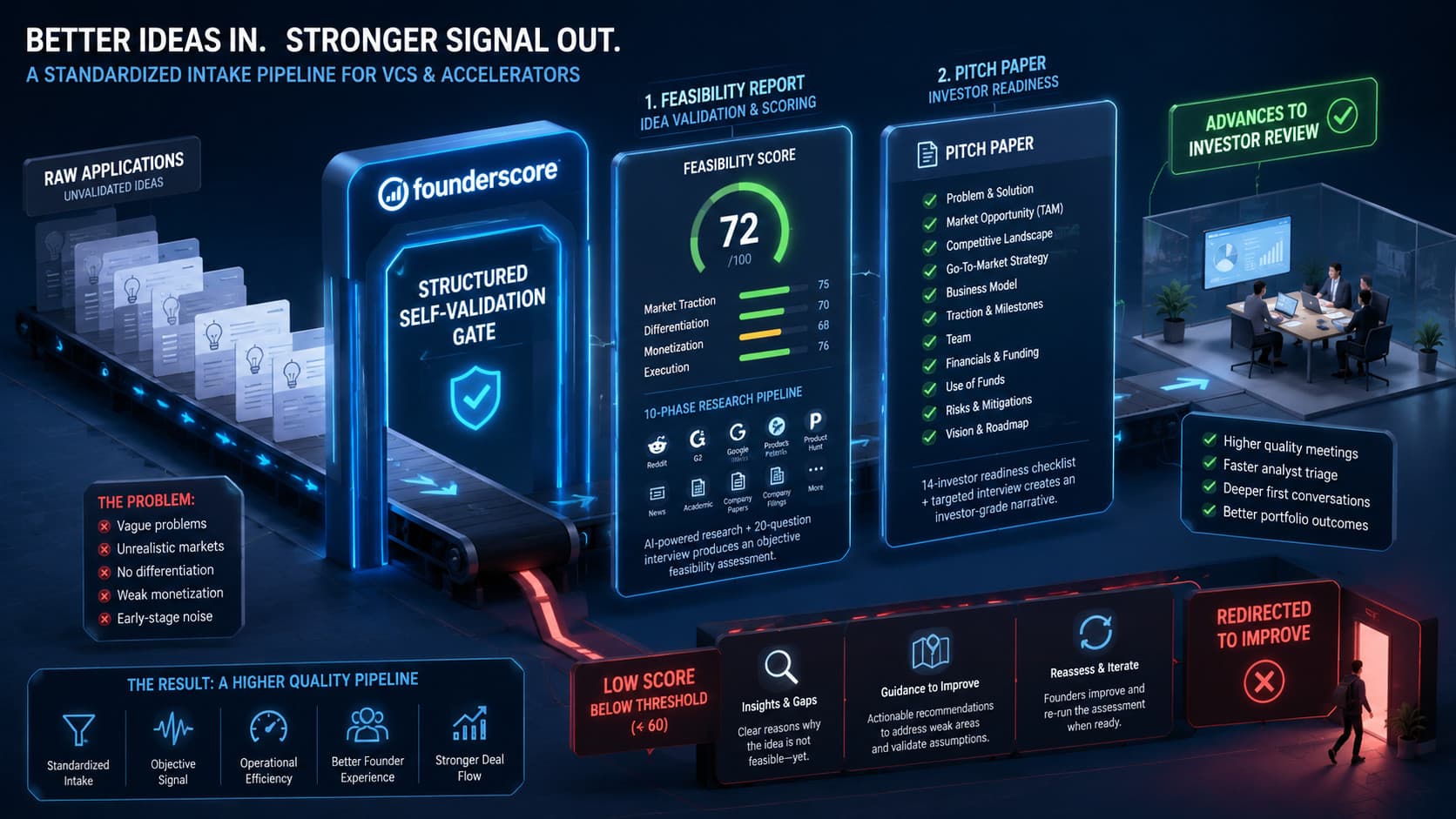
The bigger opportunity is not asking founders to submit a Feasibility Report alone. It is standardizing intake around a validated submission package consisting of both the Feasibility Report and the Pitch Paper.
Together, those two documents create a far more complete intake signal than a slide deck or open-form application ever could.
The Feasibility Report handles structured validation. founderscore takes a founder through an adaptive venture-style interview, runs a multi-phase research pipeline across public and commercial sources, stress-tests the market landscape, and produces a weighted score across core dimensions such as Market Traction, Differentiation, Monetization, and Execution. The output is not just a number. It is a documented record of whether the founder has seriously interrogated the viability of the business.
The Pitch Paper handles investor readiness. After the validation stage is complete, founderscore expands the submission into a structured investor narrative that addresses the practical questions investors actually evaluate during first-pass review and early diligence. Founder credibility, GTM strategy, competitive positioning, capital requirements, market sourcing, operational risks, design partners, regulatory exposure, execution assumptions, and commercial readiness are surfaced in a consistent format.
That distinction matters. The Feasibility Report tells you whether the idea appears worth pursuing. The Pitch Paper tells you whether the founder appears prepared to pursue it. When both documents are submitted together, the intake process changes from subjective interpretation to structured comparison.
Instead of reviewing:
- different submission formats
- inconsistent storytelling quality
- missing market data
- vague TAM claims
- unsupported moat language
- incomplete competitive analysis
- shallow customer definitions
...your team receives standardized submissions built around the same evaluation framework. That dramatically improves reviewer efficiency.
Analysts and investment teams spend less time extracting missing information and more time evaluating actual opportunity quality. First-pass review becomes faster because the baseline questions have already been answered. Internal comparison across applicants becomes cleaner because submissions arrive normalized into the same structural format.
The score itself also becomes operationally useful. You can establish intake thresholds, weighted review criteria, or priority queues based on validated submissions rather than presentation quality. A firm might fast-track all submissions above a certain score range for analyst review while routing lower-scoring applications into deferred review queues.
More importantly, the intake process begins filtering for founder rigor instead of founder polish. A founder who has completed both the validation process and the investor readiness workflow has already demonstrated a willingness to pressure-test assumptions, respond to difficult questions, gather supporting evidence, and refine positioning before approaching investors. That is a materially stronger signal than the ability to assemble a visually attractive pitch deck.
The Pitch Paper also changes the dynamic of the first meeting itself. Instead of spending the first thirty minutes uncovering missing fundamentals, conversations can begin at a deeper level. Investors can move directly into strategic discussion, diligence clarification, execution risk, and market timing because the foundational intake work has already been completed.
For accelerators and funds operating at scale, that throughput improvement compounds quickly across an entire cohort.
The "Do Not Build" Verdict Does Real Work
One of the less obvious benefits of requiring self-validation is what it removes from your pipeline before you ever see it.
When founderscore scores an idea below 50, the verdict is "Do Not Build." That verdict is not gentle. The report explains specifically what research found, which dimensions scored low, and what would need to change for the picture to look different. A founder who gets that verdict and still submits hasn't learned from it. But most founders who get that verdict don't submit. Working through a 14-item gap audit and coming out with a score in the 30s is a fairly effective self-selection mechanism.
What this means for your pipeline, the ideas that were never going to fund stop consuming application review time. You don't have to write the rejection. The platform already delivered the honest signal.
The Tradeoffs Are Real
Requesting validated submissions does introduce additional founder effort. Completing both a Feasibility Report and Pitch Paper requires more work than uploading a generic slide deck.
That is true. But from an investor perspective, the more important question is whether the added effort produces higher-quality intake signals and better downstream throughput.
In practice, it usually does. The additional structure filters out speculative submissions, forces foundational research to happen earlier, and reduces the number of first meetings spent uncovering obvious weaknesses that should have surfaced before the application stage.
The result is not simply fewer applications. It is a higher concentration of prepared applications. That distinction matters because most early-stage pipeline inefficiency is not caused by a shortage of applicants. It is caused by the amount of reviewer time consumed by incomplete founder preparation. Validated submissions help solve that problem.
The process also creates operational leverage internally. Analysts spend less time chasing missing information. Partners spend less time in low-signal meetings. Review discussions become more standardized because every submission follows the same structural framework.
There will still be some founder drop-off. Founders who apply indiscriminately to every accelerator or fund will often avoid additional prep requirements. But those are frequently the same applicants creating the highest review burden relative to investment quality. Serious founders generally adapt quickly when the expectations are clear.
In many cases, the requirement itself becomes part of the signaling process. A founder willing to complete structured validation and investor-readiness preparation before submission is already demonstrating a level of discipline and execution maturity that investors claim to value.
The framing also matters. This should not be positioned as gatekeeping or administrative friction. It should be positioned as a standardized investment intake framework designed to improve application quality, accelerate review cycles, and create more productive first conversations for both sides. That is a much stronger investor narrative than simply requiring a score threshold.
What to Actually Do
Start with recommended, not required. Add a line to your application portal, "We strongly encourage applicants to run a founderscore Feasibility Report before submitting. Applicants who include their Pitch Paper as a supporting document advance to first review faster." That creates genuine incentive without a hard gate.
Watch what happens over two cohorts. Track the correlation between Feasibility Report scores and first-meeting conversion rates. If the pattern holds, move to a minimum score threshold in cohort three.
For later-stage programs where the application bar is already higher, required makes more sense from day one. Founders applying to Series A-adjacent accelerators or sector-specific funds are not going to be scared off by a structured validation step. They are doing that work anyway. You are just asking to see it.
The Pitch Paper is the practical handoff document. When you make it the expected submission format, you stop receiving 12-slide decks that tell you nothing and start receiving structured documents that address what you actually evaluate. Your first-pass review gets faster. Your first meetings get better. The founders who arrive have already done the thinking that normally happens in the room.
That is the actual value of requiring self-validation before submission. Not a gatekeeping function, a depth filter.