You have used the same enterprise platform every day for years. You know the screens, the clicks, the routine. Then one afternoon you accidentally open a settings panel you have somehow never noticed. A cascade of features unfolds across the screen, and you realize you have been operating at a fraction of what the tool was designed to do. The limitation was never the software. The limitation was always your understanding of it.
That moment of discovery is not unique to you. It plays out across every department in every organization that relies on modern technology to run its operations. Teams learn the minimum they need to get through the day, and then they stop exploring. The safe, manual path from point A to point B becomes muscle memory. Over time, that muscle memory hardens into the only way things get done, even when the software is quietly offering a better path right next to the one you have always taken.
The cost of this pattern is enormous, and it is almost entirely invisible. Organizations pour budget into new licenses while the tools they already own sit underutilized, quietly capable of solving the very problems that triggered the purchase in the first place. The issue is not a lack of technology. It is a lack of understanding of the technology that is already there.
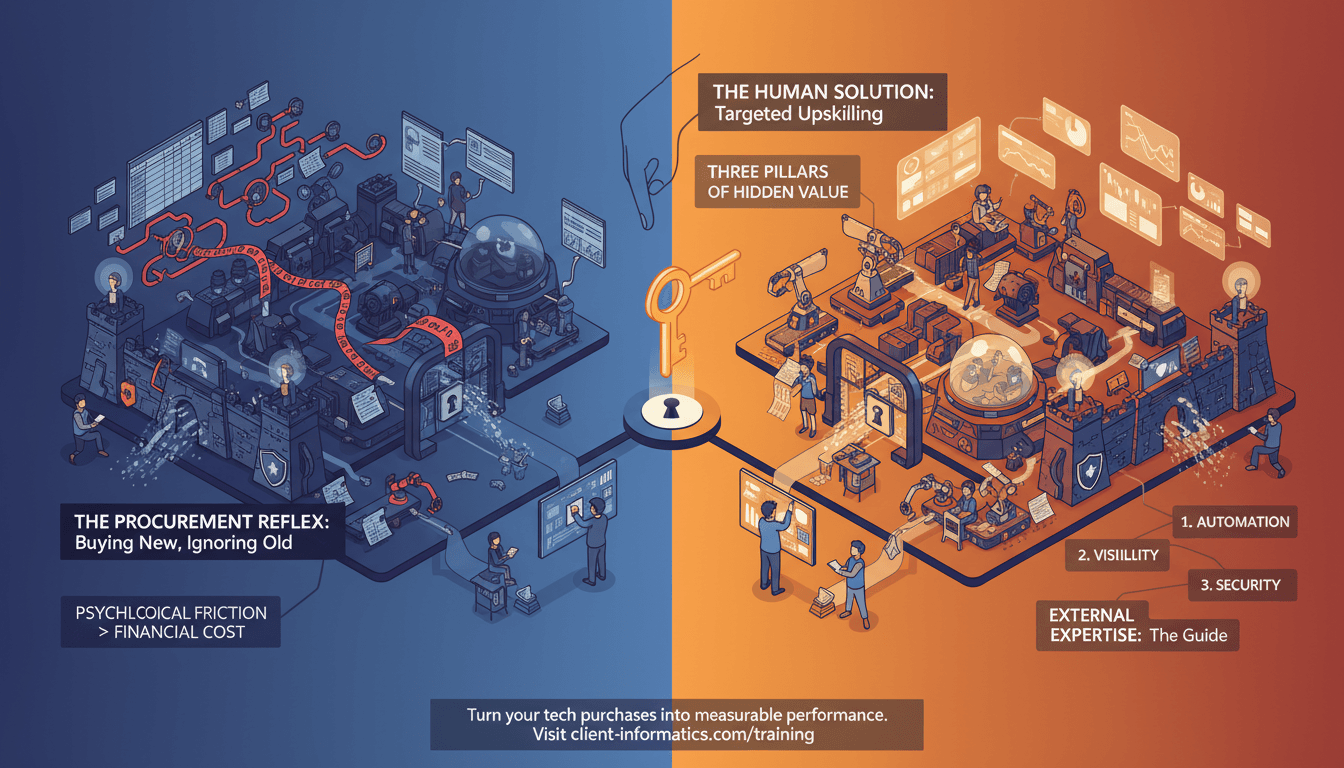
The Procurement Reflex
When a workflow breaks down or a new business need surfaces, the instinct in most organizations is to look outward. A new platform, a new vendor, a new contract. It feels decisive. You draft a request for a proposal, sign an agreement, attend the kickoff meeting. The process feels like forward motion, and that feeling is seductive. Procurement produces a dopamine hit of visible action that leadership can point to and say the problem is being addressed.
Meanwhile, the idea of digging into the obscure capabilities of a platform you purchased three years ago feels like tedious homework. It requires cognitive effort, patience, and something most teams quietly avoid, which is vulnerability. To admit that the existing tool is not the problem is to admit that your team has not been operating at its full potential. Nobody wants to be the person who discovers that the software could have automated a six-month manual workaround with a single configuration change. That realization turns the mirror inward, and the reflection is uncomfortable.
There is a sunk cost dimension to this as well. If you have spent months building fragile workarounds using spreadsheets and manual processes, learning that the platform could have handled it automatically all along feels like admitting you wasted that time. The cognitive dissonance is real, and it pushes people toward blaming the tool rather than adapting their workflow.
This is why the psychological friction of learning what you already own often feels higher than the financial cost of buying something new. It is not a rational calculation. It is a deeply human one. And it repeats itself across organizations of every size and industry, creating what amounts to a quiet epidemic of underutilization.
Three Pillars of Hidden Value
The capabilities buried inside your existing technology stack tend to fall into three categories, each connected to the next in a chain of cause and effect.
The first is automation. Your platform almost certainly has the ability to eliminate repetitive, manual work that your team performs every day. The features are not hidden in any technical sense. They are visible on the screen. But when a deliverable is due in an hour, nobody stops to read documentation or experiment with a workflow builder. You rely on the manual path because it is familiar and because experimenting with something new feels like a risk when you are under pressure. Over time, highly paid professionals spend their days doing data entry that the software was actively designed to handle for them. The automation is not physically hidden. It is psychologically hidden, buried under the weight of deadline pressure and the comfort of routine.
The second pillar is visibility. If your team actually implemented the automation capabilities sitting dormant in your stack, data would begin moving between departments faster. But speed without the ability to track and interpret that data creates a different kind of problem. You end up making messes faster instead of decisions. Visibility in enterprise software typically depends on understanding the platform’s data models, configuring reporting tools, and mapping your organizational structure into the system’s native analytics. That is not a matter of clicking a dashboard button. If leadership has not invested the time to learn how the reporting engine actually works, they see only the default metrics, the surface-level numbers that tell you very little about what is happening on the ground. The result is a stressful feeling of blindness that, predictably, triggers the procurement reflex all over again. Instead of learning to query the tool they already own, the organization bolts on a third-party analytics overlay just to read data that the primary platform already knows how to visualize. It is the equivalent of buying an expensive flashlight because you never learned where the light switch is in the room you are already standing in.
The third pillar is security. If you cannot properly see and map your data, you certainly cannot protect it. But the reason security features go unused follows a different pattern than automation or visibility. Software vendors prioritize something called time-to-first-value, meaning how quickly a new customer feels that the product is working. If a vendor enforced strict role-based access controls, mandatory multi-factor authentication, and IP whitelisting during the initial deployment, the rollout would stall. People would get locked out, complaints would escalate, and the software would look like a failure before anyone had a chance to use it. So vendors ship their platforms with advanced security features turned off by default. The unspoken expectation is that your IT team will go back later and configure those protections once the organization is comfortable with the interface. But later almost never comes. The platform stays in its vulnerable default state, and when a compliance audit fails or a breach occurs, the response is to purchase yet another dedicated security tool. Buying a second shield does not help if you never learned how to raise the first one.
The Human Solution
The solution to all three of these problems, the dormant automation, the missing visibility, the exposed security posture, is not another software purchase. It is not a patch, an upgrade, or a migration. It is entirely human.
You unlock this value by upskilling the people you already have. Not through generic training, but through something far more specific and far more effective. The distinction matters more than most organizations realize.
Generic training is a feature tour. A vendor walks your team through every menu and every option, usually in a windowless conference room with a blurry projector and stale sandwiches in the back. By the time they reach the fifth feature, nobody remembers the first. The information goes in one ear and out the other because it lacks the one thing that makes learning stick. Context.
Targeted product training works in the opposite direction. It starts with the organizational pain point and works backward to the dormant capability. If your teams are struggling with data silos, the training focuses exclusively on the native integration and reporting tools within your current platform. If you are failing compliance audits, the training targets the identity and access management features that have been sitting idle since the day the software was deployed. Nothing else. No feature tours, no generic overviews, no irrelevant noise.
Think of it this way. A generic gym orientation is someone pointing at fifty machines and naming them. Targeted training is a personal trainer who learns that your lower back hurts when you sit at your desk and then shows you the exact exercise and the exact form to fix that specific problem. One approach is forgettable. The other changes how you operate every day.
The key is that discovery and application must happen together. Knowing a feature exists is trivia. Applying that feature to a real workflow is where value actually gets unlocked. Targeted upskilling provides the context that makes the connection between the obscure menu and the daily frustration, and that connection removes the psychological friction that kept your team from exploring in the first place.
Why External Expertise Matters
Internal upskilling efforts almost always fail for a simple reason. The people closest to the problem are also the people least able to see it clearly. Your team has been building workarounds and duct-tape processes for months or years. Those workarounds feel normal. They feel like the way things work. It takes an outside perspective to look at your stack objectively, identify where the dormant capabilities align with your actual business needs, and design a training approach that connects the two.
You cannot unlock the value if you do not know where the key is hiding. And most organizations need a guide who can point out the keyhole.
The shift this requires is not a small one. It means reallocating investment away from expanding your infrastructure and toward expanding the capability of your workforce. It is not about upgrading to a faster ship. It is about giving your crew the operating manual they never had a chance to read. That shift in thinking, from acquisition to utilization, is what separates organizations that get real value from their technology from organizations that simply collect expensive licenses.
Before you request budget for the next platform, take an honest look at the ones you already own. Ask yourself whether your team has truly explored what those tools can do. Consider a simple thought experiment. If your organization’s tech stack were completely frozen today, no new purchases, no new vendor contracts, no new migrations for an entire year, how much untapped potential could your team unlock just by fully mastering what is already at their fingertips? For most organizations, the answer is extraordinary.
If you are not sure where to start, that uncertainty is the clearest signal that the next step is not another vendor’s pricing page. The next step is targeted training that connects your people to the technology sitting right in front of them.