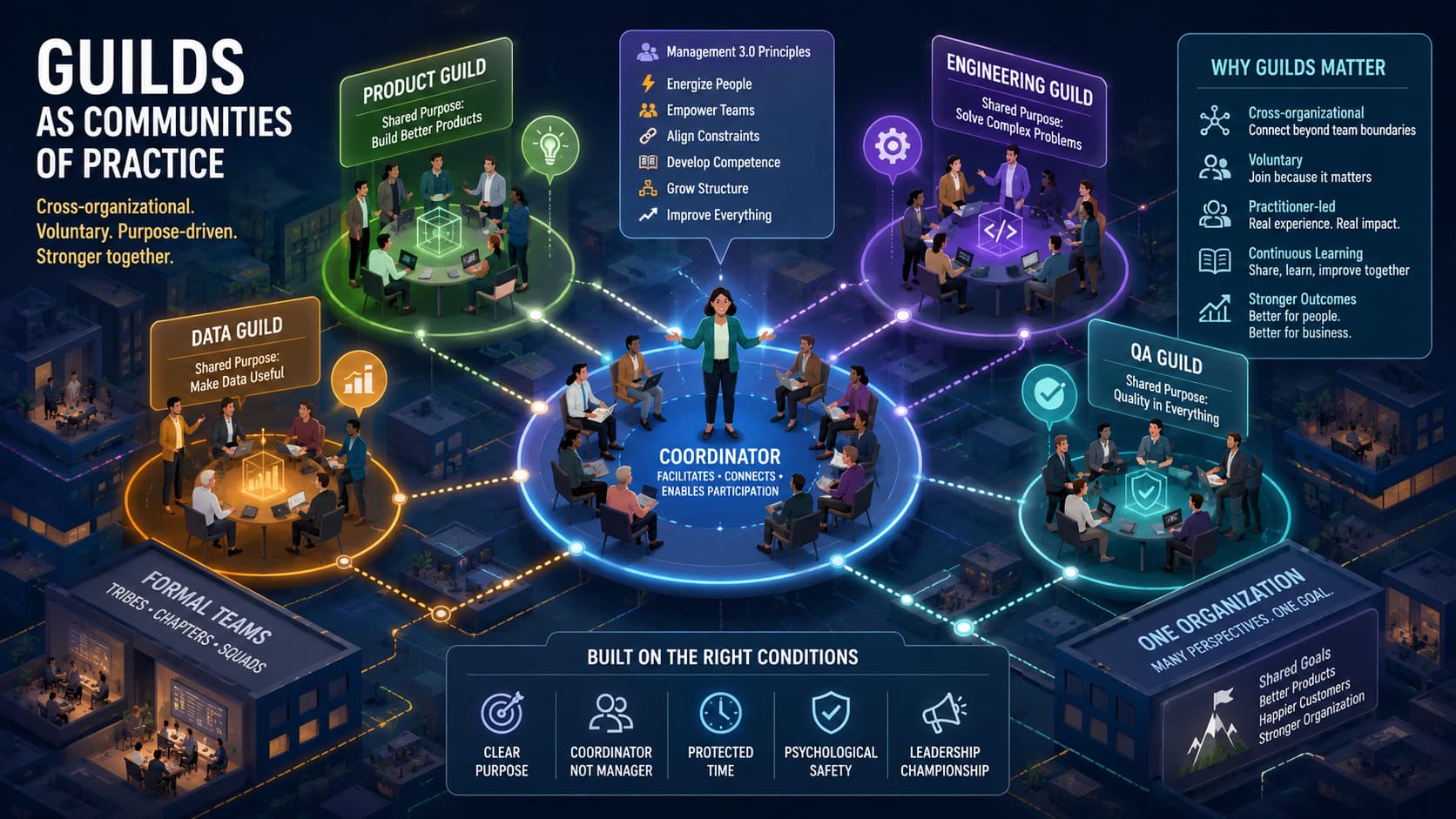
Three months in, the Product Guild is down to five attendees. The coordinator sends a calendar invite every two weeks, a few people show up, someone shares a link to an article they meant to read, and the group disperses. No one formally disbanded the guild. It just stopped meaning anything. Meanwhile, two product managers who never joined it are solving the same problem set in separate corners of the business, with no mechanism to connect them.
This is not a story about disengaged employees. It is a story about an organizational structure dropped into conditions that cannot support it.
Where Guilds Come From and Why That Matters
The concept entered mainstream organizational design through a 2012 whitepaper by Henrik Kniberg and Anders Ivarsson, who documented how Spotify structured its engineering organization. In that model, guilds are voluntary, cross-organizational communities of interest. Anyone can join. No one reports to anyone. They differ from Chapters, which group people by skill within a formal team structure and stay local to a Tribe. A guild cuts across the whole organization.
What most organizations miss when they borrow this structure is that Spotify built it on top of a decade of deliberate cultural investment in autonomy, distributed ownership, and psychological safety. The guild form is not the cause of those outcomes. It is an expression of them.
Management 3.0, Jurgen Appelo's leadership framework built on the premise that organizations are living networked systems rather than machines, makes this explicit. Leaders in that model manage the conditions that allow people to succeed, not people directly. The framework's six views, Energize People, Empower Teams, Align Constraints, Develop Competence, Grow Structure, and Improve Everything, describe what those conditions look like. Guilds appear naturally in at least three of those views: peer-driven motivation and belonging, self-organization across team boundaries, and practitioner-led continuous learning.
The implication is specific: a guild cannot outlast the cultural conditions around it. If those conditions don't exist, building the guild doesn't create them.
What Actually Fails and Why
Most guild failures trace to one of three structural gaps.
The first is absent purpose. Guilds positioned as "communities of interest" with no delivery-based focus drift quickly into optional social events. People attend when they have time, which means they stop attending when they don't. A guild without a clear answer to "what specific problem does this serve, and how does it connect to business goals" is not a community of practice. It is a recurring meeting with a better name.
The second is the wrong leadership model. Guilds need coordinators, not managers. That distinction sounds simple and gets ignored regularly. A coordinator's job is to create conditions for others to contribute, not to produce content and broadcast it to a passive audience. The most effective guild leaders practice what some call "center-out" leadership, actively seeking out the quieter voices and creating structured space for participation from people who would otherwise defer to the senior voices in the room. When the coordinator becomes the sole engine of the guild, the guild is one coordinator departure away from collapse.
The third gap is unprotected time. Guilds typically sit outside formal work structures, which means members carry them alongside their actual job commitments. When leadership does not acknowledge guild participation in team planning, members treat it as optional. Engagement falls. The guild stalls. Organizations that formally recognize guild time in capacity planning see participation recover, not because the content changed, but because the signal changed. Guilds do not need to be controlled by leadership. They do need to be championed by it.
The Management 3.0 Frame as a Diagnostic Tool
One practical use of the Management 3.0 progression is as a self-diagnosis. Management 1.0 treats the organization as a machine: people are parts to be optimized, and control flows from the top. Management 2.0 adds HR processes and engagement programs on top of that same hierarchy, producing a softer surface over the same structure. Management 3.0 treats the organization as a living system: people self-organize, the leader's job is to design the conditions, and accountability is distributed outward.
Most organizations that attempt guilds sit somewhere in the transition between 2.0 and 3.0. They have started to value self-organization in principle but have not restructured their time, incentives, or decision-making to support it in practice. Guilds land in that gap and struggle to survive.
This does not mean guilds are only viable in fully transformed organizations. It means organizations need to be honest about which conditions they are actually prepared to create, and which ones they are gesturing at.
The Tradeoffs Worth Naming
Open membership, where anyone can join regardless of role or seniority, is the right default for guilds, but it is not costless. A QA engineer who joins a Product Guild brings a different vantage point that genuinely improves the thinking in the room. It also requires the coordinator to actively manage the halo effect, the tendency for senior voices to fill the available conversational space. If that work does not happen, open membership produces the appearance of inclusion with the reality of the same hierarchy playing out in a different venue.
Closed or semi-formal guilds with curated membership are sometimes defended as higher-signal environments. The cost is real: exclusivity turns guilds into insider groups. That dynamic undermines the cross-organizational knowledge flow the guild exists to create.
Organic cadence versus structured cadence is a similar tradeoff. Guilds that form rituals, recurring lightning talks, demo sessions, structured problem-solving formats, build momentum and lower the activation energy for participation. Guilds that keep cadence loose "to avoid being too corporate" often end up with sporadic attendance and no institutional memory. The cost of structure is some spontaneity. The cost of no structure is the guild itself.
Distributed ownership is the third tradeoff. Getting each member to organize at least one session is not just good practice for engagement. It is the structural difference between a guild that survives coordinator turnover and one that doesn't. The cost is real: asking members to organize sessions is asking them to do more. That ask requires leadership air cover. One tradeoff depends on another.
What to Actually Do
None of this means guilds are too difficult for most organizations. It means guilds need to be built in a specific order with specific inputs.
Start with purpose before structure. Before the first calendar invite goes out, the founding group needs concrete answers to two questions: What specific domain does this guild serve? What does success look like in six months? Vague answers at this stage produce vague guilds. "We want to build a learning culture" is not a purpose. "We want to reduce the time it takes for new product managers to develop estimation fluency by documenting and sharing how experienced PMs actually do it" is a purpose.
Appoint a coordinator who understands their job as facilitation rather than content production. That coordinator should run the first few sessions with explicit attention to who is speaking, who is not, and what structural moves change that ratio.
Set a realistic cadence and protect it. Monthly is better than bi-weekly if bi-weekly will not survive contact with sprint planning. Announce the cadence, secure leadership acknowledgment that participation counts as real work time, and hold to it.
Design three or four recurring ritual formats before launch. Lightning talks. Problem boards. Retrospective reviews of decisions made since the last session. The specific formats matter less than having them. Rituals reduce the friction of participation to near zero because members know what they are showing up to.
Distribute ownership from the first session. Ask one or two members, not the coordinator, to own the second or third session before the first one ends. Frame it as the default, not a special request.
Build in an honest review at ninety days. If genuine participation is not happening, pause the guild or merge it with a related one. Guild fatigue, the slow accumulation of resentment from forced activity, is harder to reverse than a clean pause. The concept survives a pause. It does not survive becoming the thing people roll their eyes at.
The organizations that run effective guilds are not the ones with the best guild structure. They are the ones that built the conditions first and let the structure follow.