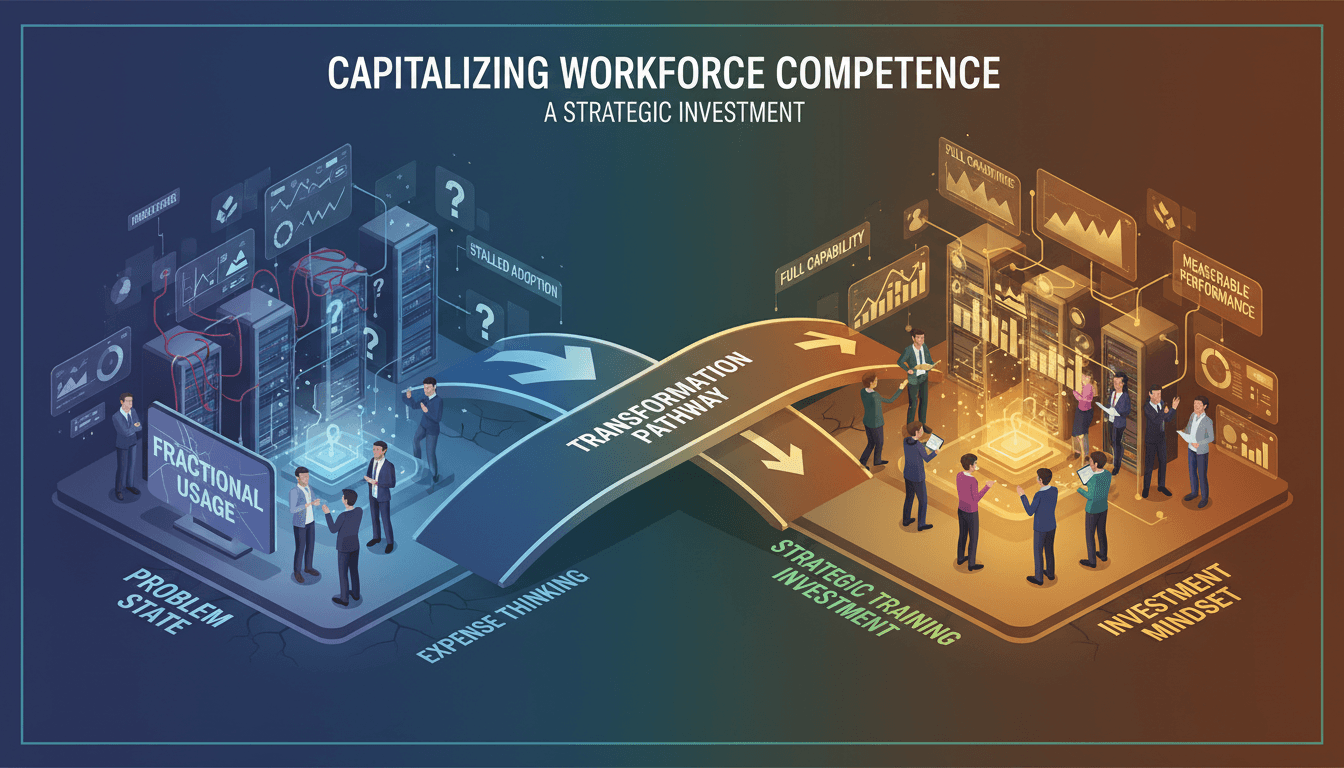
Most organizations can tell you exactly how much they spent on their technology stack. They can pull up the line items for cloud infrastructure, software licenses, and hardware refreshes without breaking a sweat. Those numbers live in tidy spreadsheets, approved by procurement, signed off by finance, and tracked across fiscal years with precision. But ask those same organizations how much productive capacity they are actually extracting from those purchases, and the room goes quiet.
This is the gap that nobody wants to talk about. Not because it is controversial, but because it is uncomfortable. The gap between what technology can do and what your team actually does with it is not a software problem. It is a competence problem. And it is far more common than most executives realize.
You have probably seen it firsthand. A platform launches to great internal fanfare. The vendor does a two-day orientation. A few power users get up to speed. And then the rest of the organization quietly reverts to whatever they were doing before, using just enough of the new system to get through the day. Months later, adoption metrics are disappointing, the promised ROI has not materialized, and someone suggests it might be time to evaluate a different vendor. The technology was never the issue. The team’s ability to use it was.
Until leadership treats that competence gap with the same financial seriousness they give to the technology itself, the cycle of underperformance will continue.
The Hardware Illusion
There is an almost unconscious bias built into how organizations allocate resources. Physical and digital assets get immediate credibility. A new server array feels like progress. A multimillion dollar CRM deployment feels like momentum. These are tangible things that show up on balance sheets, depreciate in predictable ways, and come with serial numbers and warranties. They feel safe to invest in because they are visible.
But when the conversation shifts to training the people who will actually use those systems every day, something changes. The budget becomes discretionary. The timeline becomes flexible. The entire initiative gets quietly reclassified from necessity to nice-to-have.
This is the hardware illusion. It is the belief that acquiring technology is the same as deploying capability. It is not. You can have the most advanced infrastructure in the world, and if your team lacks the competence to use it fully, you are operating at a fraction of potential capacity. Consider the analogy of purchasing a fleet of high performance aircraft and then refusing to train the pilots because training costs money. The aircraft sit on the tarmac, technically available but functionally grounded. The asset exists, but the capability does not. Organizations make this exact mistake with technology every single year.
The illusion persists because hardware is concrete and competence is abstract. You can point to a server rack. You can photograph a new office full of monitors. You cannot point to a team’s growing understanding of how to route data through an advanced analytics platform, and that invisibility makes it dangerously easy to deprioritize.
What makes this particularly costly is the ripple effect. When a team underutilizes a platform, the organization does not just lose the value of the training it skipped. It loses the compounding value of every workflow that platform was supposed to improve. Reports that should take minutes take hours. Data that should flow between systems gets manually exported to spreadsheets. Decisions that should be informed by real-time dashboards get made on intuition and outdated numbers. The cost is not a one-time miss. It is an ongoing drag on the entire operation.
The Expense Trap
The mechanics of this deprioritization are not accidental. They are structural. Traditional accounting frameworks force training into an operational expenditure category. And once something is classified as expense rather than investment, it becomes vulnerable to the first budget review that comes along.
Expenses are things you minimize. Investments are things you optimize. That distinction shapes every downstream decision. When revenue tightens, operational expenses get scrutinized, cut, and deferred. Training is almost always near the top of that list, not because it lacks value, but because its value is harder to quantify in the short term.
But here is what that calculation misses. Failing to invest in training is not a neutral decision. It is not simply cost avoidance. It is deferred risk accumulation. Every quarter that passes without meaningful competence development adds hidden liabilities to the organization. Skill gaps widen. Knowledge becomes outdated. Adaptability erodes. None of this shows up on the balance sheet immediately, but it compounds in ways that eventually surface as missed targets, failed deployments, and teams that cannot respond to change.
Think about cybersecurity. An untrained team operating sophisticated security infrastructure is not just underperforming. It is a vulnerability. Think about cloud optimization. If your engineers do not understand current cost management practices, you are leaking money through inefficient configurations every single month. Think about customer-facing platforms. If your support team only knows how to use the basic ticket queue and has never been trained on the automation, routing, and analytics features built into the system, every customer interaction takes longer than it should.
The absence of training is not passive. It is active erosion happening in real time. And the longer it goes unaddressed, the harder it becomes to reverse, because the gap between where your team is and where they need to be grows wider with every release cycle and every platform update they fall behind on.
Competence as Capital
The reframe that changes everything is deceptively simple. Stop thinking of competence as something soft and start thinking of it as capital.
When we hear capital, we think of something that generates returns over time. Physical capital, financial capital. Human competence functions the same way. When you invest in structured, continuous training, you are increasing your organization’s productive capacity. You are building something that compounds.
And unlike hardware, which depreciates from the moment you install it, competence can appreciate. A well trained employee becomes more effective over time. They mentor others. They design better systems. They anticipate problems before those problems become incidents. The return multiplies across the organization in ways that a software license renewal never will.
There is also a resilience dimension that deserves attention. In volatile markets, in rapidly evolving technological landscapes, adaptability is not a luxury. It is a competitive requirement. Organizations that treat training as capital are essentially future proofing their teams. They are building the capacity to pivot when conditions change, to absorb new tools without months of disruption, and to maintain operational continuity when competitors are scrambling.
Once you internalize this reframe, the conversation shifts permanently. You stop asking whether you can afford to train your team. You start asking whether you can afford not to. And that question, posed with genuine financial rigor, changes how organizations plan deployments, allocate budgets, and measure success.
Compounding Returns
One of the most overlooked dynamics in workforce development is the compounding nature of competence. When training is continuous and aligned with strategic objectives, its effects accumulate. Teams become faster at implementing new technologies. They reduce error rates. They innovate more confidently because they understand the tools deeply enough to push beyond basic functionality. Each new skill layer builds on the previous one, and the gap between trained and untrained teams widens with every cycle.
But when training is sporadic or purely reactive, you never achieve that compounding effect. You are constantly patching gaps instead of building depth. Every new system rollout starts from scratch because the foundational knowledge was never established. The organization spends more time recovering from change than benefiting from it.
This is why the argument for institutionalized training is so compelling. Not ad hoc workshops scheduled when someone remembers, and not compliance modules that exist only to satisfy an audit. Training needs to be an integrated, strategic program tied directly to organizational goals, funded with the same rigor as any other capital expenditure.
The question executives inevitably ask is how to measure return on competence. The answer is to look beyond immediate productivity spikes. Measure reduced downtime. Measure improved deployment speed. Measure decreased incident response time, higher retention of skilled employees, and faster adoption of new systems. These are downstream indicators that tell you whether your competence investment is generating real returns.
There is also a cultural dimension that compounds alongside the operational one. When organizations consistently allocate meaningful resources to development, they send a signal that growth matters. That expertise is valued. That long term thinking is rewarded. That signal has its own performance implications. People engage more deeply when they feel invested in, and disengagement is one of the most expensive hidden costs in any organization.
The Challenge for Leadership
The hardware illusion dissolves the moment you see competence for what it actually is. Not a perk, not an operational afterthought, but the mechanism that determines how effectively every other asset in your portfolio performs.
In modern enterprise environments defined by complexity and rapid change, the scarcest resource is not technology. It is adaptive, competent teams who know how to use what you have already bought. Capitalizing competence is not an HR initiative. It is a strategic imperative that touches every function, every deployment, and every dollar you have already committed to your technology stack.
The collision between legacy expense thinking and modern investment mindset is not theoretical. It is playing out right now in organizations across every industry. It determines whether teams merely survive technological evolution or actively shape it.
You do not need to buy more technology to get better results. You need to unlock the value that is already sitting inside the technology you own. That starts with treating the competence of your workforce not as a line item to be managed, but as the strategic asset it has always been. The organizations that figure this out first will be the ones that turn their existing investments into a genuine competitive advantage, not because they spent more, but because they invested in the people who make it all work.