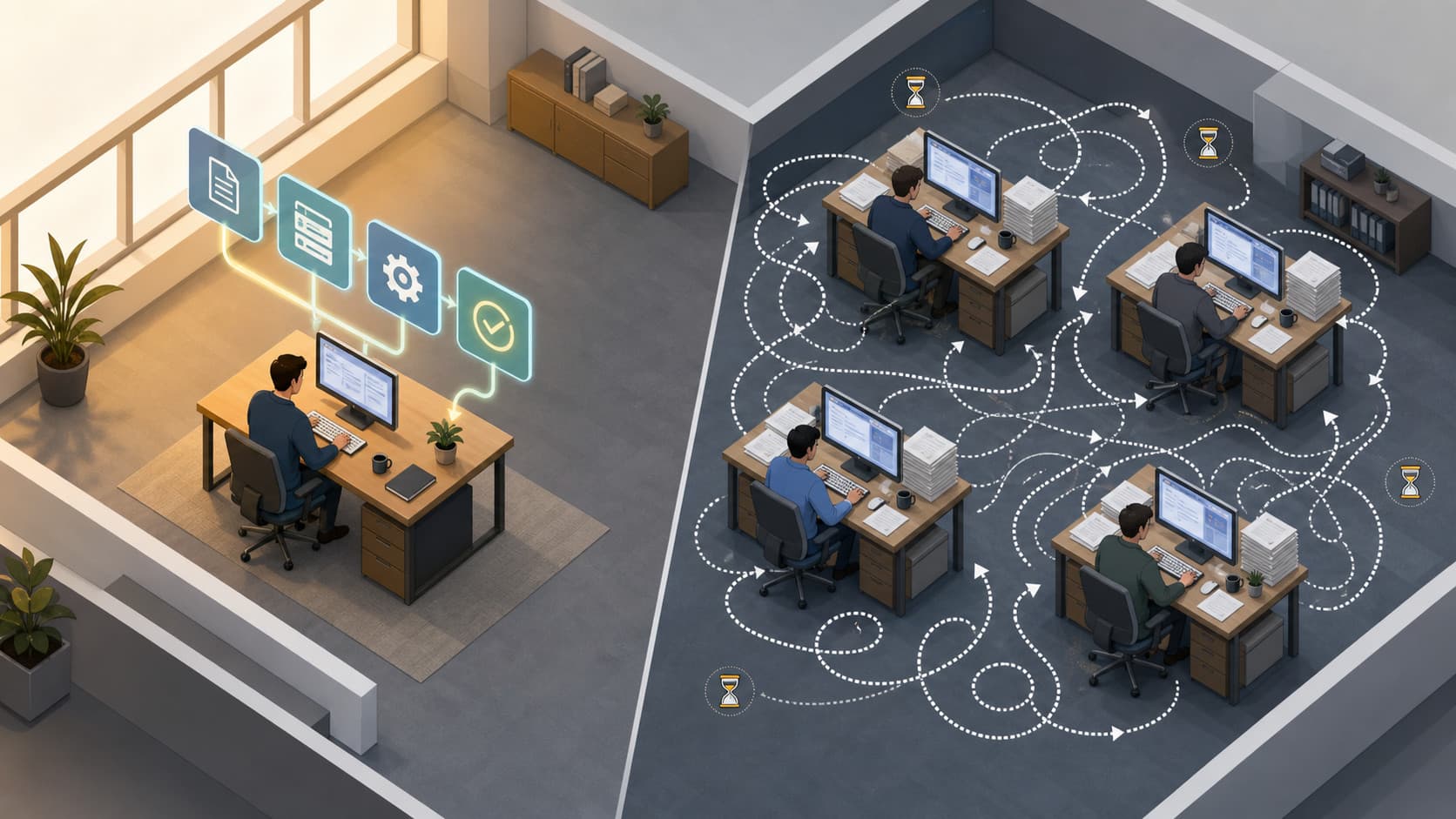
A capable team member sits down with a tool she uses every day. What should be a ten-minute task takes forty-five. She is not confused about what she wants to accomplish. She is not distracted. She just does not know how the tool works, so she routes around it, approximates, and backs up to try again. Multiply that by eight people, forty hours a week, and you are not looking at a training gap. You are looking at a structural drag on everything the team produces.
What Most Organizations Get Wrong
Tool training usually happens once, at onboarding, then never again. The assumption is that people learn on the job. And they do, eventually. They learn enough to get things done. They develop workarounds that become habits. They reach a functional ceiling and stay there, because no one told them there was more capability above it.
The result is a team that is busy but not fast. Tasks get completed, but the path from start to done is longer than it needs to be. Errors happen at the seams where tool logic and user intuition do not line up. Revisions pile up not because the work is wrong but because the output format was off, the file structure was inconsistent, or someone exported the wrong version for the third time this month.
This is not a personnel problem. It is a training system problem.
The Gap Between Functional and Fluent
There is a meaningful difference between a user who can operate a tool and one who has internalized how it thinks. The functional user knows the steps. The fluent user knows why those steps work, which means they can adapt when something breaks, find a faster path when one exists, and make fewer decisions per task because the patterns are already loaded.
That fluency is not built through documentation or feature tours. It is built through deliberate practice on real tasks, with feedback loops tight enough to change behavior. Most training programs skip the feedback loop entirely. They deliver information and call it learning.
The practical consequence: your team keeps using ten percent of a tool’s capability, and the other ninety percent sits idle while people work around the gaps.
Where Errors Actually Come From
Errors in knowledge work are rarely random. They cluster around tool transitions, format inconsistencies, and steps where users have to translate between what they know and what the tool expects. These are the friction points that deliberate training can eliminate.
A team that understands how a project management tool structures dependencies will catch conflicts before they become delays. A team that knows how a reporting tool handles data filters will not spend Friday afternoon troubleshooting a dashboard built on a misconfigured date range. The errors are predictable. The training to prevent them is also predictable. Most organizations just never connect the two.
The cost of not connecting them compounds. Every error that gets caught in review is a revision cycle. Every revision cycle is time that could have gone into the next deliverable. The team is not slow because people are slow. The team is slow because the tools are not working for them.
The Tradeoffs Worth Naming
Structured tool training takes time upfront. A half-day workshop, a series of short practice sessions, a set of documented workflows specific to how your team uses the tool. That is a real cost, and it is visible on the calendar.
What is less visible is the cost of skipping it. Forty-five minutes where ten was the ceiling. Revision cycles that could have been caught at the source. Senior team members answering the same questions about the same tool for the third time this quarter because nothing was ever formalized.
The tradeoff is not training versus productivity. It is front-loaded investment versus distributed friction. The friction always wins in the long run. It just wins slowly, which makes it easier to ignore.
There is also a secondary cost: cognitive load. When a tool is not fluent, every task requires more active decision-making. Users have to think about the tool while they are trying to think about the work. That split attention degrades the quality of both. Training that produces fluency frees up that cognitive bandwidth for the actual problem.
What to Do Next
Pick one tool your team uses every day. Not the most complex one, not the one in the roadmap for replacement. The one that is already central to how work gets done.
Map the gap. Sit with two or three team members and watch them use it. Note where they slow down, where they back up, where they route around the tool’s logic. Those are your training targets.
Build a short intervention around those specific gaps. Not a feature tour. Not a vendor walkthrough. A set of practice tasks drawn from real work, with immediate feedback on whether the output is correct. Thirty to sixty minutes, focused on the three or four patterns that account for most of the friction.
Measure before and after. Time-to-task on a representative set of work. Error rate on the outputs that matter. You will have the data to show whether the investment paid off, and you will know exactly where to go next.
Tool mastery is repeatable. The teams that treat it as infrastructure rather than onboarding get faster over time. The ones that leave it to chance stay exactly where they started.