Maria opens her project tool on Monday and the sidebar has moved. The button she clicked forty times a day last week now lives behind a menu she has never seen. There was a banner about it on Thursday. She closed it. She had a deadline. Now she is staring at a redesigned screen with a client call in nine minutes, and her first thought is not "what improved." Her first thought is "what else broke that I do not know about yet."
This is the part of digital work that rarely makes it into a strategy deck. Not the big migration. Not the all-hands tool rollout. The drip. The Tuesday feature shift, the Thursday interface refresh, the Friday integration that quietly changes how two apps talk to each other. Each change is small. Together they produce a low, constant hum of "I am one update behind," and that hum is where a lot of tech burnout starts.
Constant platform change is wearing your team down. The fix is not more training. It is a smaller, steadier system for absorbing change.
The cost is the watching, not the learning
When people say software change stresses them out, they usually picture the effort of learning the new thing. That is real, but it is not the heavy part. Learning a moved button takes ninety seconds. The heavy part is the watching.
Your team carries a background process that never shuts off. It scans for what changed, decides whether each change matters, and braces for the one that will. That vigilance runs whether or not anything broke that day. It is the same reason a smoke alarm with a dying battery is more exhausting than a fire. The threat is small and the alertness is constant.
Multiply that across a stack of fifteen apps, each on its own release schedule, each pushing notifications, and you get a workforce spending real cognitive budget on monitoring instead of doing. Nobody logs that time. It does not show up in a ticket. It shows up six months later as a quietly disengaged team and a manager who cannot explain why everyone seems tired and slightly behind.
Why the usual response makes it worse
The standard reaction to "people are struggling with our tools" is to add enablement. More training sessions. More documentation. A new internal wiki. A Slack channel for tips. The instinct is generous and the result is often counterproductive.
You have now added more surfaces a person has to watch. The wiki is another place that might have the answer, which means it is another place they feel guilty for not checking. The tips channel scrolls forty messages a day, so they mute it, so they miss the one that mattered. Every channel you open to reduce confusion becomes one more input competing for the same attention you were trying to protect.
There is a second failure built into volume-based enablement. It treats every change as equally worth announcing. The button move and the security-critical workflow change land in the same inbox with the same urgency. So people learn to triage by ignoring all of it, which means they miss the change that required action. You did not reduce the noise. You taught them to tune out the signal.
What thoughtful enablement looks like
The goal is not to inform people about every change. The goal is to let people stop watching. Those are different jobs, and the second one is what lowers the anxiety.
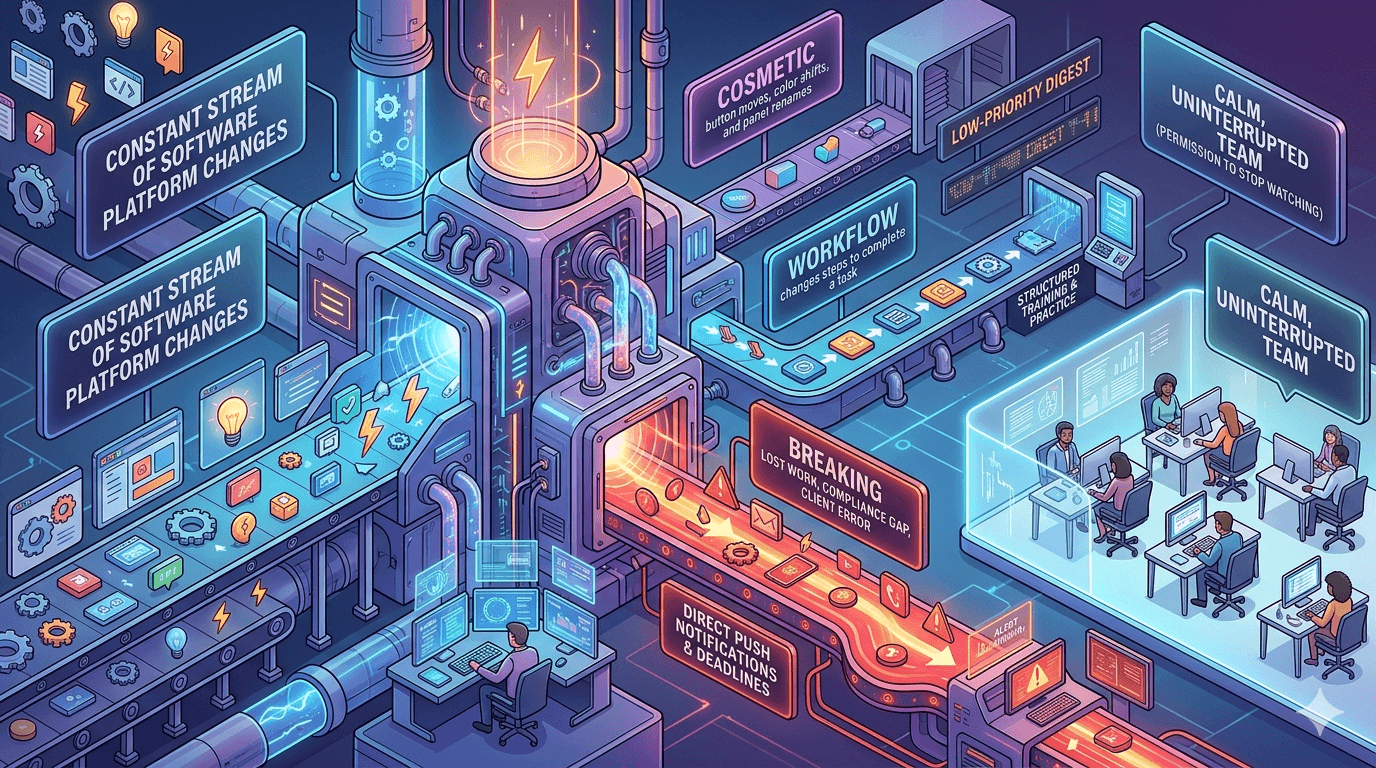
Start by separating change into three buckets, and treat them as genuinely different events. Cosmetic change is anything where the work still happens the same way, a button moved, a color shifted, a panel renamed. People need to know it exists so they are not startled, and that is all. Workflow change is anything that alters the steps to complete a task. People need a clear before-and-after and one chance to practice. Breaking change is anything that, if missed, causes lost work, a compliance gap, or a client-facing error. People need this pushed to them directly, named as required, with a deadline.
Most organizations route all three through the same announcement channel at the same volume. When you separate them, the cosmetic noise stops competing with the breaking signal. A moved button gets a one-line note in a low-priority digest. A breaking change gets a direct message that says, in plain words, "this changes on the 15th, here is the one thing you must do, here is who to ask." The person stops scanning for danger because they trust that real danger will find them.
Then assign the watching to someone whose job it is. Pick one person per tool, or one per team, to own the release notes for that platform. They read the updates so nobody else has to. They translate vendor language into "here is what changes for us, in our words." Once people believe a named human is doing the watching, they release the background process. That release is the entire point. The relief does not come from better information. It comes from permission to stop monitoring.
The tradeoffs, named plainly
This approach is not free. Routing change into buckets means someone has to make the judgment call on which bucket each change belongs in, and they will sometimes get it wrong. A change you tagged cosmetic will occasionally trip someone up. That is the cost of filtering, and it is a smaller cost than the alternative, which is filtering nothing and exhausting everyone.
Naming a release-notes owner per tool adds a small recurring duty to someone's week, maybe twenty minutes. That time is real and it has to come from somewhere. The trade is that twenty minutes of one person's focused reading replaces fifteen people's fragmented, anxious half-attention. The math favors the owner model by a wide margin, but it only works if you protect that person's twenty minutes and do not let it become unpaid invisible labor.
There is also a control cost. Centralizing change communication means a manager can no longer claim "I sent the email" as proof of enablement. The new standard is harder. It asks whether the right people understood the right change with the right urgency. That is a higher bar, and some leaders will resist it because it removes a convenient defense.
Where to start this week
Pick your noisiest tool. The one that generates the most "wait, when did that change" messages. Assign one person to own its release notes and tell the team that person is now the source of truth for that platform. Then write down your three buckets and sort the last month of changes into them. You will likely find that ninety percent was cosmetic, dressed up as if it mattered, and that the two changes that genuinely required action got the same flat treatment as everything else. Fix that ratio, and you have done more for your team's stress than another training session ever would.
The burnout was never about the buttons. It was about a workforce that never got permission to stop watching. Give them that permission, back it with a system they can trust, and the hum quiets down.