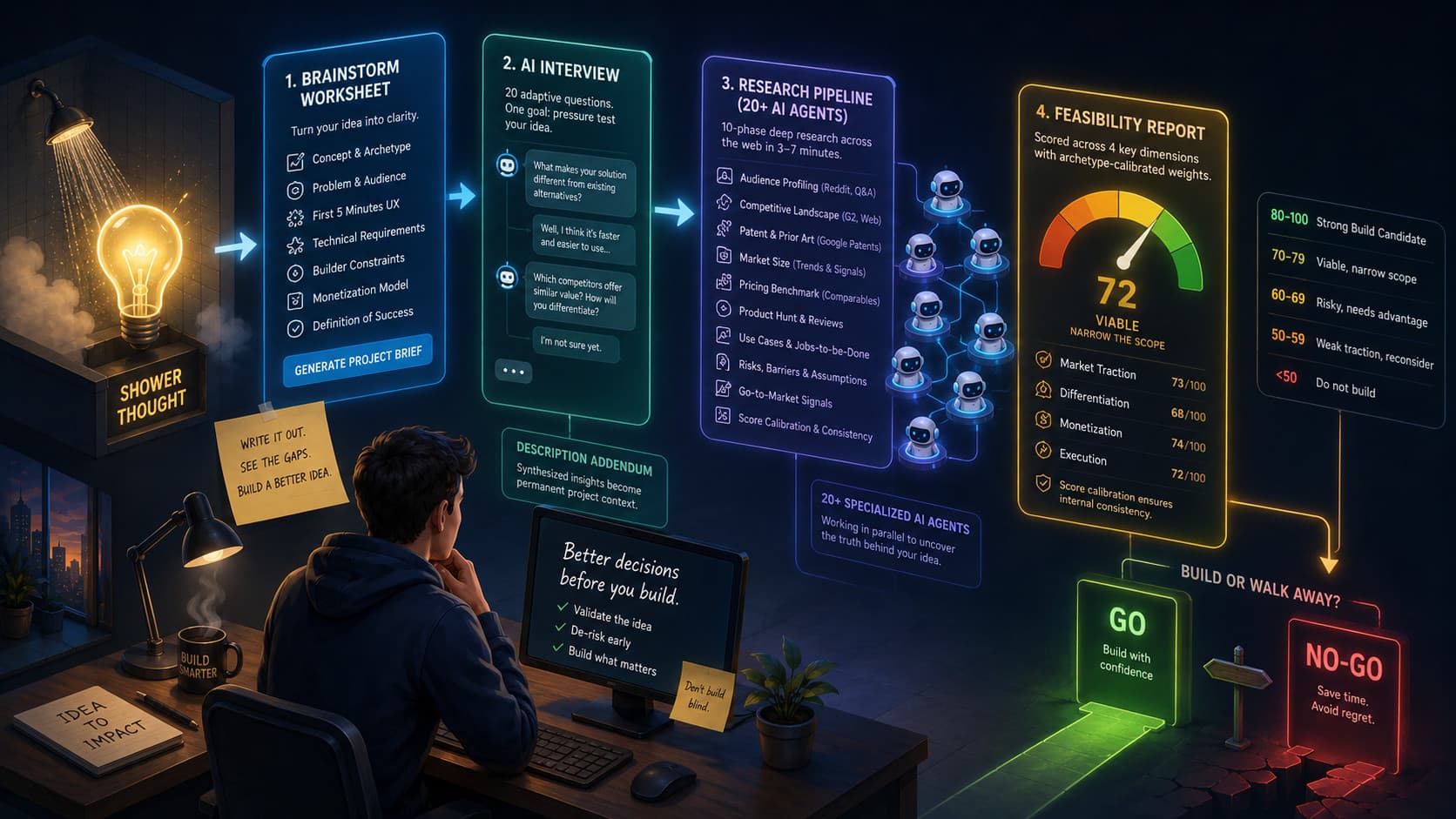
It's 6:15am. You're in the shower and an idea hits you, a productivity tool for freelance designers who juggle multiple clients and can never remember which project is billable and which one isn't. You've had this problem yourself. You know three other people who have. You spend the next twenty minutes mentally building the feature set, naming the product, and calculating what you could charge for it.
By the time you're dressed, you're already thinking about landing pages.
This is where most solo founders lose time they can't get back. Not because the idea is bad, but because the twenty-minute version of the idea, the one formed in steam and optimism, is missing about forty hours of context you don't have yet.
The Real Problem Isn't the Idea
The constraint isn't creativity. Solo founders have plenty of ideas. The constraint is evaluation capacity. A team with a product manager, a designer, a developer, and a few advisors has six people who can instinctively poke holes in a concept over lunch. A solo founder has themselves, and the natural human tendency is to fall in love with what they've already imagined.
Without a structured process, the decision tree collapses into two bad options. You either commit prematurely, building something for months before finding out the market is saturated or the pricing won't work. Or you kill the idea out of vague unease, never knowing if it had legs.
Neither of these is a decision. They're just reactions.
What the Structured Flow Does
founderscore runs every idea through the same sequence, regardless of how fully formed it is when you start. The entry point is the Brainstorm Worksheet, and it matters more than it looks.
The worksheet walks you through seven areas: the basic concept and its archetype, the specific problem and who experiences it, the first-five-minutes user experience, the technical requirements, your constraints as the builder, the monetization model, and your definition of success. For each section, you answer questions in plain language. You don't need polished prose. You need honest answers.
When you submit, an AI agent reads everything you wrote and synthesizes it into a structured project brief. This brief lands in your description editor as a first draft covering overview, problem, features, technology stack, business model, and success criteria. It's not a finished document. It's a forcing function. Writing it out forces you to confront the gaps you were hand-waving past in the shower.
The brief also becomes the foundation for what comes next, the AI interview.
The Part That Challenges You
Before the interview starts, the AI reads your entire project description and identifies the three or four biggest information gaps. It shows you what it found before asking a single question. This ready-check is useful because it tells you what a senior analyst would want answered before taking your idea seriously.
Then the interview begins. Twenty adaptive questions, one at a time, from a virtual venture analyst. The questions don't follow a fixed script. They follow your answers. If you claim strong differentiation, it asks you to name specific competitors and explain what you do differently. If you say you haven't thought about pricing yet, it offers you frameworks to work through on the spot. If you say "I don't know," it gives you two or three concrete directions to consider rather than moving on.
This is the first real pressure test. Not hostile, but persistent. The kind of pressure that surfaces whether the idea you described and the idea in your head are the same idea.
After the interview, the AI synthesizes your answers into a description addendum and lets you review it before anything else happens. Approve it, and all that context becomes permanently attached to the project.
Twenty Agents You Don't Have to Hire
Once the interview is complete, you trigger the Feasibility Report. Behind the scenes, a ten-phase research pipeline runs across Reddit, G2, Google Patents, Product Hunt, and the broader web. Twenty-plus specialized AI agents each have a specific job. One profiles your target audience using real-world signals. One maps your competitive field. One checks patent databases for prior art. One estimates market size from search trends and community data. One evaluates your pricing against comparable products.
This is the research you would need three to four weeks and a team to assemble yourself. It runs in three to seven minutes.
The output is a scored Feasibility Report. Your idea receives a 0 to 100 score across four weighted dimensions: Market Traction, Differentiation, Monetization, and Execution. The scoring weights are calibrated to your product archetype. A SaaS tool gets evaluated differently from a hardware device or a marketplace. A score calibration agent cross-checks all sub-scores for internal consistency before the report is written.
The verdict is direct:
- 80 to 100 - Strong Build Candidate
- 70 to 79 - Viable, but narrow the scope
- 60 to 69 - Risky, needs a clear advantage
- 50 to 59 - Weak traction, reconsider
- Below 50 - Do not build
That last verdict is the one that saves the most time. Getting a clear signal to stop before you've written a line of code is not failure. It's exactly what the tool is designed to do.
What You're Trading
Using founderscore costs you a credit and a focused hour. Skipping it costs you nothing today and potentially months later.
The tradeoff isn't really about the tool. It's about when you want to get the hard feedback. The Brainstorm Worksheet and the AI interview surface the same questions a skeptical co-founder or investor would ask. The research pipeline finds the competitors and the market signals you would have found eventually, after you'd already built something.
Running the process before you commit means the hard questions arrive when you can still answer them cheaply. Running it after means you're answering them with sunk cost on the table.
There's also an iteration path built in. If the score comes back lower than you expected, the report includes specific recommendations. Update your description, re-interview, and run an improvement analysis. Each re-run measures what changed. The score can move up to three points per dimension per run. The system is built for iteration, not for generating a single verdict and walking away.
What to Do Next Time You Have a Shower Thought
Sign into founderscore and create a project. Give it a title and a rough build scope. Open the Brainstorm Worksheet and answer the questions honestly, including the ones where your answer is "I don't know." Submit the worksheet, review the brief it generates, and then start the interview.
By the end of that session, you'll have a cleaner description of the idea than the one you had at 6am, a list of the gaps the AI flagged, and a record of your own thinking you can share with advisors before the report is even generated.
Then run the report. Read the verdict. If it's a go, you have an evidence base to build from. If it isn't, you found out this week instead of six months from now.
That's the flow. It works the same way every time.