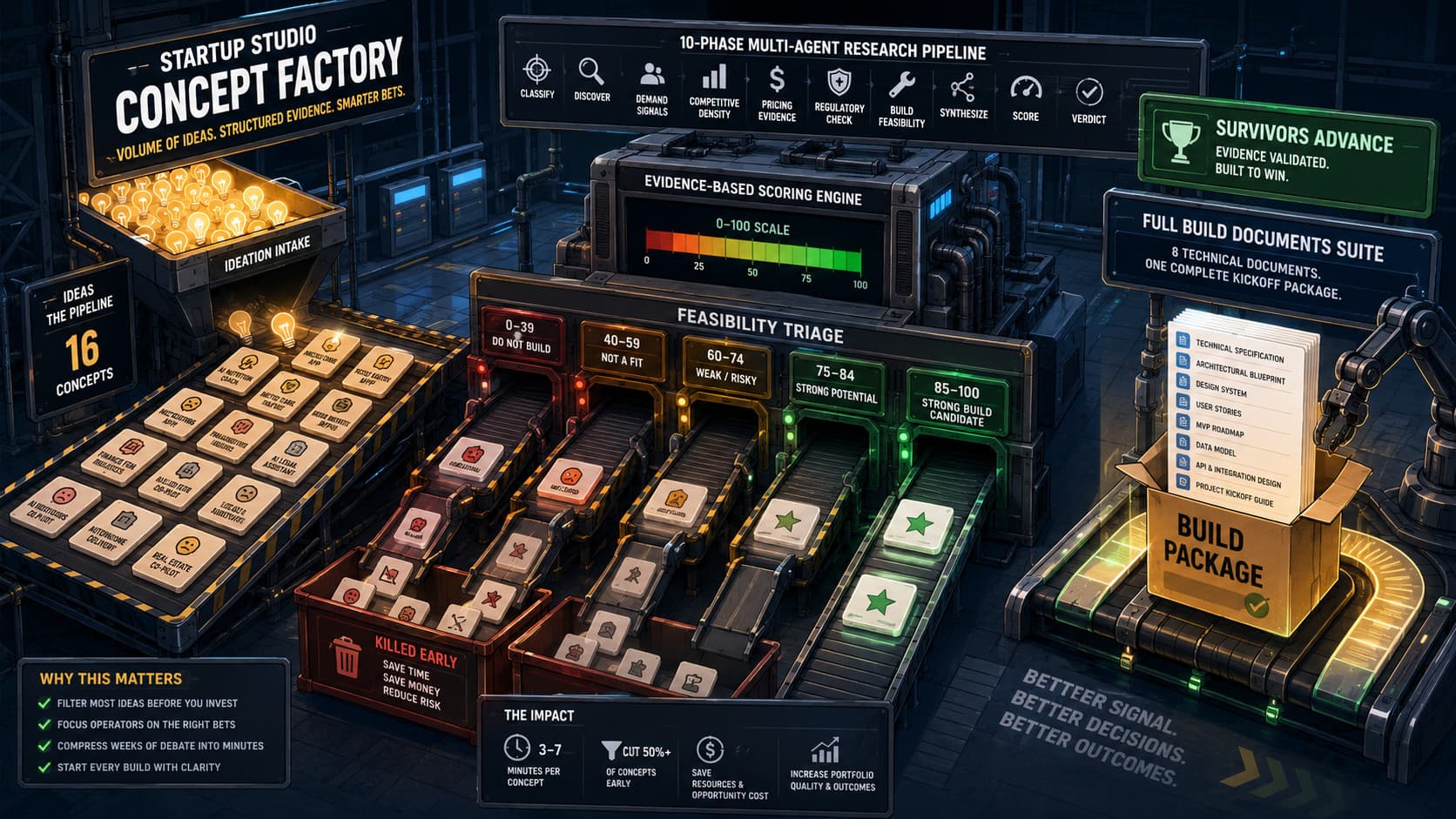
The whiteboard in the weekly concept review has sixteen ideas on it. Four were added this morning. Three came from last week's session and haven't moved. The team has discussed all of them at least once, and nobody has killed any of them yet.
This is not a creativity problem. Studios and venture builders are good at generating ideas. They run structured ideation sprints, track market signals, recruit operators with domain knowledge. The pipeline fills up fast. What slows everything down is the triage layer: figuring out which concepts are worth the next dollar of time and which ones should have been discarded two weeks ago.
Without a structured filter, concept reviews become opinion contests. The strongest personality in the room wins. Ideas survive not because they have evidence but because nobody wants to be the one to shoot them down.
Why Studio Triage Breaks Down
A startup studio operates differently from a solo founder. The solo founder has one idea and needs to know if it's worth pursuing. A studio has a portfolio of concepts in various stages of development and a fixed pool of operators, engineers, and capital to allocate across them.
The triage problem compounds quickly. If a studio runs twelve concepts through informal review, six survive on the strength of their pitch rather than their evidence. Those six get assigned operators and early resources. Three of them collapse at the first real market test, which means the operators, the infrastructure spend, and the opportunity cost were all absorbed by concepts that could have been cut at week one.
The constraint isn't the quality of the ideas. It's the absence of a consistent, evidence-based evaluation standard applied before any resource commitment happens.
Gut-feel triage is not random, but it is biased in predictable directions. Concepts with compelling narratives score higher than their evidence supports. Concepts that resemble past successes get implicit preference. Novel ideas with weaker storytelling get cut too early. None of these patterns correlate with which concepts will find real markets.
What a Structured Filter Actually Does
founderscore runs each concept through a 10-phase multi-agent research pipeline before any human makes an allocation decision. The pipeline classifies the concept by product archetype, then searches Reddit, G2, Product Hunt, Google Patents, and the broader web for demand signals, competitive density, pricing evidence, regulatory exposure, and build feasibility.
The output is a Feasibility Report covering 13 research areas with a scored verdict on a 0-100 scale. The five verdict bands run from "Strong Build Candidate" down to "Do Not Build." The pipeline is built to deliver the low end of that scale honestly, not to produce encouraging outputs.
For a studio running sixteen concepts, the immediate value is elimination. If eight of those concepts come back with scores below 60 and verdicts indicating weak traction or misaligned unit economics, the portfolio has shrunk by half before anyone has spent on development, design, or operator time. That's the function: compress the evaluation cycle and make the kill decision before the cost accumulates.
Each concept takes one credit to score. At 3-7 minutes of pipeline runtime per concept, a studio can process a full ideation batch in the time it previously spent on a single concept review meeting.
What Survives Gets More Than a Score
The concepts that clear the scoring threshold don't just get a green light. They get the full Build Documents suite generated as their kickoff package.
Build Documents translate the validated concept into eight technical documents: a Technical Specification, an Architectural Blueprint, a Design System, User Stories, an MVP Roadmap, a Data Model, an API and Integration Design, and a Project Kickoff Guide. The suite is generated through a 30-question build interview with a senior technical architect AI that reads the Feasibility Report and tailors every document to the specific concept.
For a studio, the operator assigned to a surviving concept starts with a complete technical foundation rather than a blank page. The Kickoff Guide lays out team roles, communication cadence, and risk mitigation. The MVP Roadmap has phased feature assignments the team reviewed and confirmed during generation. A reasoning-optimized model calibrated for technical depth writes the Technical Spec and Blueprint.
Handing this package to an operator on day one cuts the pre-build ambiguity period from weeks to hours.
The Tradeoffs
The score is evidence-based but not infallible. The research pipeline draws on public data sources, so it reflects what the web can see. For concepts in emerging categories where public signal is thin, the pipeline will note limited data confidence in the relevant sections. Studios operating in frontier markets should treat low-confidence sections as areas requiring primary research rather than accepting the default conservative score at face value.
Build Documents cost 3 credits per concept, more than a feasibility report alone. For a studio triaging twelve concepts and advancing three, that's fifteen credits total. At scale, this is efficient. For a smaller studio running tighter credit budgets, the economics favor using feasibility scoring broadly and reserving Build Documents for concepts that have cleared both the score threshold and an internal go/no-go gate.
The other tradeoff is speed versus depth. The pipeline produces a report in 3-7 minutes, fast enough to process an entire batch in a single session. The depth of that analysis depends on what public sources contain. A concept with a well-documented competitive market returns a richer competitive section than a concept in a market with little online discussion. Studios should plan for uneven report depth across a diverse concept portfolio.
How to Run the Factory
Run every concept through founderscore before the first concept review meeting. Generate a feasibility report for each idea in the batch during the days before the review. Walk into the meeting with scores in hand.
Discard anything below 60 before the meeting starts. Treat scores between 60 and 70 as conditional: they need one identified advantage to justify moving forward, and that advantage must be something the team controls rather than a market variable. Advance concepts scoring 70 and above into the operator assignment queue and generate Build Documents for each one.
Give the assigned operator the full Build Documents suite on day one. Treat it as the kickoff package, not a deliverable to produce later. Review the phase assignments in the MVP Roadmap in the first team session, adjust as needed, and let the Technical Spec and Blueprint drive the architecture conversation.
The studio that kills 80% of its concepts at the idea stage and hands the other 20% a complete technical foundation to operators on day one is running a different kind of factory than one that advances ideas on instinct and reconverges later. The difference shows up in how much capital reaches products that find markets.