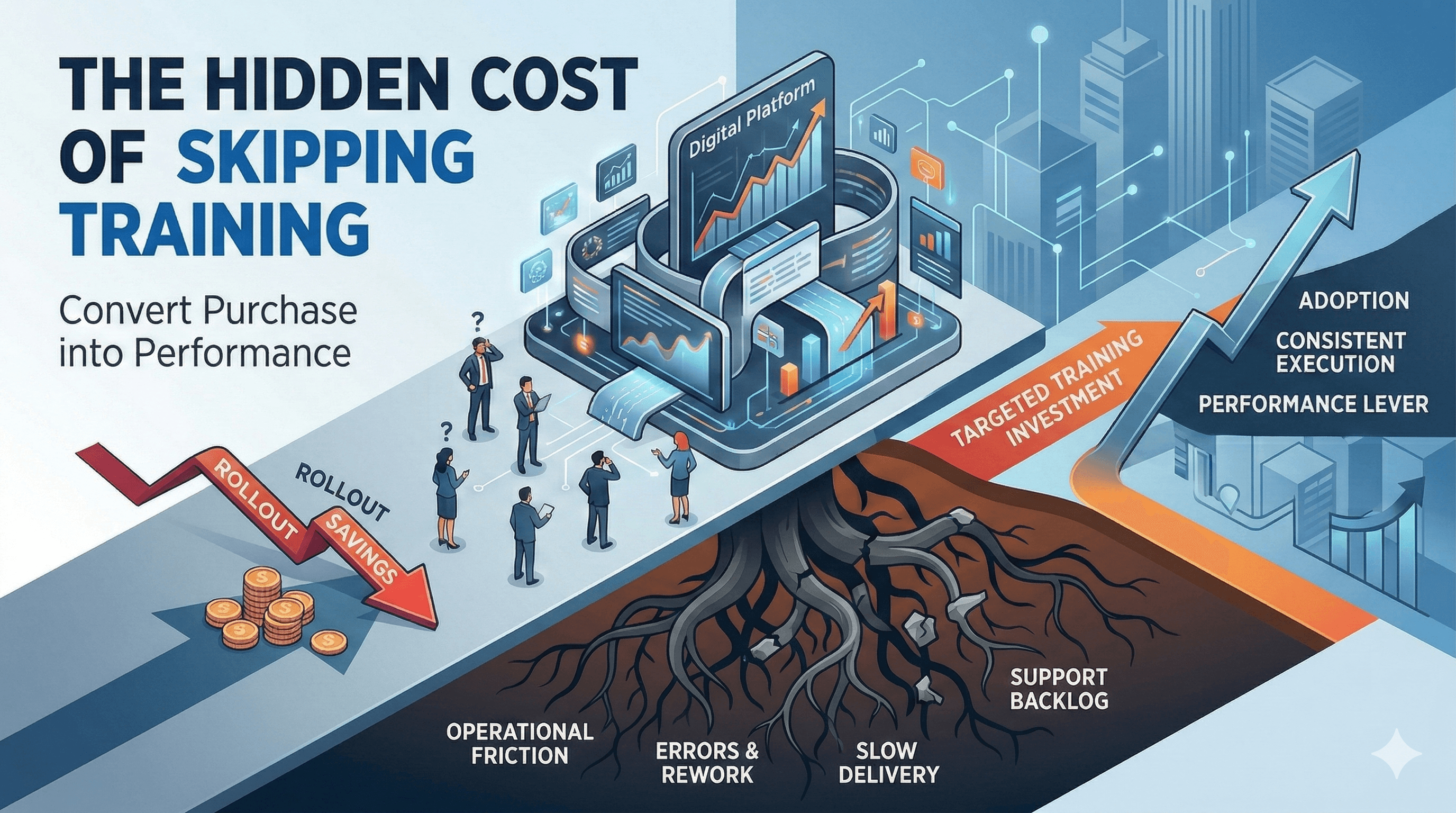
Most organizations can point to at least one major technology purchase that looked smart on paper and still felt frustrating in practice. The platform shipped. Licenses were provisioned. A rollout plan existed. Yet weeks or months later, teams were still struggling, projects were moving slower than expected, and leadership was hearing the same refrain: “We bought the tool, but we are not getting the results.”
This gap between purchase and performance is common. It is also predictable. In many cases, the root cause is not the technology itself. It is the decision, explicit or implicit, to treat training as optional. Training is often the first line item to be trimmed when timelines are tight and budgets are under scrutiny. It seems reasonable. It is visible. It is controllable. It is easy to defer.
But skipping training does not remove cost. It shifts cost. It turns an upfront investment into a steady operational drain that is harder to see, harder to quantify, and much harder to unwind once it becomes normal.
The goal of this article is not to sell a quick fix or argue that every rollout needs a large training program. The goal is to lay groundwork for clearer decision making, especially for product managers, procurement professionals, and executive leaders who are accountable for outcomes. When training is prioritized and designed around real work, it becomes one of the most reliable ways to protect adoption, delivery, and the credibility of the investment.
The spreadsheet savings that show up as operational friction
When a training budget is reduced, the first effect is often a sense of relief. There is one less project to coordinate. There is a clear cost avoided. There is an immediate reduction in vendor spend. The decision is easy to defend because it is tangible and measurable.
The problem is that the cost does not disappear. It reappears in a different form, spread across dozens or hundreds of people and embedded into the daily operating rhythm. It becomes time lost in small increments. It becomes preventable errors. It becomes rework. It becomes slowed delivery. It becomes a growing dependency on a handful of experts.
Because these costs are distributed, they rarely show up in a single report. They show up as a general sense that the organization is moving slower than it should. Leaders see delayed milestones, a backlog that never clears, or a tool that is “not being used the way we expected.” Teams feel frustration, confusion, and a constant need to ask for help. Everyone is working, but progress feels heavier than it should.
If you have ever wondered why a rollout feels expensive even after “saving money” on training, this is why. The savings were real in the moment, but the tradeoff was long term friction.
What happens when people are left to figure it out
The most immediate consequence of skipping training is that formal learning time is replaced by informal trial and error. This is not a moral failing on the part of employees. It is a natural response to being asked to perform work in a new system without being shown how that system fits their job.
People do what they can. They click around. They guess. They look for something that resembles the old process. They search internal documentation that may not exist yet or may be written for a different audience. They watch a vendor video that covers far more than they need and far less than their real workflow. They ask the coworker who seems to have figured it out first.
Each of these steps consumes work time. None of it is free. And because the learning is unstructured, the time cost repeats. It repeats across users. It repeats across teams. It repeats every time a new person joins. In the early days of a rollout, that may look like a short-term dip. Over time, it becomes a permanent tax.
There is a second cost embedded here that is easy to miss. Trial and error does not only slow work. It increases mistakes. When someone is guessing, they will eventually guess wrong. They will take a shortcut that breaks a rule. They will interpret a field differently than intended. They will create a workaround that solves their problem but creates a new problem downstream.
What makes this difficult is that errors do not always show up immediately. Someone can use a tool incorrectly today and the impact can surface next week when a report is wrong, a workflow fails, or a downstream team cannot reconcile what happened. At that point, the organization spends time diagnosing symptoms rather than building capability. The cycle becomes reactive.
This is one reason training should be viewed as risk management, not just enablement. Training reduces the probability that new tools will be used in ways that create hidden defects and future cleanup work.
Adoption slows, and delivery slows with it
Most technology purchases are made with an expectation of acceleration. A new platform is supposed to reduce cycle time, standardize processes, and improve visibility. But those benefits depend on adoption, and adoption depends on confidence.
When people do not feel confident, they avoid the tool. They delay using the new process. They revert to old habits. They keep parallel systems alive “just in case.” They export into spreadsheets because the spreadsheet is familiar and feels controllable. They run important work through email because email is reliable and does not require a new mental model.
These workarounds are understandable, but they are expensive. They create a hybrid operating state where old and new processes coexist. The organization now has duplication and confusion. Different teams use different methods. The same data lives in multiple places. People argue about which version is correct. Meetings become longer because alignment takes longer. Delivery slows not because teams are lazy, but because the system of work is fragmented.
This is where product managers often feel the pain. Roadmaps slip. Dependencies become harder to manage. Feedback cycles lengthen because the data is not consistent. Teams struggle to instrument the product lifecycle because the workflow is not stable enough to measure. Procurement professionals feel it too. The expected return on investment becomes harder to defend, not because the purchase was wrong, but because adoption is incomplete.
Executives see it as sluggish execution. They see missed targets. They see investments that do not translate into capability. The organization is moving, but not as an integrated system.
Training is not the only lever that affects adoption, but it is one of the most direct. Training gives people the confidence to move from “I can muddle through” to “I know how to execute my work here.” That confidence changes behavior, and behavior changes outcomes.
The support backlog that never seems to shrink
When training is missing, support becomes the default learning mechanism. This support may take formal shape, like tickets, or informal shape, like chats, direct messages, and impromptu desk visits. In many organizations, it becomes both.
At first, this support load can feel normal. Rollouts always create questions. But a pattern emerges when training is skipped or is too generic. The questions do not taper off. The backlog does not shrink. The organization starts to accept a steady stream of low-level support as part of normal operations.
The deeper issue is that the knowledge gap is systemic. If a tool is rolled out without workflow-based enablement, then many people will have the same questions. The same confusion repeats across individuals because the rollout did not create shared understanding. This turns support into a treadmill. Teams answer questions, but the volume does not drop.
This is where the hidden cost becomes visible in operational metrics. Not always in dollars, but in time and attention. Teams spend increasing time on coordination and assistance. People wait for answers before they can move forward. Work queues stretch out. A surprising amount of capacity is consumed by helping others do basic tasks.
Over time, this creates fatigue. It also creates dependency, and dependency is the opposite of scalability.
The most expensive consequence is what it does to experts
The most damaging outcome of a training deficit is the way it pulls experts into routine questions. Every organization has people who become the de facto source of truth. Sometimes they are subject matter experts. Sometimes they are senior engineers. Sometimes they are the product operations lead who understands how the tool was configured. Sometimes they are simply the early adopter who invested enough time to learn the system.
When training is insufficient, these people become the support layer. That seems reasonable at first because it is efficient in the moment. The expert knows the answer. The team needs to move. The quickest solution is to ask the expert.
The true cost is the interruption. Expert work often requires deep focus. Strategy, architecture, analysis, and complex problem solving are not tasks that can be cleanly sliced into small pieces. When an expert is interrupted, the cost is not only the time it takes to respond. The cost is the mental context that gets dropped and has to be rebuilt. The cost is the momentum lost. The cost is the fragmentation of work that turns high-value output into scattered progress.
Now multiply that across a day, a week, a month. The organization has effectively converted scarce, expensive capacity into an informal help desk. That is not just wasteful. It is a direct hit to strategic execution.
This is why training deficits often manifest as projects slipping one small delay at a time. There is no dramatic failure. There is no single incident that triggers an escalation. There are micro delays. A milestone moves by a day. A review takes longer than expected. A feature is not instrumented correctly and requires rework. A report is delayed because someone did not know how to generate it. Each event is small enough to be dismissed. Over time, they add up to a meaningful loss of pace and innovation.
The worst part is what never happens. The innovation that does not get built. The strategic work that gets postponed. The experiments that are not run. The improvements that are deferred because the people who should be driving them are answering operational questions instead.
Why this keeps happening in smart organizations
If this pattern is so costly, why does it keep happening, even in organizations with strong leadership and disciplined procurement?
One reason is that training is easier to cut than technology. Contracts are signed. Systems are purchased. There is often pressure to deliver quickly. Training can look like a delay, especially when it is treated as a generic add-on rather than an adoption accelerator.
Another reason is that training is sometimes framed poorly. Vendor training can be broad, feature-heavy, and disconnected from real work. Leaders experience training as time away from delivery, not as a force multiplier for delivery. That experience leads to skepticism, and skepticism leads to budget cuts.
There is also a measurement problem. The cost of training is obvious. The cost of not training is distributed. It appears as lost time and reduced velocity, and those outcomes are often attributed to execution issues, change resistance, or tool limitations. The organization sees symptoms but does not connect them back to enablement decisions.
None of this means that training should be treated as a massive program by default. It means training should be treated as an adoption strategy, designed with the same rigor as product rollout.
The case for targeted training, not generic training
When training is treated as a checkbox, it often fails. A three-hour webinar that covers everything in a platform does not help someone who needs to complete five specific workflows every day. A library of videos does not help if people do not know which ones matter for their role. A generic certification path rarely maps to the job-to-be-done that prompted the technology purchase in the first place.
What works is targeted training. Targeted training is built around real workflows and real decisions. It answers the question, “What does success look like in this tool for this role?” It reduces the time it takes for a person to become productive and reduces the variance in how work is performed across teams.
Targeted training is also where procurement and product leaders can align. Procurement wants measurable outcomes from spend. Product leaders want adoption and consistent execution. Executives want speed and reduced risk. Training that is mapped to business drivers is one of the few levers that supports all three.
If you are evaluating what “targeted” should mean in your environment, it usually includes these elements:
-
Clear identification of the workflows that matter most
-
Role-based expectations for what people must be able to do
-
Training that focuses on the tasks, not the feature set
-
Examples and practice anchored in real scenarios
-
Reinforcement mechanisms that reduce regression into old habits
-
A plan to reduce dependency on experts by building shared competence
This approach is not about making everyone a power user. It is about making the organization consistently competent in the work that creates value.
A decision framework for leaders who own outcomes
Leaders often ask a reasonable question: “How do we know if training is the problem?” The answer is rarely found in a single metric, but patterns are usually clear if you look for operational signals.
Here are diagnostic questions that tend to surface the truth:
-
Are support questions and tickets accumulating without shrinking over time?
-
Are experts frequently interrupted for basic operational guidance?
-
Are milestones slipping through small, repeated delays rather than one obvious blocker?
-
Are teams using workarounds instead of the intended workflow?
-
Are errors, rework, or reporting inconsistencies rising after rollout?
-
Are different teams using the same tool in fundamentally different ways?
If these patterns are present, the organization is paying for a training deficit whether it is labeled that way or not.
From a decision-making standpoint, training should be evaluated like any other investment. The relevant question is not “How much does training cost?” The relevant question is “What cost are we currently paying because people are not enabled to use what we bought?” Once that question is asked honestly, the math changes.
Training is a performance lever, not an accessory
Technology purchases are made to improve performance. Training is one of the primary mechanisms that converts a purchase into performance. When training is skipped, the organization does not save money. It relocates cost into hidden operational friction that slows delivery, increases rework, and drains expert capacity.
For product managers, this shows up as adoption gaps, inconsistent execution, and slower iteration. For procurement professionals, it shows up as reduced ROI and the need to justify investments that are not producing expected outcomes. For executives, it shows up as a slower organization, less strategic output, and constant pressure on the same experts.
Prioritizing training does not mean defaulting to large programs or generic content. It means designing targeted enablement that reflects how work actually gets done, tied to business drivers and goals. When done well, training reduces risk, restores velocity, and gives teams the confidence to deliver.