Every founder’s worst nightmare is pouring months of effort and thousands of dollars into building something that nobody wants. The tech landscape is littered with perfectly engineered products that solved problems no one had. Not because the founders lacked talent or commitment, but because they never rigorously tested whether the idea deserved to exist before writing the first line of code.
That’s the problem founderscore was built to solve. The platform launched today as an AI-powered feasibility engine that gives founders something the startup world has long resisted offering: an honest answer.
Calibrated Skepticism: The Building Inspector for Your Ideas
For the past decade, startup culture has celebrated blind optimism and rapid execution. While that energy has fueled genuine innovation, it has also been responsible for an enormous waste of human potential and financial resources. founderscore takes a different position, one it calls calibrated skepticism.
Think of it as a building inspector for your idea. You wouldn’t pour a foundation for a skyscraper without first testing whether the soil beneath it can support the structure. You shouldn’t invest months of development into a business concept without objectively assessing its viability first.
The psychological case for this is straightforward. As humans, we’re naturally susceptible to confirmation bias. We seek evidence that validates our ideas while filtering out warning signs. We ask friends who don’t want to hurt our feelings. We operate inside our own enthusiasm. An automated, objective system that forces you to pause and examine real market data before committing resources is a fundamentally different experience. You’re not failing. You’re gathering evidence.
## The Five-Tier Verdict System: When “Do Not Build” Is a Feature
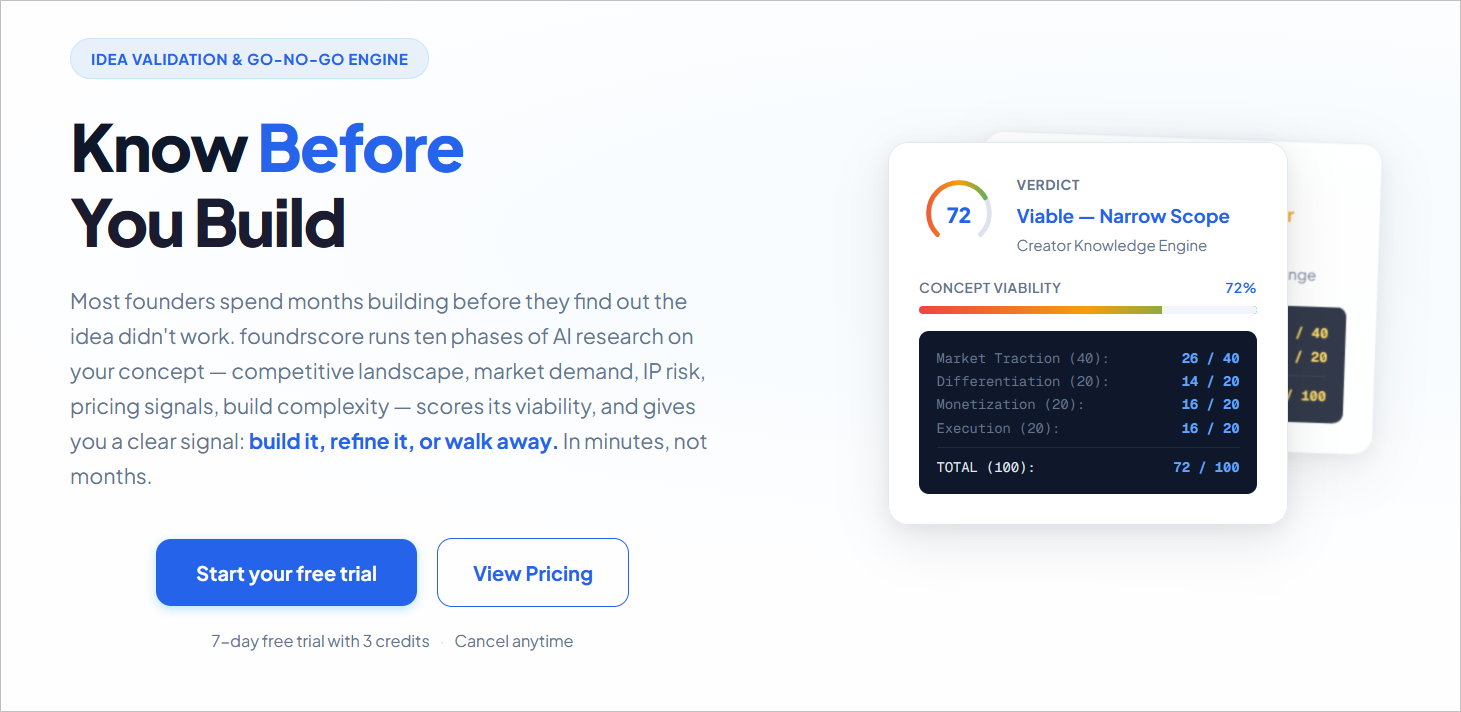
What makes founderscore genuinely different from other validation tools is its willingness to be honest. The platform produces an evidence-based score from 0 to 100 that maps to one of five verdicts:
-
Strong Build Candidate (80–100)
-
Viable, Narrow Scope Required (70–79)
-
Risky, Only Build With Clear Advantage (60–69)
-
Weak Traction, Reconsider (50–59)
-
Do Not Build (below 50)
The lowest tier is not a glitch in the system. It’s a feature, and arguably the most valuable one.
Consider a real-world failure pattern: a founder spends six months and tens of thousands of dollars building a product that addresses a real frustration, only to discover that the frustration isn’t painful enough for anyone to pay to solve it. The market looked plausible on the surface. The competition seemed thin. Friends said it sounded interesting. Every signal pointed forward, except the data.
The “Do Not Build” verdict delivers that same lesson in an afternoon for the cost of a single credit. It’s not a dead end. It’s a redirect that frees you to pivot to something with genuine market demand before you’ve spent anything irreplaceable.
founderscore is worth using precisely because it won’t just tell you what you want to hear.
From a Single Question to a Comprehensive Verdict
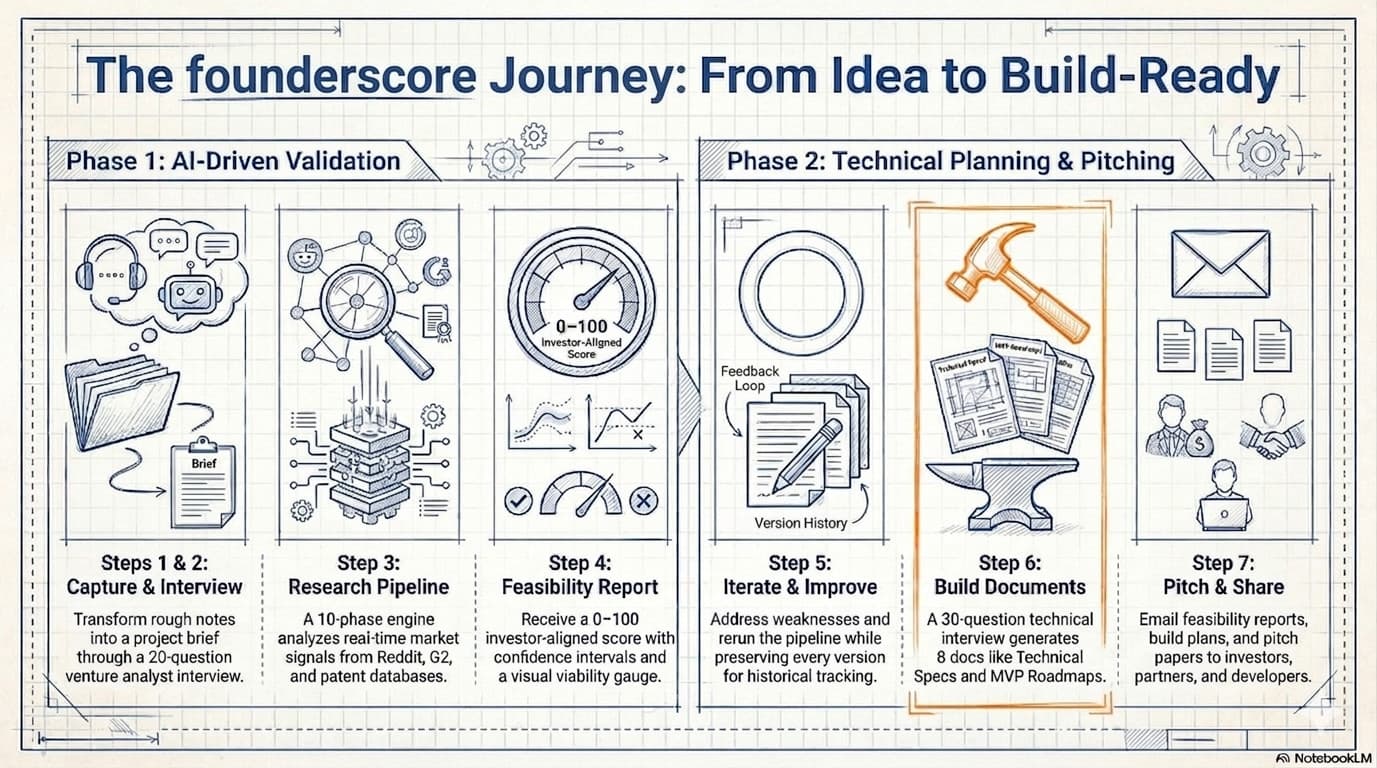
The validation process begins with an adaptive AI interview. The platform reads your project description, identifies the highest-priority information gaps specific to your idea, and opens a structured Q&A that can run up to 20 questions. It’s not a generic questionnaire. The interview covers 13 knowledge areas including target customer definition, competitive alternatives, business model viability, regulatory exposure, technical complexity, founder domain expertise, and existing traction.
Once the interview closes, a 10-phase multi-agent research pipeline gets to work. Across the feasibility analysis alone, 12 specialized AI agents run in parallel and series, researching brand and naming viability, target audience signal, competitive landscape, IP and regulatory risk, market demand, feature gaps, pricing strategy, and build feasibility. A dedicated Score Calibration agent then cross-validates all sub-scores before the final report is compiled.
The research draws on real-time web data from Google, Reddit, product review platforms, patent databases, and startup graveyard sources. It does not rely on static training data.
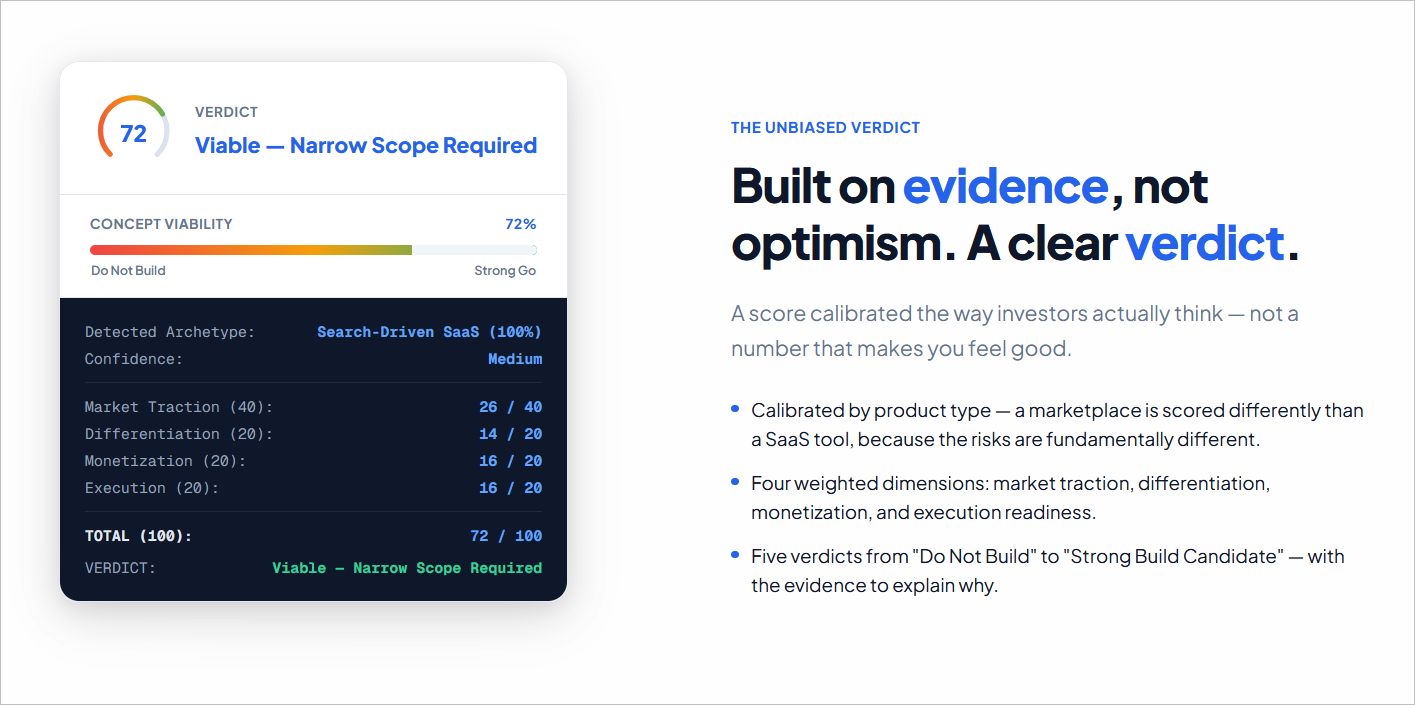
Every idea is also classified across 10 product archetypes (Search-Driven SaaS, Marketplace, Community Platform, Infrastructure Tool, and others), each with its own scoring weights and demand signal types. A marketplace is evaluated differently than a productivity SaaS, because they face fundamentally different market dynamics and execution risks. The scoring model reflects that.
The result is a scored Feasibility Report with a verdict, a detailed breakdown of every research dimension, and a Score Improvement Roadmap: a prioritized list of the specific actions that would move the score higher if you chose to iterate.
## Two Differentiators That Matter
Most AI tools in this space do one of two things: they help you articulate your idea more clearly, or they generate a generic market summary. founderscore does something structurally different at both ends of the workflow.
The honest verdict: The willingness to recommend against building isn’t a positioning choice. It’s a design choice. The scoring model is calibrated specifically to avoid founder-friendly inflation. Sub-scores are cross-validated. Certain structural weaknesses (like no viable cold-start strategy for a marketplace) can cap the total score regardless of other signals. The verdict is the product.
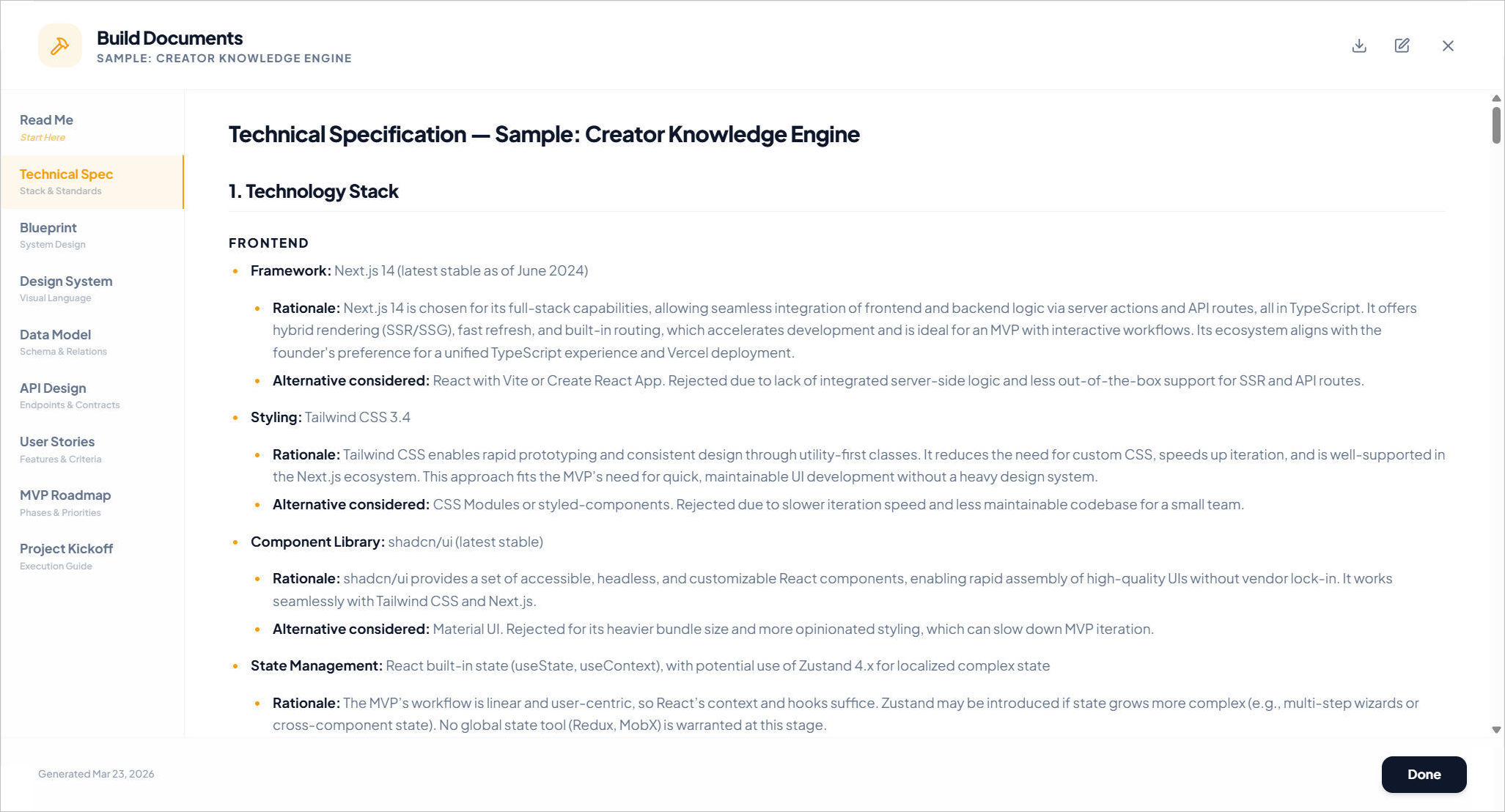
The build document suite: For ideas that earn a positive verdict, founderscore doesn’t stop at validation. After a 30-question technical architect interview, a second generation pipeline produces nine interconnected files: a Read Me, Technical Specification, Architectural Blueprint, Design System, Data Model, API Design, User Stories, MVP Roadmap, and Project Kickoff document. These are not high-level summaries. They map entity relationships, define API endpoint schemas, specify authentication flows, establish design tokens, and sequence the build phases in dependency order.
The gap between “validated idea” and “ready to build” is where most founders lose weeks. The build document suite is designed to close it in a single session.
54 Specialized AI Agents, Nine Activity Stages
The platform runs 54 specialized AI agents across nine distinct activity stages:
-
1 Brainstorm Agent
-
1 Description Synthesizer Agent
-
3 Feasibility Report Interview Agents
-
12 Feasibility Report Generation Agents
-
2 Pitch Paper Interview Agents
-
13 Pitch Paper Generation Agents
-
2 Build Documents Interview Agents
-
19 Build Documents Generation Agents
-
1 Vera Chatbot Agent
Each agent has a defined role, a specific information scope, and outputs that feed downstream agents. The architecture is designed so that no single model is responsible for the overall judgment. Specialized agents surface evidence, and synthesis agents weigh it. This separation is what allows the platform to maintain calibrated skepticism rather than generating optimistic noise.
The Economics of Knowing Before You Build
The comparison to traditional methods is significant. Professional market research and technical requirements documentation can take 8 to 12 weeks and cost tens of thousands of dollars. That price point puts rigorous validation out of reach for most solo founders and small teams.
founderscore offers a 7-day free trial with 3 credits included, enough to run a complete feasibility analysis on your most promising idea. Paid access is $49/month or $490/year. Additional credits are available in top-up packs for those who need to evaluate multiple ideas beyond the monthly allocation.
One credit runs a full feasibility analysis or a pitch paper. Three credits unlock the complete build document suite. The financial barrier to rigorously testing an idea before building it has effectively dropped to near zero.
## What Comes After the Score
The platform is designed as a sequential workflow, not a collection of standalone tools. Validate first. Then, if the score supports it, generate the investor-grade Pitch Paper: a narrative document structured around the 14 information gaps most relevant to raising capital. Then, when the idea is ready to build, generate the document suite.
Each step builds on the last. The Pitch Paper draws on the Feasibility Report’s research. The build documents draw on everything upstream. The workflow enforces a discipline that most founders skip, and that skipping is often why products fail.
Vera, the platform’s AI help assistant, is available on every page to answer questions about how the platform works, grounded exclusively in founderscore’s documentation.
A Different Kind of Launch
Most product launches lead with what the product does. This one leads with what it’s willing to say.
founderscore will tell you not to build something. It will score your idea in the 40s, hand you a “Do Not Build” verdict, and explain exactly why. That verdict might be the most valuable thing you receive. Not because failure is the goal, but because knowing before you build is infinitely cheaper than learning after.
The ideas that deserve to be built will survive the scrutiny. They’ll emerge from the process with a clearer scope, a stronger narrative, and a technical foundation that’s ready for execution. The ones that don’t survive are saving you something irreplaceable.
Start your free trial. 7 days, 3 credits, no long-term commitment.
Whether your idea earns a “Strong Build Candidate” verdict or a “Do Not Build” recommendation, you’ll have something more valuable than optimism: you’ll have evidence. You’ll know where the opportunity actually lives, what the real obstacles are, and whether this is the hill worth climbing.