Sarah runs a workflow automation company out of a co-working space in Austin. Five people, including her. Last month she closed a seed round, and her lead investor asked the question every founder hears within a week of the wire hitting the account: how fast can you get to fifteen people. Sarah told him she wasn't hiring a sixth person for at least six months. He pushed back twice. She held the line. She was right to.
The math nobody adjusted for AI
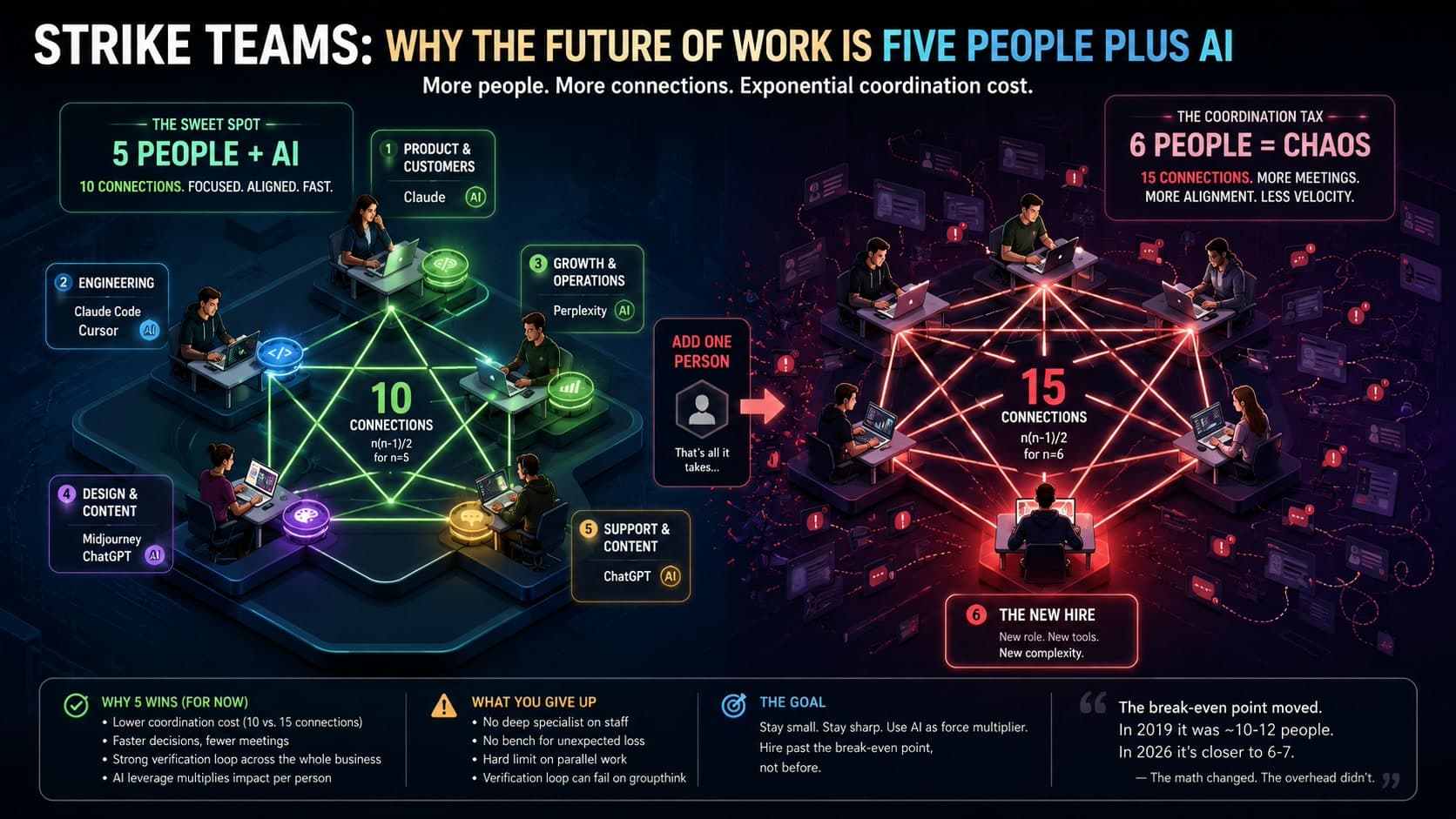
Team coordination cost follows a simple formula: the number of communication paths in a group of n people is n(n-1)/2. Five people have 10 paths to manage. Add a sixth, and you jump to 15, a 50 percent increase in coordination overhead for one additional headcount. This isn't new. Every operations textbook from the last forty years covers it.
What changed is the other side of the equation. Before AI tools got good, one more engineer meant roughly one more engineer's worth of output, and that output was usually worth the added coordination tax. A team of six shipped more than a team of five, even accounting for the extra meetings and handoffs.
That trade stopped holding. One person handling code review and spec drafting with Claude Code or Cursor now produces what used to take two or three people, and the tool throws in test coverage as a side effect. The marginal output from person six shrank. The coordination tax stayed exactly where it was, or grew. More people still means more standups and more decisions that need three signatures instead of one. It also means more Slack threads just to keep everyone aligned on what those decisions were.
Run the numbers on a real week. A five-person team spends maybe six hours total on cross-team syncs. Add one person and that climbs past nine hours, not because meetings got longer, but because more pairs of people need to stay aligned. Meanwhile, the AI-augmented output of that sixth person might replace a week of work one of the existing five would have eventually gotten to anyway. The math that used to favor hiring now favors staying small and pushing more leverage through the people already in the room.
This isn't an argument that hiring is bad. It's an argument that the break-even point moved. In 2019, a five-person team hit a coordination wall around ten to twelve people, and the added output from each new hire still cleared that wall for a while. In 2026, with each person carrying real AI leverage, that wall shows up closer to six or seven, because the baseline output per person is already so much higher. The team that ignores this and hires on the old schedule ends up paying full coordination cost for headcount that isn't adding proportional output.
What a strike team runs on
A strike team isn't five specialists in a trench coat. It's five generalists, each running a personal AI stack tuned to their part of the business, and each one capable of sanity-checking the others' output.
One person handles product and customer conversations. Another is a full-stack engineer. A third covers growth and ops. A fourth designs and writes code. The fifth floats between support and content, picking up whatever's on fire that week. Each of them pairs their work with an AI tool suited to the task. Claude Code or Cursor handles anything technical. A language model drafts customer emails and support responses in the team's actual voice. A research tool synthesizes competitor moves and user feedback into something the team can act on that day.
The mechanic that makes this work isn't the AI. It's the verification loop. AI output reads confidently even when it's wrong, and a five-person team catches those errors because everyone knows enough about every part of the business to spot something off. When the engineer uses Claude to draft a database migration, the ops person, who isn't a database specialist, still catches the missing rollback step, because she's seen enough migrations get deployed to know one is supposed to be there. That catch doesn't happen at a twenty-person company, where the ops person never looks at a migration because that's engineering's job and staying in your lane is the norm.
Five people who each understand the whole business can catch each other's blind spots. Twenty people organized into departments can't, because nobody outside engineering ever sees the migration script, and nobody outside sales ever sees the pricing model. Specialization that used to be an efficiency gain becomes a verification gap once AI is generating a meaningful share of the first draft.
What you give up to stay this small
None of this is free. A five-person strike team trades away real capability, and pretending otherwise sets the team up for a bad surprise later.
There's no deep specialist on staff. A generalist using Claude to draft a SOC 2 policy is not the same as a security engineer who has done four audits and knows where regulators push back. For regulated domains like healthcare data or financial services, this gap matters regardless of how good the AI leverage is. You need a certified specialist, full stop, and no amount of prompt engineering substitutes for that credential when an auditor is asking questions.
There's no bench. Losing one of five people costs 20 percent of total capacity overnight, and there's no backup ready to absorb it. A twenty-person team loses 5 percent when someone leaves and barely feels it in the next sprint.
There's a hard ceiling on parallel work. Five people, even at full AI leverage, cannot run eight simultaneous product workstreams. AI multiplies what one person can produce inside a task, but it doesn't multiply how many tasks a person can hold in their head at once. Context switching still costs what it always cost.
And the verification loop has a failure mode. It works when the five people collectively understand the domain well enough to catch an error, even if none of them is a specialist. It stops working when the task requires expertise none of the five hold, like cryptography implementation or embedded firmware. In that case, a confident-sounding AI mistake sails through because nobody on the team knows enough to notice it's wrong. That's not a hypothetical. It's the specific way this model breaks.
Timezone coverage is another real cost. Five people in the same two time zones cannot staff a support desk that promises four-hour response times around the clock. AI chat deflection covers some of that gap, but not all of it, and a company that needs real 24-hour human coverage will hit that wall regardless of how efficient the five are during business hours. Know which of these limits applies to your business before you commit to staying small past the point where it's costing you customers.
When to hire person six
Don't hire based on a board deck's headcount projection or an investor's comfort level with your org chart. Hire when you can point to a specific category of work that none of the five can do, even with a full AI stack behind them, and that category has blocked real progress for more than a few weeks running.
Track what gets pushed to next week on your team's board for three weeks straight. If the same type of task keeps sliding, and it's sliding because nobody on the team has the underlying expertise rather than because everyone's just busy, that's your hiring signal. Hire a specialist for that exact gap. Not a generalist backup, not "someone senior to help out." The person who closes the specific hole you found.
Before that point, spend the money on tools instead of headcount. A better model subscription and a code review agent that catches what your generalists miss both cost a fraction of a salary, and either one raises the ceiling on what your existing five can cover. Most teams reach for a hire when what they need is a sharper AI stack for the people already doing the work.
Sarah's team stayed at five for eight months. When they finally hired a sixth person, it was a security engineer brought on to run a SOC 2 audit, a job none of the five could do no matter how well they prompted Claude. That's the signal that should trigger a hire: a task category your current team structurally cannot cover, not a target headcount pulled from a pitch deck.