You ask an AI assistant to generate a complete authentication flow for a new API. The response looks solid at first glance: route handlers, token creation, a basic schema. But the refresh token logic is missing. Error handling covers the happy path and nothing else. The database schema doesn't account for token rotation. You paste it into your project and spend two hours debugging the gaps the model didn't mention.
This isn't an intelligence failure. The model knows what refresh tokens are. It knows error handling matters. The problem is structural: you gave a complex, multi-part task to a system with no mechanism to verify its own output, no way to delegate sub-tasks to something more specialized, and no loop that lets it catch what it missed on the first pass.
The Jagged Frontier Is an Architecture Problem
AI models don't fail uniformly. Ask GPT-4 to summarize a document, and it does it well, consistently. Ask it to generate a complete, production-ready module with interlocking components, and results scatter. Some outputs are 95% correct. Others fail at critical junctions. The unevenness isn't random. It follows a pattern tied to task complexity, verification requirements, and output length.
Researchers and practitioners call this the "jagged frontier": the uneven edge where AI capability reliably stops. Most people assume it reflects model intelligence. It reflects something more fixable: the mismatch between complex tasks and single-turn execution.
A single prompt has no self-correction loop. Once the model generates a response, that output is final unless you manually review it and ask again. There's no internal check that asks: "Did I actually cover the refresh token case?" There's no second agent whose job is verification. The model fills the context window as best it can, in sequence, and stops.
For simple, bounded tasks, this is fine. For tasks that require complete coverage, multi-step logic, or correctness guarantees, it's a structural liability.
How Multi-Agent Systems Change the Shape of the Work
Multi-agent systems solve the single-turn problem by decomposing work and building in verification at the architecture level, not the prompt level.
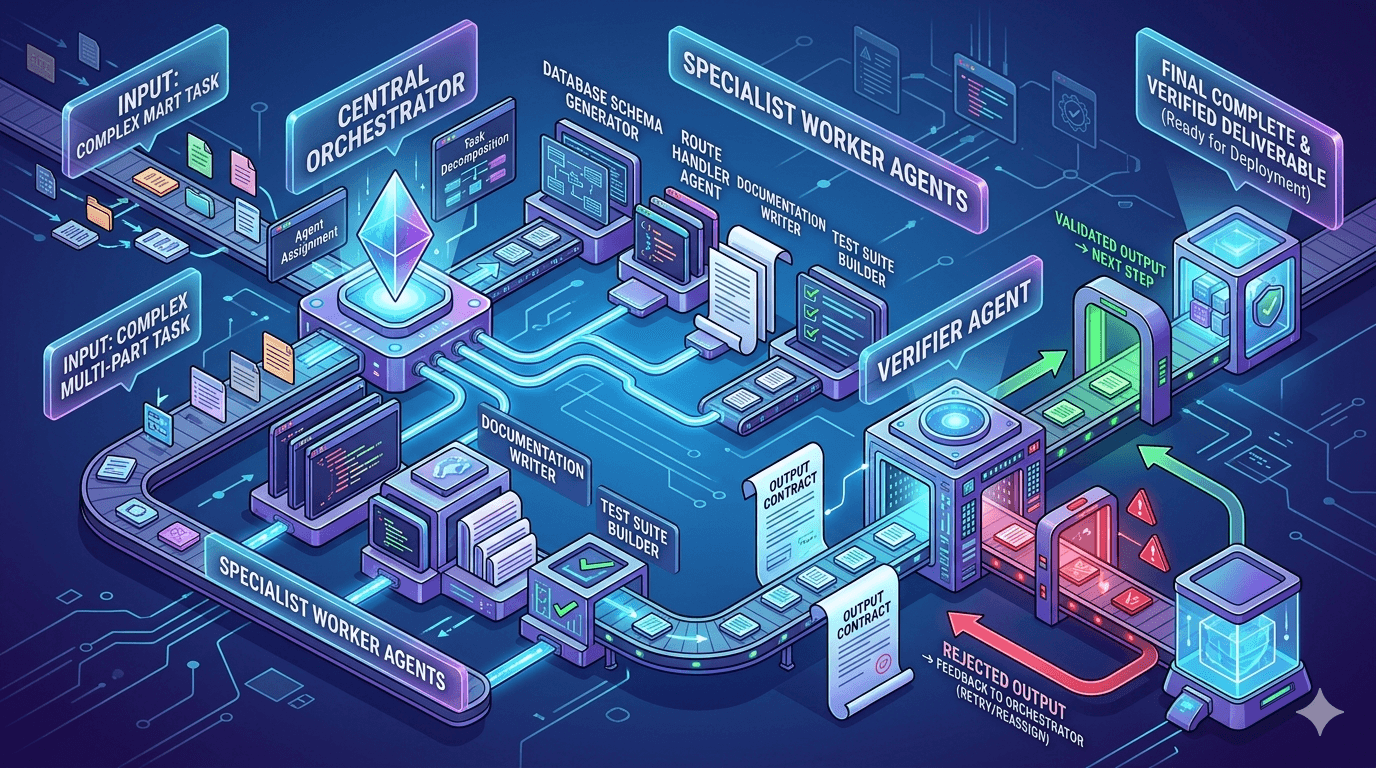
The basic pattern: an orchestrator receives the high-level task and breaks it into sub-tasks. Specialized agents handle each sub-task. A verifier agent checks outputs against a defined contract before they get passed forward or assembled into a final result. The orchestrator manages sequencing and handles failures.
This mirrors how human organizations handle complex deliverables. A team lead doesn't ask one person to design the system, write all the code, test it, and document it in a single sitting. Work gets distributed to people with specific roles, outputs get reviewed before they move forward, and errors get caught before they compound. Multi-agent AI harnesses apply the same logic to AI workflows.
In practice, the components look like this:
The orchestrator handles task decomposition and state. It decides what gets done in what order, which agents get called, and what to do when an output fails verification. Good orchestrators use tool calls and structured output contracts, not free-form language, to coordinate with sub-agents.
Specialist agents are narrowly scoped. One agent generates the database schema. Another writes the route handlers. Another drafts the test suite. Narrow scope means each agent can produce output with higher density relative to context, and errors in one sub-task don't contaminate the others.
Verifier agents check outputs against specifications before those outputs move forward. Verification can be rule-based (does this schema include a refresh token field?), model-based (does this logic handle edge cases X, Y, Z?), or both. The key is that verification happens inside the system, not after the human receives the final result.
This is what "iterative output refinement" actually means in production. It's not asking the model to "try again." It's building a loop where failure states have defined handlers, and incomplete outputs don't propagate.
What You Give Up and What You Get
Multi-agent systems are not free. The tradeoffs are real and specific.
Latency increases. A single-turn response returns in seconds. A coordinated multi-agent workflow with verification passes can take minutes. For interactive use cases where a developer needs a quick answer, this is often unacceptable. For background workflows where correctness matters more than speed, it's usually fine.
Cost increases. Each agent call consumes tokens. An orchestrator, two specialist agents, and a verifier might use four to six times the tokens of a single-turn prompt. At scale, this adds up. The question isn't whether multi-agent is cheaper (it isn't), but whether the cost per correct output is lower than the cost of fixing single-turn failures.
Complexity increases. You now have an orchestrator to maintain, output contracts to define, and failure handling to implement. For a solo builder, this is a meaningful overhead. The system needs to be debuggable, and multi-agent failures can be harder to trace than single-turn failures. When the verifier rejects an output and the orchestrator retries, you need logging that tells you what the verifier saw and why it rejected.
What you get in return: verifiable outputs, composable workflows, and the ability to handle tasks that single-turn approaches fail on structurally. You can also swap out specialist agents independently. If the schema generator starts underperforming, you replace it without touching the rest of the pipeline. Single-turn prompts don't give you that modularity.
The break-even point is roughly: tasks where partial failure is expensive, output correctness is checkable, and the work is complex enough that a single context window creates compression problems. Authentication systems, production code generation, document assembly from multiple sources, multi-step data transformations: those are candidates. Summarization, classification, and simple Q&A are not.
When to Add Agents, When Not To
The biggest mistake builders make with multi-agent systems is applying them too broadly. If a single well-structured prompt reliably produces the output you need, adding orchestration creates overhead with no return.
The test is not "is this task complex?" The test is: does single-turn failure on this task cost you something real? If you run a single-turn prompt and get a 90% correct output, and the 10% failure is easy to spot and fix manually, the coordination overhead of a multi-agent system is hard to justify. If that 10% failure is difficult to detect, expensive to fix, or creates downstream errors in automated pipelines, the multi-agent overhead starts paying for itself.
For teams building production AI workflows, a staged approach works well. Start with single-turn prompts for every task. Identify where failures are expensive or frequent. Add a verifier agent first. It's the simplest addition and catches the most obvious failures. Graduate to full orchestration when task complexity genuinely requires decomposition.
Start With Two Agents
If you're building your first multi-agent workflow, the minimum viable pattern is a generator and a verifier. The generator produces the output. The verifier checks it against a specification. If it passes, it ships. If it fails, the verifier returns a structured failure message and the orchestrator decides whether to retry, escalate, or surface the failure to the user.
This two-agent pattern handles the most common single-turn failure mode: outputs that look complete but aren't. It adds one extra model call per task and requires you to define what "correct" looks like in a machine-readable format. That specification work is often the most useful part of the exercise. It forces you to be explicit about what you need, and that clarity tends to improve your single-turn prompts too.
Add specialist agents when you find a specific sub-task where a narrower prompt consistently outperforms a broad one. Build orchestration state management when your workflows require branching or retry logic that's too complex to handle inline.
The jagged frontier doesn't smooth itself, but it responds to structure. Tasks that collapse in a single turn often complete reliably when broken into checkable pieces. That's what multi-agent coordination gives you, and it's a strong enough return to justify the overhead for the right class of problems.