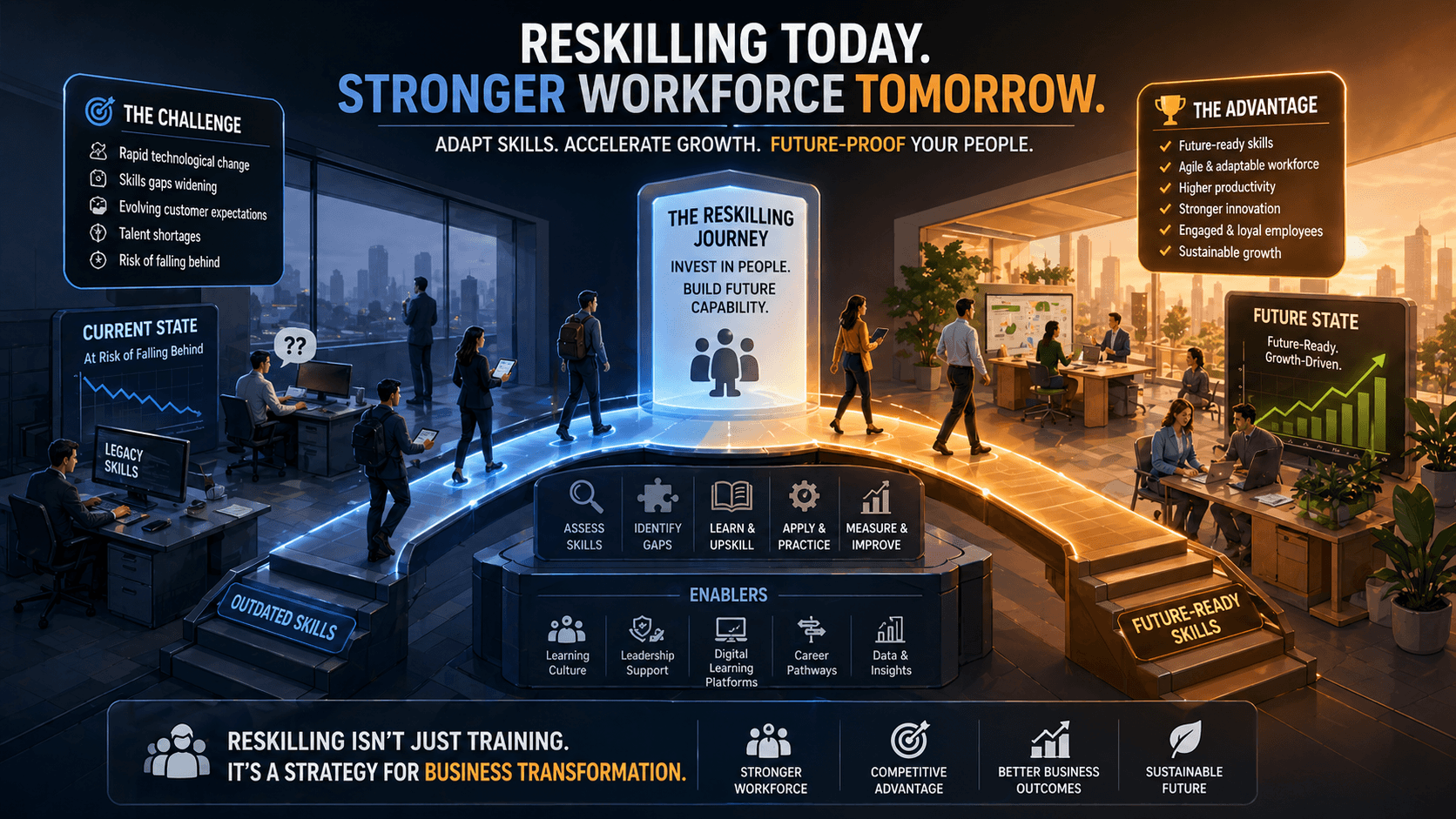
The new platform is live. The vendor did three demo sessions. IT sent a walkthrough video. L&D built a module and pushed it to the LMS two weeks before go-live.
Ninety days later, half the team is still routing around the system. Using the old tool where they can. Creating workarounds that are going to be a headache to untangle.
The training happened. The capability did not.
This is not a story about a bad rollout. It is the default outcome when learning plans and technology decisions live in separate rooms.
The gap nobody talks about
Most organizations treat reskilling as a reaction to technology change. A new platform gets approved, a go-live date gets set, and somewhere in the final stretch, someone asks L&D to build training.
That sequence produces one predictable result: a workforce that is perpetually catching up.
The problem is structural. Technology decisions happen in product and IT. Learning decisions happen in L&D. They share a calendar, not a planning process. So by the time the training gets built, the technology is already live, the pressure to perform is already on, and there is no lead time left to actually develop the capability.
The other issue is scope. Most reskilling programs are built around features, not capability shifts. They teach people how to navigate the tool. They do not address how the tool changes the way work gets done, what new judgment calls it requires, or what skills become obsolete because of it.
Knowing where to click is not the same as being ready to work differently.
Why the standard approach fails
Three things consistently break reskilling programs. None of them are about content quality.
L&D gets looped in too late. When training is scoped after a technology decision is final, there is no room to build capability in advance. The team is learning while performing, under pressure, which is the worst possible condition for durable skill development.
Training is scoped to the launch, not the work. Go-live is a deadline, not a destination. What the workforce needs at 30 days post-launch is different from what it needs at 90 days or 12 months. Programs that treat launch as the endpoint miss most of the actual learning curve.
“Long-term” plans are not tied to anything. Most capability frameworks are lists of competencies with no connection to a delivery timeline. No milestones. No sequencing logic. No forcing function. Without a link to the tech roadmap, there is no way to prioritize and no way to know if you are on track.
No shared planning cycle. No lead time. No visibility into what comes next.
The reframe: your tech roadmap is a learning plan
Every technology decision your organization makes is also a workforce capability decision. They are the same decision. Treating them as separate tracks is where the problem starts.
When a new tool or platform appears on the roadmap, the first questions are not about format or vendor. They are about capability: What does operating this tool require that our people do not currently have? How long does it realistically take to build that before they need to perform with it? What does good look like at 30 days, 90 days, and 12 months post-launch?
Those questions change the timeline. They also change what gets built.
Start with a skills gap audit. Not a 200-item competency framework. A focused inventory tied to the specific capabilities your roadmap requires over the next 12 to 24 months. Map the milestones. Identify the capability shifts each one demands. Measure the current gap. That gap is your curriculum.
Build in lead time. Most capability shifts require 60 to 90 days of deliberate practice before they become reliable performance. That means if a tool launches in six months, the learning needs to start now. Not at month five. Not after go-live. Now.
This is not about being overprepared. It is about the basic arithmetic of skill development. Rushing the timeline does not compress the learning curve. It just moves the gap from before launch to after it, where it costs more.
Match the learning to the gap, not to a default format. Some capability gaps close with structured instruction. Others close only through applied practice inside the actual workflow. Many require both, in sequence. The modality is a decision. It should follow from the gap analysis, not from whatever the LMS vendor recommends or whatever the team built last time.
Three moves to make now
This is where most articles on reskilling end up vague. So here is what actually needs to happen.
Get into the roadmap meeting.
L&D belongs in the technology planning cycle, not at the end of it. The business case is straightforward: technology without capability does not produce outcomes. If you are not in the room when platforms get selected and timelines get set, you are always going to be late.
If you need to make the case to be there, start with your last rollout. Ask what percentage of users were performing at expected levels 90 days post-launch. That number usually makes the argument for you.
Build a 12-month skills horizon, not a course catalog.
Start with the next three milestones on your tech roadmap. For each one, identify the two or three capability shifts it requires. Map where your workforce currently sits against those shifts. Define what “ready” looks like before go-live. Then build the learning sequence backwards from that date.
This is not a training calendar. It is a capability plan with a timeline attached to it. The distinction matters because it changes what you measure and when you intervene.
Measure capability, not completion.
Completion rates tell you the training ran. They do not tell you the workforce is ready. For each capability shift in your plan, define a behavioral indicator. Something observable and specific: the analyst applies the tool to complete a workflow segment without assistance; the team lead uses the new system to generate the weekly report independently; the error rate on X process drops to Y within 60 days of training.
Track that. Not whether people clicked through a module.