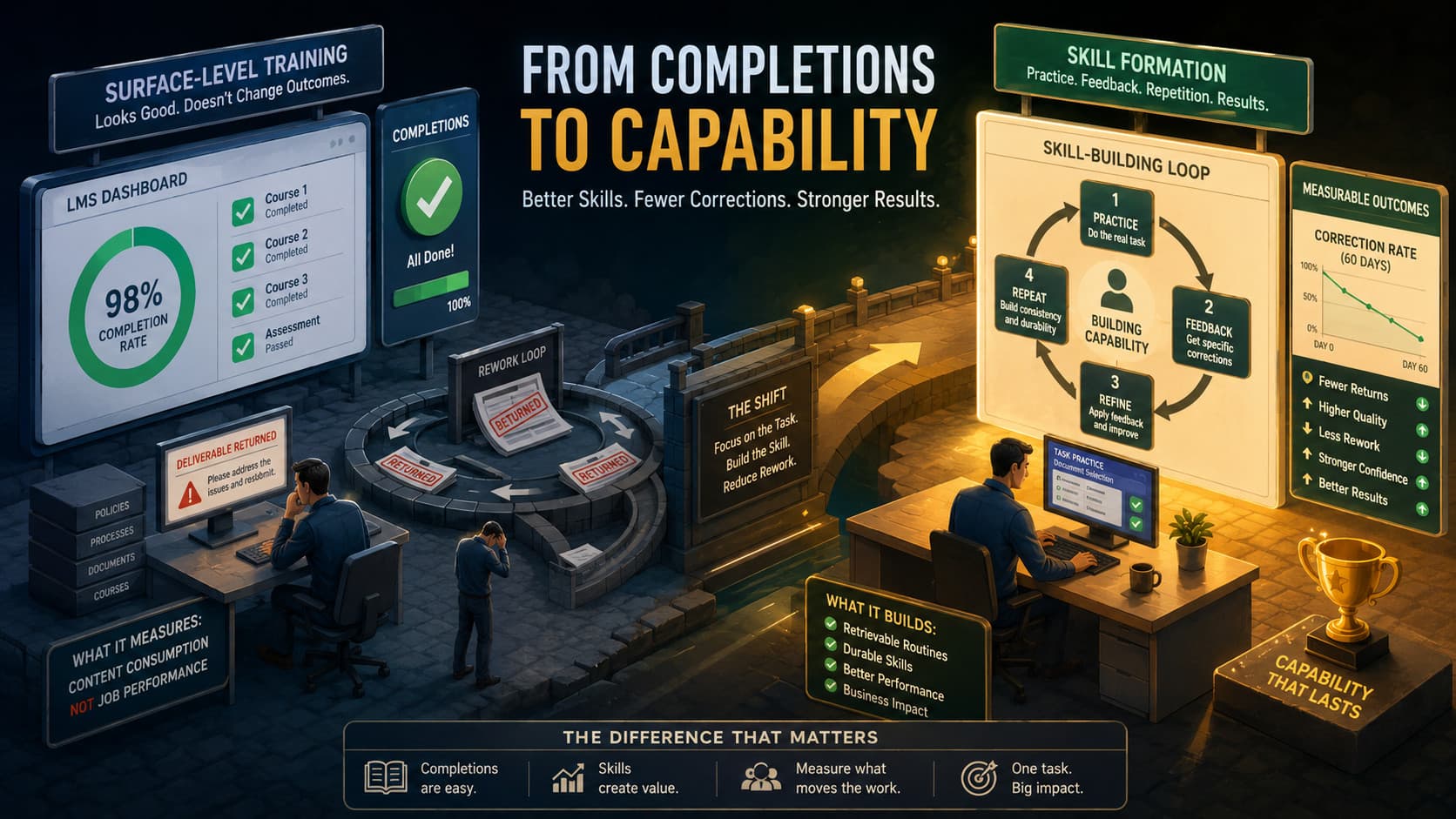
A project manager sends a deliverable back for the fourth time. Not because the work is wrong in any fundamental way. Because the format is off. The wrong template was used. A required review step got skipped. The employee went through onboarding six months ago. Covered all of it. Passed the quiz.
The manager chalks it up to carelessness. Sends a reminder about standards. The cycle runs again next month.
What Rework Is Actually Telling You
Most organizations treat rework as a symptom of attitude or attention. People are rushing. They are not taking care. So the response is a reminder email, a refresher meeting, or another policy document.
That response misses what rework is actually measuring. It is the distance between what someone knows in a training context and what they can do under real conditions. That distance is a skill gap. It does not close by adding more content.
When someone reads a process document and passes an assessment, they have demonstrated recall. When they sit down to do the actual task three weeks later with competing priorities and a slightly different use case, recall is not what they need. They need a practiced, retrievable routine. Those are different things, and most training programs only build the first one.
Why Completions Are Not Capability
The easiest metric in L&D is the completion rate. X percent of the team finished the course. The LMS shows green checkmarks. The training box is checked.
Completions are easy to track because they require nothing beyond finishing the module. They tell you that someone moved through the content. They tell you nothing about whether that person can now do the job task the content was designed to support.
That is not a minor distinction. It is the reason teams run the same training repeatedly without seeing improvement. Content consumption does not transfer to job performance on its own. Transfer requires practice, feedback, and repetition in conditions close to actual work.
When training stops at consumption, the skill never forms. The task gets attempted based on partial memory. Errors occur. Someone corrects them. The team accepts rework as a normal cost of doing business.
It is not a normal cost. It is a predictable result of a training model that was never designed to build skills in the first place.
What Skill-Building Actually Requires
Skill formation follows a recognizable pattern. It is not complicated, but it requires more structure than a course completion.
The learner needs to practice the specific task, not a simulation of it. Generic exercises build general familiarity. Practicing the actual deliverable, using the actual tools, in the actual workflow, builds the routine that holds under pressure.
The practice also needs feedback before errors become habits. When someone completes a task incorrectly three times before getting any correction, they have now practiced the wrong version. Catching errors early is not micromanagement. It is how skills actually form.
Then the practice needs to repeat until the behavior is stable. One pass through a process does not build retention. Spaced repetition, brief reinforcement sessions, and periodic application build the kind of durability that survives interruptions and context switching.
None of this is expensive to build if you start with the right unit of analysis. The right unit is not a course. It is a task. One specific, repeatable task that someone does regularly and currently does inconsistently. That is where the rework is coming from, and that is where the training investment pays off.
The Tradeoffs
Targeting skill gaps directly costs something. It requires someone to analyze where errors actually occur rather than building a broad content library. It requires designing practice activities instead of just recording presentations. It requires connecting training outcomes to job performance data, which means L&D and operations have to coordinate, and that coordination is often where this kind of work stalls.
The alternative is cheaper to build and cheaper to measure. A course gets recorded once. A quiz gets automated. The LMS reports completion. The training budget looks efficient.
The rework cost shows up in operations instead. Revision cycles. Manager time spent on corrections. Downstream quality problems. A developer who rebuilds a module because the spec was misread. A customer-facing team that sends the wrong document because onboarding never built a reliable routine around document selection. These costs are real and ongoing, but they do not appear in the training budget line. They stay invisible until someone looks at how much time the team actually spends on corrections.
When you map the rework back to the skill gap and then to the training gap, the math shifts. A targeted skill-building intervention costs more per learner than a course completion. It costs less than three months of the rework it eliminates.
Start With One Task
Do not rebuild the training program. Pick one task with a clear rework pattern. Something that goes back for correction more than once per cycle. Something with a measurable correct output, so you can tell the difference between done and done right.
Map what the task actually requires. Not what the policy document says. What a skilled person actually does, in what order, making what decisions. That is your skill model.
Design three to five practice repetitions with feedback. Not a video. Actual attempts at the actual task, reviewed against the model, with specific corrections before the next attempt.
Track correction rate, not completion rate. If the rework on that task drops within 60 days, you have your proof of concept. If it does not, you have learned something specific about the gap that your next iteration can address.
That is how you move from a training program that produces completions to one that produces results. One task at a time, until the rework stops.