A product manager at a twelve-person startup signed up for an "AI agent" that promised to run her competitive research. The demo was clean. She typed a prompt, the agent searched the web, pulled data from three sources, and handed back a summary in under a minute. She paid for the year.
Three days later she asked it to update Monday's research with new numbers. The agent had no idea what Monday's research was. It re-ran the whole task from scratch, in a different format, with different section headers. She now had two documents that did not match and no way to merge them without doing the comparison herself. The tool had not saved her time. It had multiplied her editing work.
This is not a one-off complaint. It is the default failure mode of most products marketed as agents in 2026.
The word "agent" stopped meaning anything
Every vendor selling a chat interface with function calling now calls it an agent. The term covers everything from a single-turn chatbot with API access to genuinely autonomous systems that plan, execute, check their own work, and remember what happened last time. Buyers cannot tell these apart from a landing page, and most cannot tell them apart from a fifteen-minute demo either, because vendors build demos to hide exactly the gap that matters.
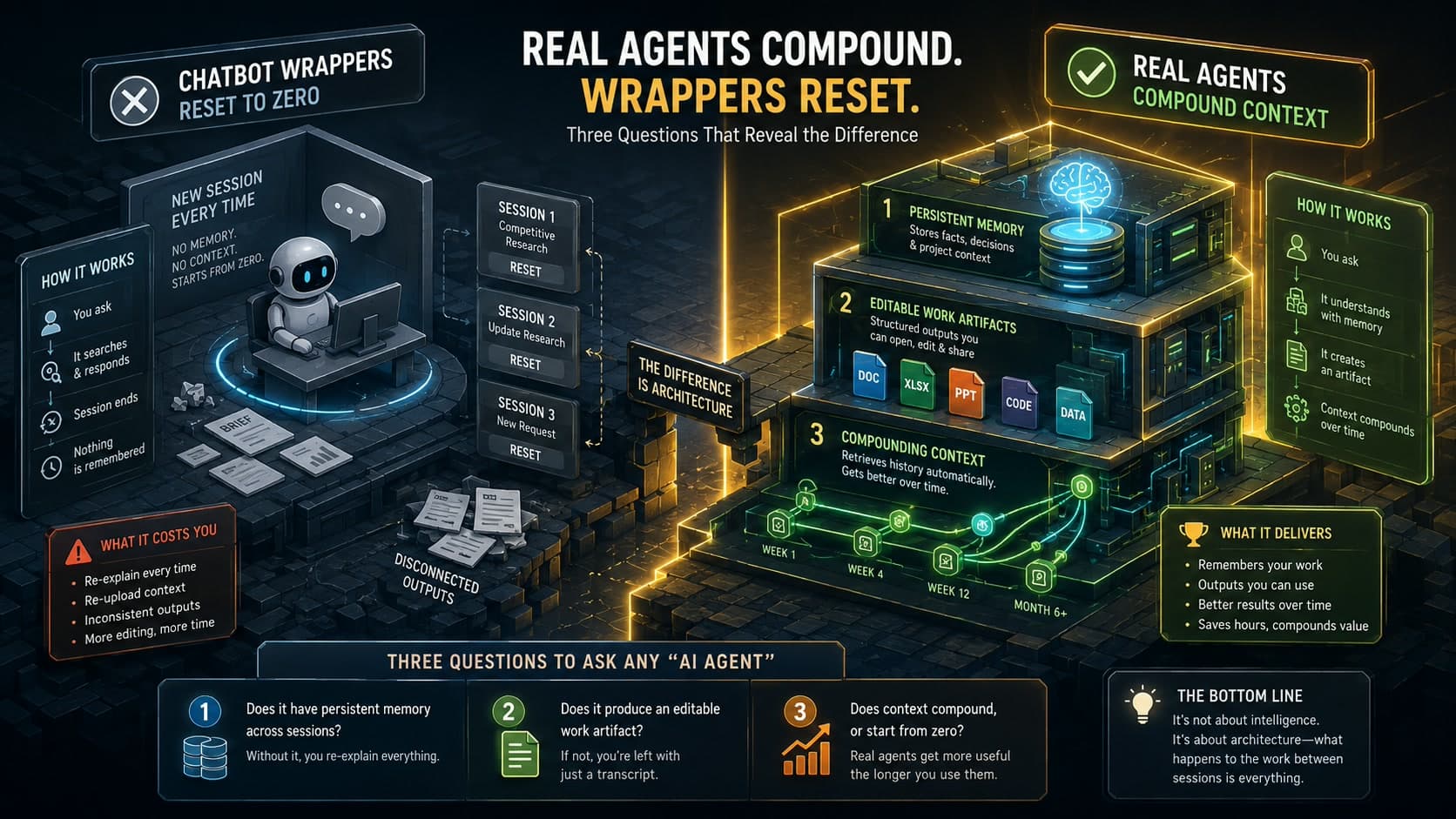
The gap is not intelligence. Every serious model in 2026 can reason well enough to plan a multi-step task and call the right tools. The gap is architecture: what happens to the work between sessions. A system that starts fresh every time you open it is a chatbot, no matter how many tools it can call mid-conversation. A system that carries forward what it learned about your project, your preferences, and your prior decisions is something structurally different, and that difference is what determines whether the tool compounds in value or plateaus after the first week.
You need a way to test for that difference before you commit budget or workflow to a tool. Three questions do it.
What separates a real agent from a wrapper
Does it have persistent memory across sessions, not just within a conversation? Every chatbot holds context inside a single conversation window. That is not memory. That is a context window doing its job. Real persistent memory means the system stores facts, decisions, and state outside the conversation and retrieves them the next time you show up, days or weeks later, without you re-explaining the project. Test this directly: open a new session, reference something specific from a session three days earlier, and see if the agent knows it without being told. If you have to re-paste your brief every time, there is no memory layer. There is a chat log.
Does it produce an editable work artifact, or just a conversation transcript? An outcome-based tool should hand you something you can open, revise, and hand to someone else: a document, a spreadsheet, a codebase, a structured dataset. If the output only exists as chat text you have to copy out and reformat yourself, the tool did not finish the job. It drafted something and left the packaging work to you. Ask what the agent's output looks like at 5pm on a Friday when you need to send it to a client in ten minutes. If the answer involves you reformatting a wall of chat text, the artifact layer is missing.
Does the architecture let context compound, or does every task start from zero? This is the deepest of the three questions, and the one vendors are worst at answering honestly. Compounding context means the system gets more useful the longer you use it, because it is building a structured model of your work, not just accumulating chat history. A tool with real compounding architecture makes fewer clarifying requests over time, produces output closer to your actual preferences without prompting for them, and references prior work correctly without you pointing it there. A tool without it feels exactly as generic on day sixty as it did on day one, because nothing about your usage changed what it knows.
These three questions map to three separate architectural components: a persistent store (usually a database or vector index tied to your account, not the model's context window), an output pipeline that generates structured files instead of raw text, and a retrieval layer that pulls relevant history back into every new task automatically. A product can fake one of these in a demo. Faking all three for a week of real use is much harder, which is exactly why the two-week test below works better than the fifteen-minute demo.
What each answer costs you
Tools with real persistent memory and compounding architecture cost more, in dollars and in setup time. You are usually looking at a platform, not a plugin: onboarding that takes an afternoon, an account structure the vendor controls, and a subscription tier built around storage and retrieval, not just API calls. You also take on lock-in. Memory that lives inside a vendor's system does not export cleanly if you switch tools six months later, and you should ask about export formats before you commit, not after.
Stateless tools are cheap and flexible. You can swap one for another in an afternoon because there is nothing to migrate, no memory store holding your history hostage. But you pay for that flexibility every single session, in the form of re-explaining context, re-uploading reference docs, and manually stitching together outputs that should have connected on their own. For a task you run once, that cost is trivial. For a task you run every week for a year, it adds up to real hours, and those hours are the ones the outcome-based pitch promised to eliminate.
There is a middle option worth naming: building your own thin memory layer on top of a stateless model, using a vector database or even a well-organized set of markdown files the model reads at the start of each session. This gives you compounding context without vendor lock-in, at the cost of engineering time upfront. For a solo builder or small team already comfortable with basic tooling, this often beats both extremes, because you control the export format by construction.
What to do before you buy
Do not evaluate an agent product on a demo. Run a two-week pilot on a real, recurring task, something you would otherwise do weekly by hand. On day one, give it full context. On day eight, come back and ask it to build on day one's work without re-explaining anything. Check the output format on day one and day fourteen: if it is still landing in a chat window instead of a document you can hand off, that is your answer.
If the tool passes the memory test, the artifact test, and shows measurably less setup friction by the second week, it is a real agent and worth the subscription. If it needs you to re-brief it every session and hands you chat text to reformat yourself, you are paying agent prices for chatbot output. Cancel it and either find a vendor that passes all three tests or spend a weekend building the thin memory layer yourself. Either path beats renewing a tool that resets to zero every Monday.