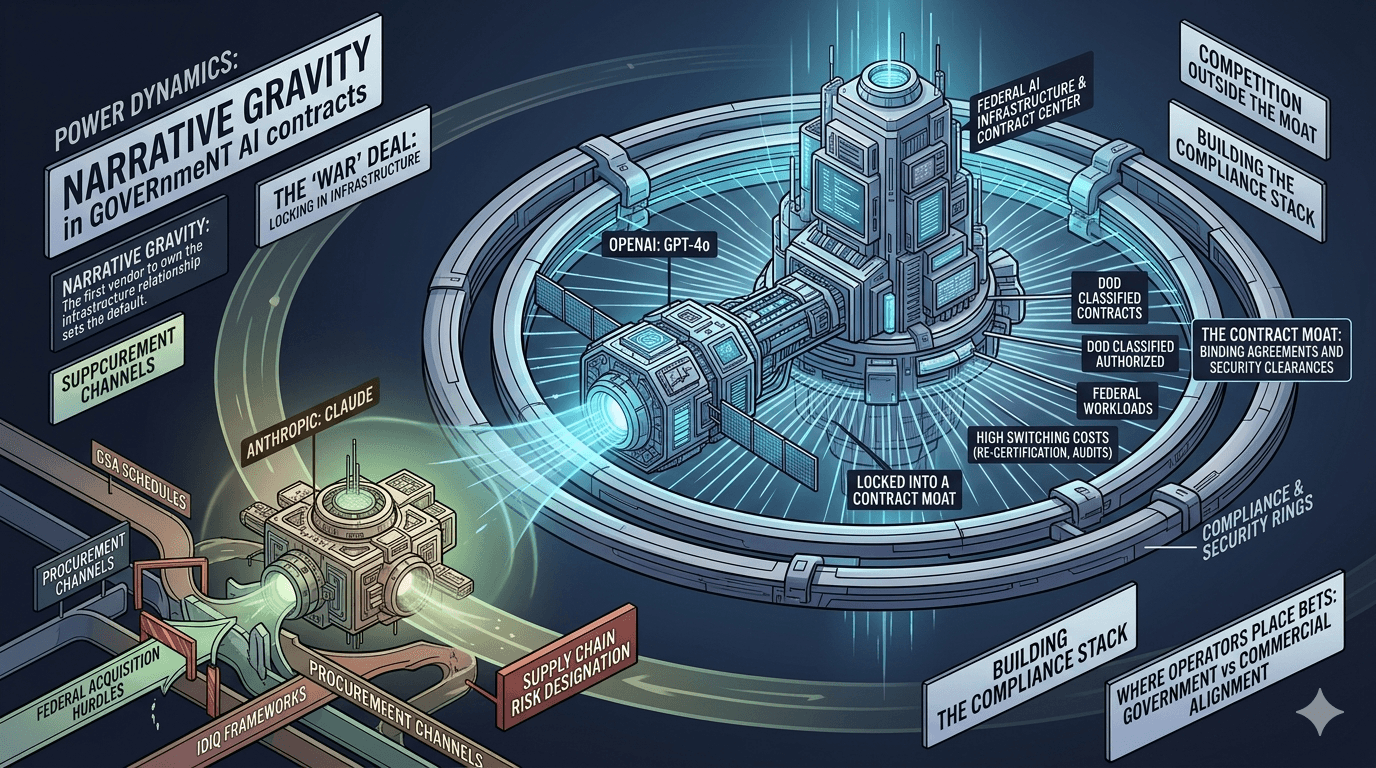
A federal acquisition officer pulls up the vendor roster in early 2025. OpenAI is on contract for classified defense work. Anthropic just got flagged as a supply chain risk. The technical capabilities of both models are close enough that no benchmark settles the decision. But the contract decision already made itself.
That is how narrative gravity works in enterprise and government AI. The first vendor to own the infrastructure relationship sets the default. Everyone else has to argue for a switch, and switching costs in government are not small.
The contracts that changed the geometry
OpenAI's deal with the Pentagon, formalized through classified agreements in late 2024 and early 2025, was not just a revenue event. It was a structural shift. Government contracts come with compliance frameworks, technical integration requirements, and security clearances that take months or years to satisfy. Once an agency runs production workloads through a vendor's stack, migrating to a competitor means re-certification, re-integration, and a full security audit. That friction is not accidental. It is the product.
The $40 billion financing round that accompanied this period tells the same story from a different angle. A significant portion of that capital came from investors who also hold positions in the government customers OpenAI was signing. The circularity is not subtle: OpenAI raises capital that validates its valuation, signs contracts with entities whose investors overlap with its cap table, and uses the contract wins to justify the valuation to the next round. The financial architecture and the contract architecture reinforce each other.
For operators watching from the outside, the number that matters is not OpenAI's valuation. It is the number of federal agencies that now run production workloads on GPT-4o. Every agency that crosses that threshold makes the category default harder to displace.
What the supply chain risk designation actually means
Anthropic's designation as a supply chain risk was not a technical judgment. No evaluation team determined that Claude produces worse outputs than GPT-4o for classified use cases. The designation reflects procurement posture: Anthropic does not yet have the clearances, contract vehicles, and compliance documentation in place to satisfy federal acquisition requirements.
That gap matters more than it sounds. Federal agencies do not buy AI models the way a startup buys an API. They buy through existing contract vehicles, GSA schedules, and IDIQ frameworks that take years to establish. Anthropic is working to close that gap. But while it builds the procurement infrastructure, OpenAI is signing the deals that generate the switching costs.
The risk designation also bleeds outside government. Enterprise procurement teams at large private organizations watch government vendor lists as a proxy for credibility. When a vendor gets flagged at the federal level, the signal leaks into commercial RFPs. It shows up in security questionnaires and vendor risk assessments. The designation becomes a talking point in competitor sales cycles, regardless of its technical basis.
Why government contracts behave differently
Commercial API contracts are sticky but not immovable. A developer team that decides Claude handles their use case better than GPT-4o can switch in weeks. The costs are integration time and prompt rework. Painful, but not prohibitive.
Government contracts do not work that way. The switching costs include re-certification against FedRAMP requirements, new Authority to Operate documentation, potential congressional notification for contracts above certain thresholds, and retraining for the government personnel who operate the systems. A federal agency moving a classified workload from one vendor to another is looking at a minimum 12-month process, often longer.
This asymmetry is narrative gravity. The vendor that wins the first contract at an agency pulls subsequent contracts toward itself because the default is already set. Program managers do not want to manage two vendors when one will do. Budget cycles reward stability over experimentation. The first vendor to reach operational status at an agency becomes the benchmark every other vendor gets measured against, and that benchmark already has a head start.
OpenAI understood this earlier than most. The Stargate announcement, the Department of Defense partnerships, the classified contracts that cannot be discussed publicly but show up in procurement databases, none of those were separate bets. They were a coordinated effort to become the gravitational center of American AI infrastructure before the government procurement machine finished deciding what it wanted.
The tradeoffs neither side publicizes
OpenAI's government strategy carries exposure that does not appear in the press releases. Classified contracts require ongoing compliance. Any model update that changes behavior in ways the government did not certify triggers a re-evaluation process. OpenAI cannot iterate on its deployed government models the same way it iterates on consumer products. The contract moat is also a ceiling on agility.
There is also political exposure. Government AI contracts are now visible to Congress in ways that commercial AI deals are not. A single notable failure in a classified deployment, a model that produces bad outputs in an operational context, could trigger oversight hearings and contract reviews that take years to resolve. OpenAI is not just building products at this scale. It is building political risk.
Anthropic's position has its own costs. The company has made a sustained public case for AI safety, Constitutional AI, and responsible deployment. Those arguments carry weight in academic and commercial circles. They carry less weight when an agency's acquisition officer needs a vendor on an existing GSA schedule by the end of the fiscal quarter. Anthropic's approach to safety and governance may ultimately produce better outcomes for the field, but it does not speed up the timeline for clearing federal procurement hurdles.
Anthropic preserves more independence from government and military entanglement, which allows faster iteration and cleaner separation between commercial and classified use cases. But independence from government also means independence from the contract moat that makes OpenAI's position so durable.
Where operators should place their infrastructure bets
If you build applications that will eventually serve government or regulated-industry clients, OpenAI is the safer platform choice right now. The compliance infrastructure and procurement documentation that agencies require are further along there. Choosing OpenAI now means less rework when your client asks for FedRAMP compliance or a DoD authority to operate.
If model behavior, safety properties, and iteration speed matter more than government procurement compatibility, Anthropic is the better fit. Claude's Constitutional AI training produces measurably different behavior on sensitive content, instruction following, and refusal patterns. For consumer applications, healthcare use cases, and any context where alignment matters more than contract status, that difference is real and worth building around.
The two platforms are solving for different markets right now. The risk for operators is building on the wrong one for your actual customer base, not because one model is better, but because the procurement and compliance infrastructure you will eventually need is only mature on one side.
The government contract race is not over. Anthropic is building procurement capacity. OpenAI is building compliance overhead. The gap will close. But the decisions you make in the next 12 months happen in the current environment, not the converged future one. Build accordingly.