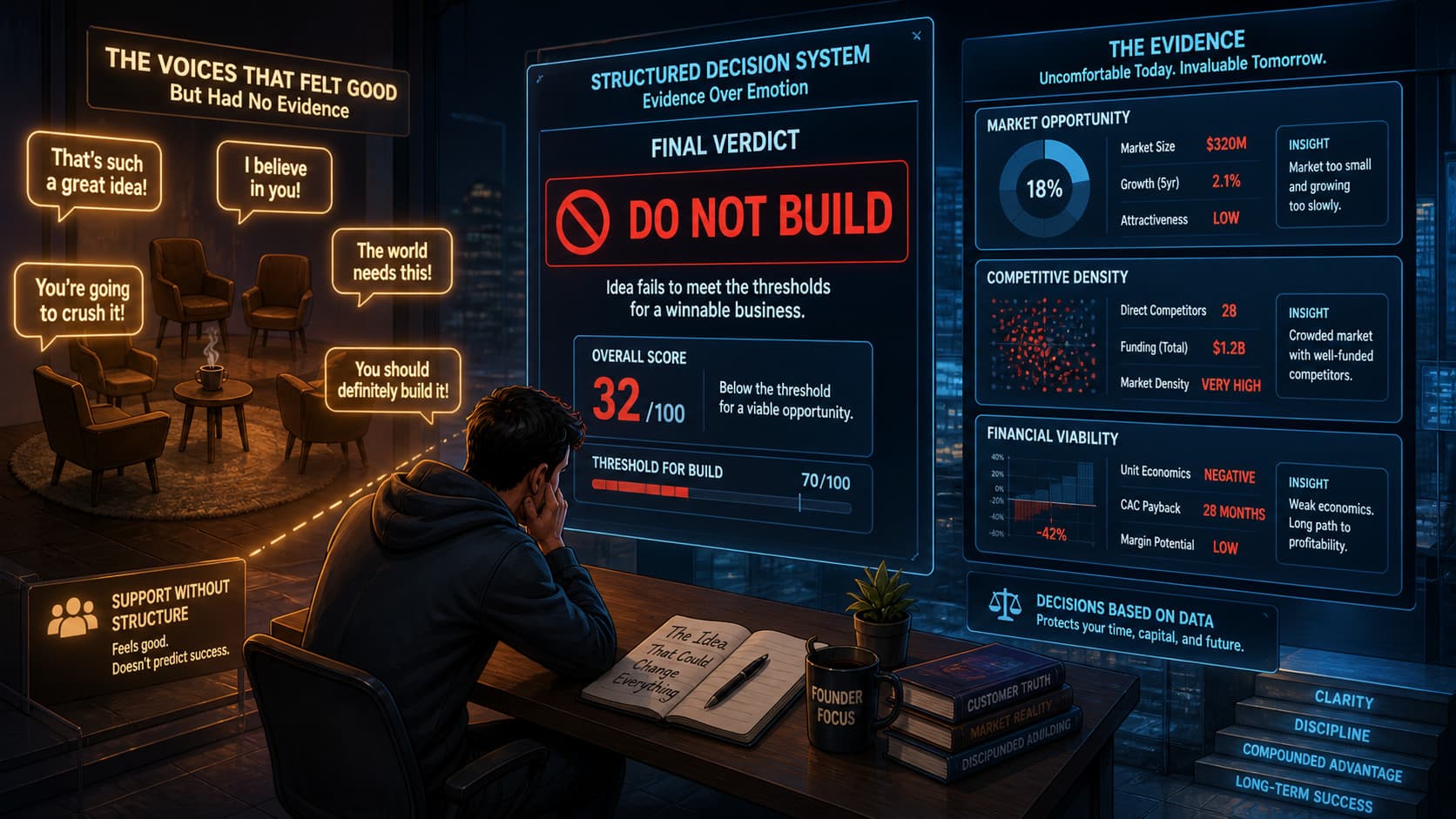
Marcus had been working on his idea for eight months. He had a name, a logo, a Notion doc with 47 pages of research, and a group chat full of friends who kept telling him it was brilliant. His brother-in-law said it reminded him of something he'd seen in a TechCrunch article. His partner said she could see it working. His former manager said he should have built it years ago.
None of them said don't.
He spent thousands on development before a paying customer pushed back on the price. The product worked. The market didn't care.
The Problem With Being Told Yes
Most founders reach for a scoring tool before they reach for anything else. That instinct makes sense. You have an idea. You want to know if it's good. You answer some questions and wait for a number.
The number almost always comes back encouraging. That is not an accident. Founders want to be told yes, and tools built for founders tend to deliver it. The result is a score that produces the feeling of having been evaluated without the substance of an actual evaluation. You walk into the build more confident than the evidence warrants, and you cannot see the problem until you are deep into it.
founderscore was built around a different premise. The most valuable verdict it can deliver is not a strong score. It is “Do Not Build.” Every design decision in the product (how ideas are classified, how scoring weights are calibrated, how external evidence is gathered) is oriented toward making that verdict possible, credible, and documented when the evidence calls for it.
What the Scoring Is Actually Doing
Before founderscore scores anything, it classifies the project by product archetype. A marketplace has fundamentally different demand dynamics than a workflow SaaS tool. A consumer mobile app faces different execution risks than an infrastructure API. Scoring a marketplace idea against a rubric designed for search-driven SaaS produces a number that means nothing.
founderscore identifies one of ten product archetypes and, for hybrid products, a secondary archetype with a blended weighting model. The scoring weights shift accordingly. Market traction carries more weight for a content platform than for a data and AI product, where differentiation is the dominant signal. The rubric adjusts to the type of thing being evaluated.
The pipeline then goes out and looks for evidence. It does not score your claims at face value. It searches Google, Reddit, G2, Product Hunt, Google Patents, and the USPTO for signals that either support or contradict what you have described. Pain evidence, competitive density, pricing acceptance, demand signals, these are gathered from external sources, not derived from your inputs. If you tell the system your market is large and uncrowded, the pipeline will go find out whether that is true.
The score that comes back reflects four weighted dimensions: market traction, differentiation, monetization viability, and execution risk. Each dimension has sub-scores. The final number is calibrated, cross-validated by a separate agent looking for anomalies, and mapped to one of five verdict bands, the lowest of which is Do Not Build.
That verdict is not a warning. It is a conclusion.
The Closure Function
When Marcus finally stopped pursuing his idea, the hardest part was not the money. He had absorbed that. The hardest part was explaining the decision to the people who had encouraged him.
His brother-in-law kept asking what changed. His partner wanted to understand why eight months of research was not enough. His former manager offered to make introductions. The encouragement that had felt like support during the build phase turned into pressure during the exit.
Founders in this position do not just need permission to stop. They need evidence they can share.
A founderscore report documents the specific reasons an idea does not hold up: where the market is too small, where the competitive density is too high, where the unit economics do not close, where customer evidence is missing or contradictory. It is a written record of a rational decision, structured in plain language.
Family and friends can read it. They can see the analysis. They can understand that stopping was not giving up. It was a conclusion reached before the spending compounded.
Transferable closure is not a secondary feature. For founders under social pressure, it is the product.
What You Trade Away With Each Option
The cost of running founderscore before you build is time and a subscription fee. You spend a few hours answering structured questions. You get a score, a detailed report, and a verdict. If the verdict is Do Not Build, you stop before the real spending starts.
The cost of skipping that step is harder to calculate because it compounds. There is the direct financial cost of development. There is the opportunity cost of six to eighteen months working on something that will not find a market. There is the relationship cost of unwinding a narrative you built publicly. And there is the cognitive cost of deciding to stop without a clear reason you can point to.
Anti-validation is not pessimism. It is precision. A scored assessment that is only capable of telling you to proceed is not an assessment. It is a mirror.
What to Do Before You Spend Anything
Run founderscore before you spend money. Not after you have a prototype. Not after you have hired a developer. Before you have spent anything you cannot get back.
Answer the questions with the same rigor you would bring to a pitch. Do not optimize your answers for a good score. The system cross-validates your inputs against external evidence, and inflating those inputs produces a verdict that is wrong in the direction that hurts you most.
If the score comes back strong, you have documented evidence to support moving forward. If the score comes back with a Do Not Build verdict, print the report. Share it with your family. File it somewhere you can find it.
Then move on to the next idea. The report is not a failure. It is proof that you made a rational decision before it became an expensive one.