A customer sends in a request. Not a complicated one. But the rep who picks it up has to check with a colleague, pull up a reference doc, then send a clarifying question back to the customer. Three days pass. The customer gets an answer that is technically correct but incomplete. They follow up. Another two days. Meanwhile, they have already started talking to a competitor.
No one on the team was lazy or careless. The process just had gaps that training never filled.
The gap no one measures
Most organizations treat training as an input. Hours completed, courses finished, certifications earned. The tracking stops there. Whether the rep can answer a product question without escalating it, whether the account manager can quote lead times accurately, whether the support agent can explain a policy without putting the customer on hold. None of that shows up in any report.
That gap, between completing training and applying it in a customer conversation, is where trust gets lost. You will not see it in a completion dashboard. It shows up in response time, error rates, callbacks, and lost deals.
The useful measure of training is not what people finished. It is how quickly and accurately they respond when a customer is waiting.
Why the connection breaks down
Internal enablement and customer-facing performance rarely get designed together. Training gets built by L&D or HR. Customer metrics get owned by sales ops, support leadership, or the CX team. The two groups rarely sit in the same room when learning programs get built.
The result is training content that answers the questions someone had six months ago, not the ones customers are asking today. A new product feature launches. A policy changes. A common customer complaint starts repeating across accounts. The frontline team learns about it through hallway conversations, email threads, and whatever they happened to catch in a Slack channel. Some of them get it right. Others do not.
This is not a technology problem or a motivation problem. It is a system design problem. The path from new information to accurate customer response has too many informal steps and no reliable structure.
What a working system actually contains
Most organizations have pieces of a working system. They rarely connect them.
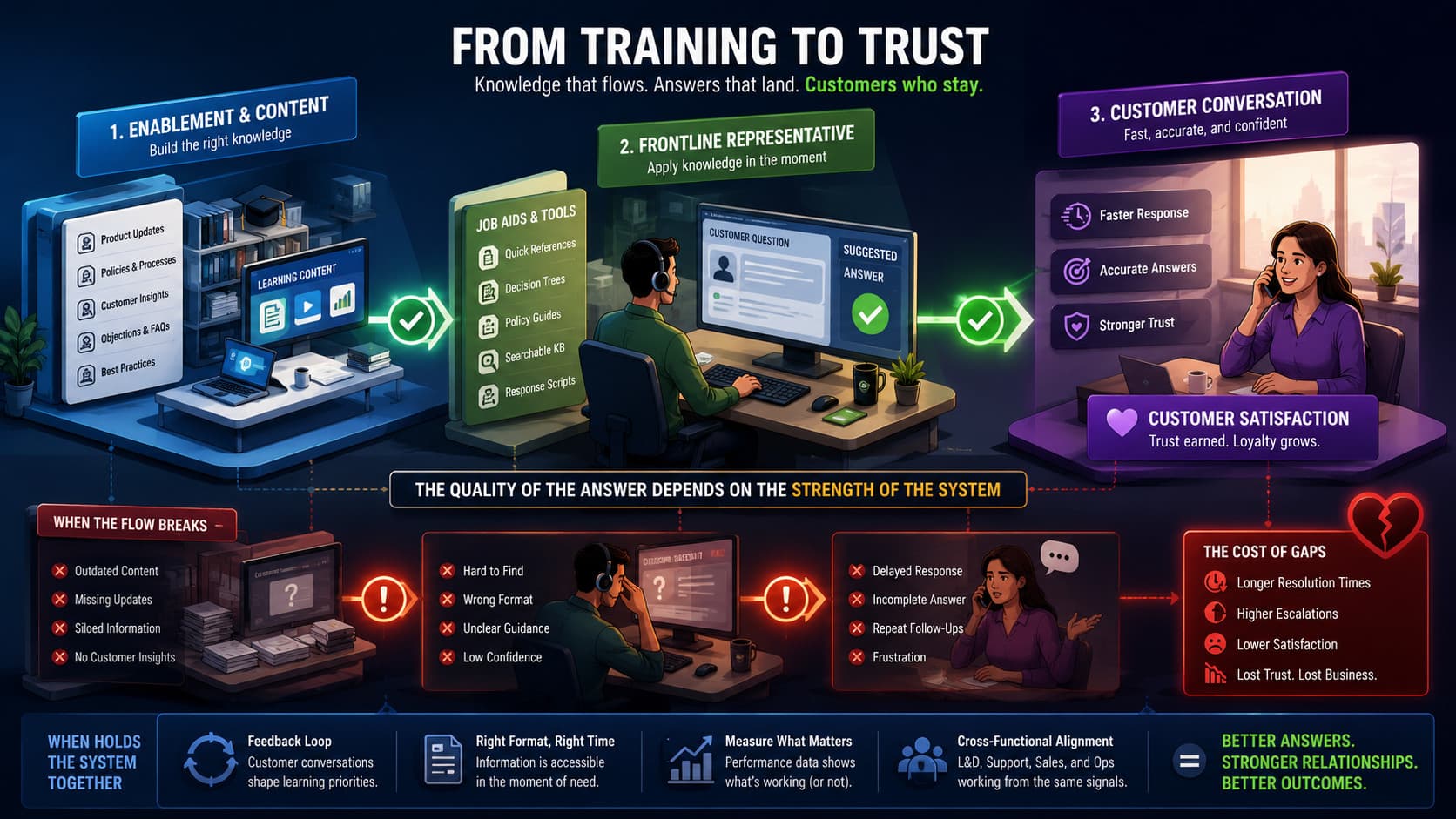
The first piece is a tight feedback loop between customer interactions and learning content. When support tickets cluster around the same misunderstanding, that pattern is a content brief. When sales calls stall at the same objection, that stall point belongs in the next training cycle. Customer conversation data should drive what gets built, not a calendar or an anniversary date.
The second is format matched to application. A 45-minute course is the wrong tool for a rep who needs to answer a pricing question mid-call. Short reference materials, decision trees, and searchable job aids put information where the rep can reach it during the conversation, not before it. The format question is not about preference. It is about when and where the information needs to be used.
The third is measurement that crosses the wall between learning and performance. If completion is the only metric, the system has no feedback. Response accuracy, first-contact resolution rates, and escalation frequency all carry signal about whether the knowledge is landing. Without that signal, L&D teams are building in the dark.
The tradeoffs worth naming
Connecting training to customer outcomes takes more coordination than running a standalone learning program. L&D teams need input from support, sales, and operations to build accurate content. They need access to performance data to measure whether it is working. Both create dependencies that take time to set up and maintain.
The alternative is faster to run and harder to defend. A disconnected training program produces completion data that looks fine until a customer escalation or a lost renewal surfaces the gap. By then the fix is reactive and expensive.
There is also a tradeoff in content freshness. A system that updates based on customer signals requires someone to own the maintenance cycle. That is a real cost. The cost of skipping it is slower, less accurate customer responses compounding across every interaction the team handles.
Better response times and higher accuracy rarely come from hiring different people. They come from giving the people you already have information they can actually use when it matters.
What to do with this
Start with one customer-facing metric that is underperforming. Pick something concrete: average resolution time, escalation rate, a repeat complaint category. Then work backward. What does the frontline team need to know to handle that situation accurately on first contact? Is that knowledge in any training material? Is the material in a format they can reach during a customer interaction?
If the answer to either question is no, that is the project. Build the content, put it where the work happens, and tie the outcome metric to the learning investment. Run it for 90 days. A 90-day result tells you more than a year of completion reports.
Training does not show up for customers through a dashboard. It shows up in the answer, and in whether the customer has to ask again.