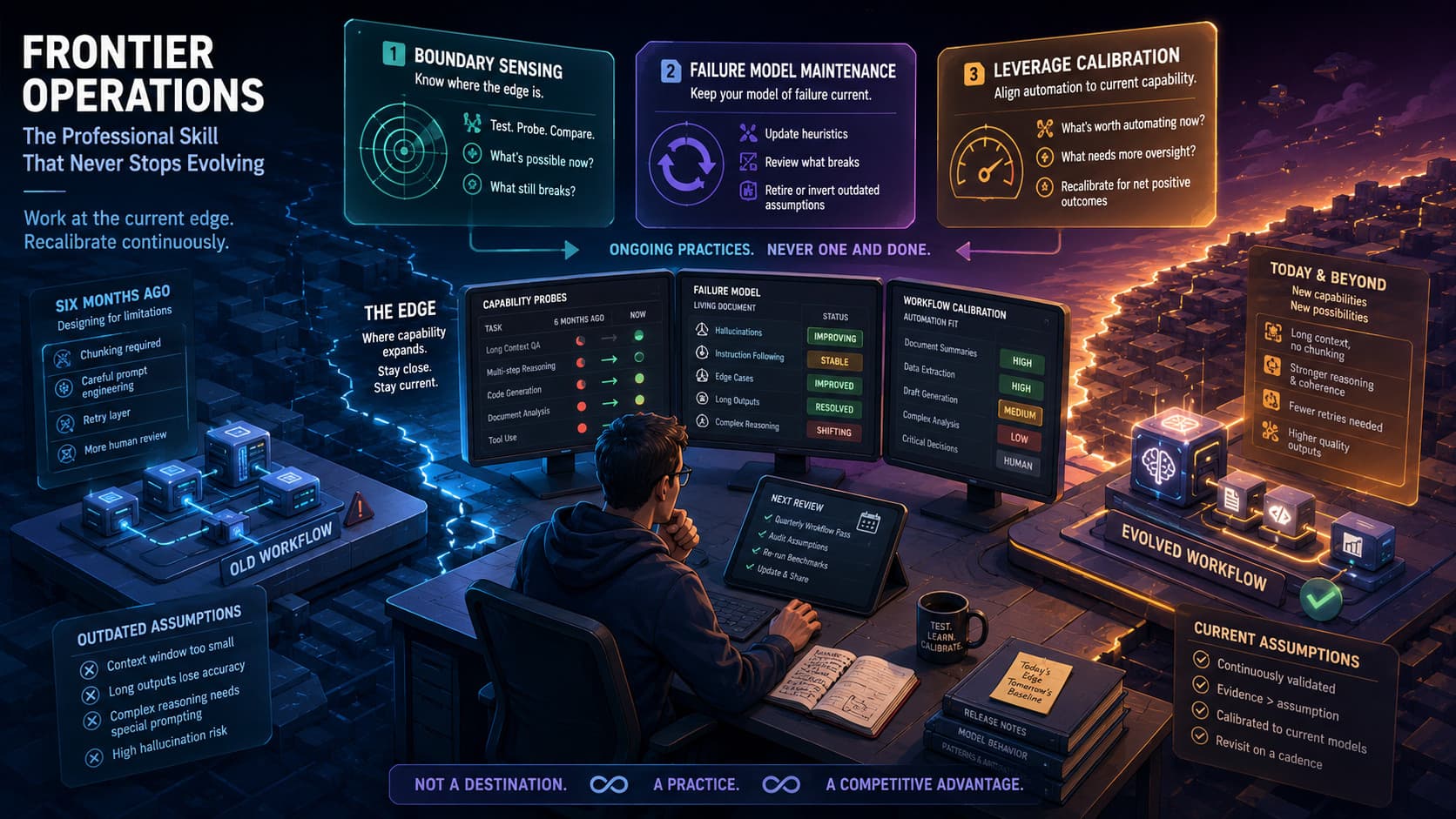
Six months ago, a solo builder shipped a document processing pipeline. It was solid work: chunked inputs, careful prompt engineering to work around hallucination on long contexts, a retry layer for when the model lost the thread. They tested it, it held up, they moved on to the next problem.
Last week, they watched a demo of the same task running on a current frontier model. No chunking required. Context handling was clean. The retry layer would have been unnecessary from the start.
The pipeline still works. But it was designed to compensate for limitations that no longer exist, and it's missing capabilities the model now has. The gap between what they built for and what's possible now is six months wide and growing.
The Problem Isn't Falling Behind
Most discussions about staying current with AI frame this as a knowledge problem. Read more. Take a course. Follow the release notes. That framing misses what's actually happening.
The difficulty isn't that model capabilities are changing. It's that the skills required to work effectively with those capabilities are not a fixed set. There's no certification you pass once. No configuration you lock in. The capability surface of the models you work with expands continuously, which means the way you interface with them needs to expand too.
Treating AI proficiency as a destination produces a specific failure mode: practitioners who are fluent with a past version of the tools, working confidently inside a set of assumptions that no longer hold. They're not incompetent. They're just operating on stale calibration.
Frontier Operations is the practice of working effectively at the current edge of model capability, not the edge from six months ago.
What Frontier Operations Actually Means
The practice has three components. Each requires ongoing attention, not a one-time setup.
Boundary sensing is knowing where the current edge is. What can current models handle that they couldn't three months ago? What still breaks? Where are the failure modes shifting? This isn't passive monitoring. It's active testing, reading release notes with intent, and running your own probes against tasks that used to require workarounds.
The builders who do this well keep a small set of benchmark tasks they run against new models or new versions. Not formal evals, just representative tasks from their actual work. They're not looking for impressiveness. They're looking for capability change that affects their workflows.
Failure model maintenance is updating your mental model of what breaks and why. Every practitioner who works with AI systems accumulates a set of heuristics: this model loses accuracy on outputs longer than X, this kind of reasoning prompt needs a chain-of-thought structure, this task requires human review because the model confabulates on edge cases. Those heuristics were built from real experience. They're also time-stamped.
When capabilities shift, some heuristics become obsolete. Others remain accurate. A few get inverted entirely. Keeping your failure model current means treating it as a living document, not a settled body of knowledge. If your team has a shared doc of "things AI can't do reliably," that doc needs a review cadence, not just a creation date.
Leverage calibration is the ongoing decision of which tasks are worth automating at current capability levels. This recalibrates constantly. A task that required too much human review to be worth automating at an earlier capability level might cross into net-positive automation today. A task you fully delegated to a model might need to come back under closer oversight if the model version changed and behavior shifted.
A quarterly pass over your AI-assisted workflows asks one question: given what current models can actually do, is this workflow still correctly calibrated? Not a comprehensive audit. A targeted check for mis-calibration in either direction.
The Costs of Each Operating Mode
Operating continuously at the frontier has real costs. You run into undocumented behavior. You build on capabilities that might shift in the next release. You spend time testing and re-testing workflows that were stable before. For teams where reliability and predictability matter more than capability ceiling, frontier operation carries more risk than it returns.
Staying with stable, known capabilities has its own costs. You accumulate workarounds for limitations that no longer exist. Your automation ceiling stays lower than it needs to be. Over time, the gap between your operating assumptions and current model behavior widens, and the eventual update becomes more disruptive than a series of smaller ones would have been.
The teams that handle this well don't pick one mode permanently. They operate at the stable tier for production systems and maintain a small frontier practice in parallel. One person, a few hours a month, keeping the boundary-sensing and failure model work current. That investment is small enough to be sustainable and large enough to prevent the six-month drift problem.
The teams that handle it poorly treat AI proficiency as a project with a completion date. They do a big training push, lock in workflows, and expect the results to hold. They do, until they don't.
What to Build First
If you're operating with AI workflows that were designed more than four months ago and haven't been reviewed since, start with a failure model audit.
Pull up the prompts and configurations your team uses regularly. For each one, ask two questions. First: was this designed to work around a limitation? If yes, does that limitation still exist at current model capability? Second: does this workflow rely on a capability assumption? If yes, does current model behavior still support it?
That pass will find the mis-calibrations without requiring a comprehensive rebuild. Fix the workarounds that are now unnecessary. Flag the assumptions that need testing. Leave everything else in place.
Then set a recurring calendar event every eight weeks to run your boundary-sensing probes. A set of five to ten representative tasks from your actual work, tested against current models, with notes on what changed. This doesn't need to be formal. It needs to happen on schedule.
Frontier Operations isn't a methodology or a framework. It's a discipline. The practitioners who maintain it consistently are the ones whose AI workflows stay accurate over time rather than drifting toward obsolescence while appearing to function normally.
The pipeline still works. That's not the same as the pipeline still being right.