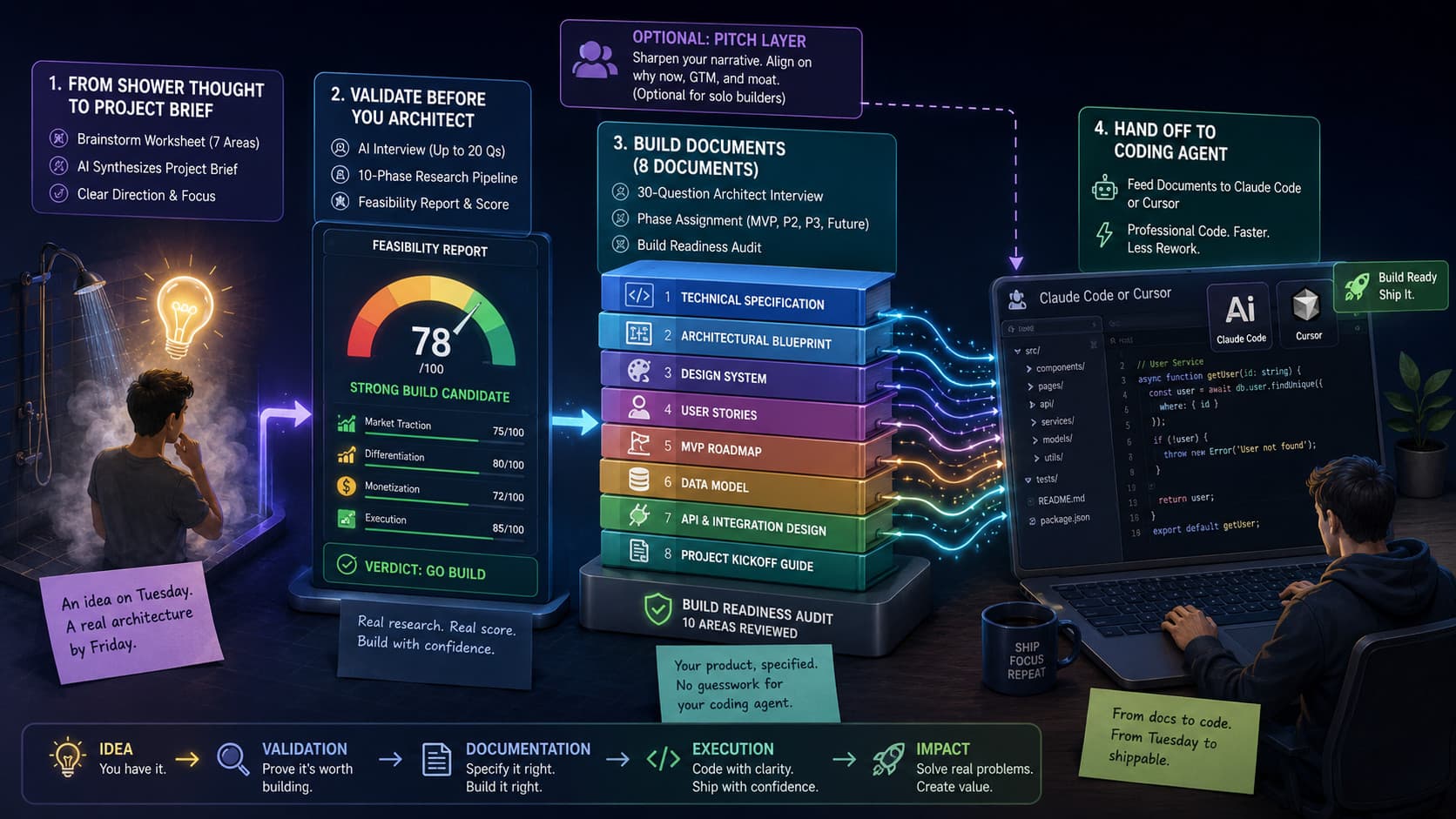
You have an idea on a Tuesday. By Friday you want to be in a coding agent with a real architecture document, not a napkin sketch. Between Tuesday and Friday, a surprising amount of work happens, but none of it is guesswork if you run the right sequence.
Most solo builders skip from idea to code too fast. They spend the first two weeks discovering problems they should have defined on day one. The stack feels wrong. The data model doesn't support the feature set. The MVP scope is either too small to test anything meaningful or too large to ship before motivation evaporates.
The founderscore workflow closes that gap by pulling decisions forward that would otherwise surface at the worst possible time.
Validate Before You Architect
The first thing founderscore does is ask whether the idea is worth building at all. This sounds obvious. Most founders skip it anyway.
The Brainstorm Worksheet walks you through seven areas: the concept, the problem, the intended user experience, the technical complexity, your constraints as the builder, the monetization model, and your definition of success. You answer in plain language. An AI agent reads your answers and synthesizes them into a structured project brief covering your overview, problem, features, technology stack, business model, and success criteria. That brief lands in your description editor and becomes the starting point for everything that follows.
Then the interview runs. A virtual venture analyst reads your full description, identifies the three or four biggest information gaps, and surfaces them before asking a single question. This ready-check tells you exactly where your thinking is thin. After you confirm, the interview begins, up to 20 adaptive questions probing differentiation, pricing, target customer, build feasibility, and regulatory risk. The questions adapt to your answers. If you say "I don't know," the AI offers concrete directions rather than moving on.
After the interview, a 10-phase research pipeline runs across Reddit, G2, Google Patents, and Product Hunt using 20-plus specialized AI agents. The output is a Feasibility Report with a 0-to-100 score across Market Traction, Differentiation, Monetization, and Execution. The verdict is direct: Strong Build Candidate, Viable, Risky, or Do Not Build.
If you score in the 70s or above, you have a go signal backed by real research. If you don't, you found out now instead of after six weeks of building.
The Optional Pitch Layer
Before moving to build documents, some builders run the Pitch Paper. This step is optional for pure solo builders who aren't raising, but it earns its place even without investors in the picture.
The Pitch Paper interview identifies gaps in your investor narrative: the "why now," your go-to-market channel, your competitive moat, your team credibility relative to the problem. Filling those gaps forces you to sharpen the product story before you build it. A clearer narrative about who the product is for and why they'll pay makes the build documents sharper downstream.
If you're planning to raise or share the idea with advisors, the Pitch Paper also produces an 11-section investor document backed by the research already done. The AI extracts what it needs from your Feasibility Report, asks 10 targeted questions to fill the remaining gaps, and assembles the narrative. You're not writing it from scratch.
For a pure solo build with no investor track, skip it and go straight to Build Documents. The validation work is already done.
The Build Documents Step
This is the step most builders underestimate. Build Documents are the specification layer that makes a coding agent produce professional-grade output rather than plausible-looking guesses.
The process starts with a 30-question interview conducted by a senior technical architect AI. It reads your project description and Feasibility Report, then probes across 10 areas: tech stack preferences, team composition, timeline constraints, third-party integrations, data model complexity, authentication requirements, scale expectations, compliance needs, CI/CD preferences, and infrastructure budget.
After the interview, the platform pauses generation at a phase assignment step. Every feature extracted from your project gets assigned to MVP, Phase 2, Phase 3, or Future. You review and adjust these assignments manually before confirming. This is where scope discipline happens. What makes it into the MVP document set is what you decided to build first, not a default assumption.
After confirmation, the pipeline generates 8 documents:
- Technical Specification covers your stack, architecture decisions, and development environment setup
- Architectural Blueprint maps your system design, component architecture, data flow, and deployment strategy
- Design System defines visual tokens, component patterns, accessibility standards, and responsive behavior
- User Stories organizes your personas, journeys, and acceptance criteria by development phase
- MVP Roadmap breaks your build into phases with milestones, timelines, and dependencies
- Data Model specifies entities, relationships, storage strategy, and migration approach
- API and Integration Design defines your endpoints, contracts, authentication flows, and third-party integrations
- Project Kickoff Guide covers onboarding, team roles, communication cadence, and risk mitigation
A Build Readiness Audit runs after all eight are complete. It rates 10 areas, including tech stack, data model, auth, scale, and compliance, as Strong, Partial, or Weak, with specific notes on what needs more definition.
The Technical Spec and Blueprint use a reasoning-optimized model for depth. The User Stories, Roadmap, Data Model, and API Design use a fast structured-output model. Total generation time is typically 3-5 minutes.
Feeding the Documents Into Your Coding Agent
This is where the workflow pays off in concrete time saved. Download all eight documents, plus the auto-generated Read Me, as a single Markdown or PDF package. Then open Claude Code or Cursor.
The Read Me is not boilerplate. It was generated from the same project context as everything else. It describes the product, the architecture decisions, the MVP scope, and the intended build sequence. When you paste it into a coding agent as the session context, you're giving the agent a working spec, not explaining the product from scratch.
Start with the Technical Specification and Architectural Blueprint. These give the coding agent the stack decisions and component structure before it writes any code. Follow with the Data Model, so the schema is defined before any feature work starts. Layer in the API Design for endpoint contracts, then move through User Stories by phase.
The phase assignments you confirmed during document generation now drive the build order. The roadmap tells you what's in the MVP, what's deferred, and what dependencies exist between features. Scope doesn't get rediscovered mid-session.
What This Approach Costs
The full workflow from idea to build-ready documentation costs 5 credits total: 1 for the Feasibility Report, 1 for the Pitch Paper if you run it, and 3 for the Build Documents. At $49 a month for 10 credits, that's roughly half a month's allocation for a complete idea-to-architecture stack.
The time cost is also real. The Brainstorm Worksheet plus interview takes 45-90 minutes. The Feasibility Report generates in 3-7 minutes. The Build Interview takes 60-90 minutes. Document generation takes another 3-5 minutes.
Call it a half-day of structured thinking followed by a few minutes of generation. Compare that against the alternative: starting with a blank file in your coding agent, figuring out the data model during a feature build, discovering the API contract doesn't match the frontend assumptions three weeks in, and spending a weekend rearchitecting a decision you made in the first hour.
The workflow pulls decisions to the front. Spend time now on structure or spend it later untangling a codebase built on assumptions.
Run the Full Stack
If you have an idea you're taking seriously, create a project in founderscore and run the Brainstorm Worksheet today. Do the interview honestly, including the questions where your answer is incomplete. Read the Feasibility Report verdict before you touch a code editor.
If the score is in the 70s or above, move to Build Documents. Do the 30-question technical interview and make deliberate decisions at the phase assignment step. Download the complete document set and the Read Me, then open your coding agent with a real specification instead of a mental model.
The gap between "shower thought" and "working codebase" is mostly structure. This is the structure.