You have been in that seminar. The presenter clicks to a slide that appears to solve a problem your team has been wrestling with for months. You take notes. You feel a genuine spark of clarity. You leave the room convinced that things are about to change. Then you sit down at your desk the next morning, open your inbox, and 50 urgent messages are waiting. Within an hour, every insight from that session has dissolved. The spark is gone, replaced by the familiar hum of survival mode.
This is not a personal failing. It is a structural one. Organizations pour enormous budgets into professional development every year, and most of that investment evaporates the moment employees return to the pressure of their actual jobs. The training event itself is rarely the problem. The problem is that a single event, no matter how well designed, is fundamentally the wrong delivery mechanism for lasting capability.
The Espresso Problem
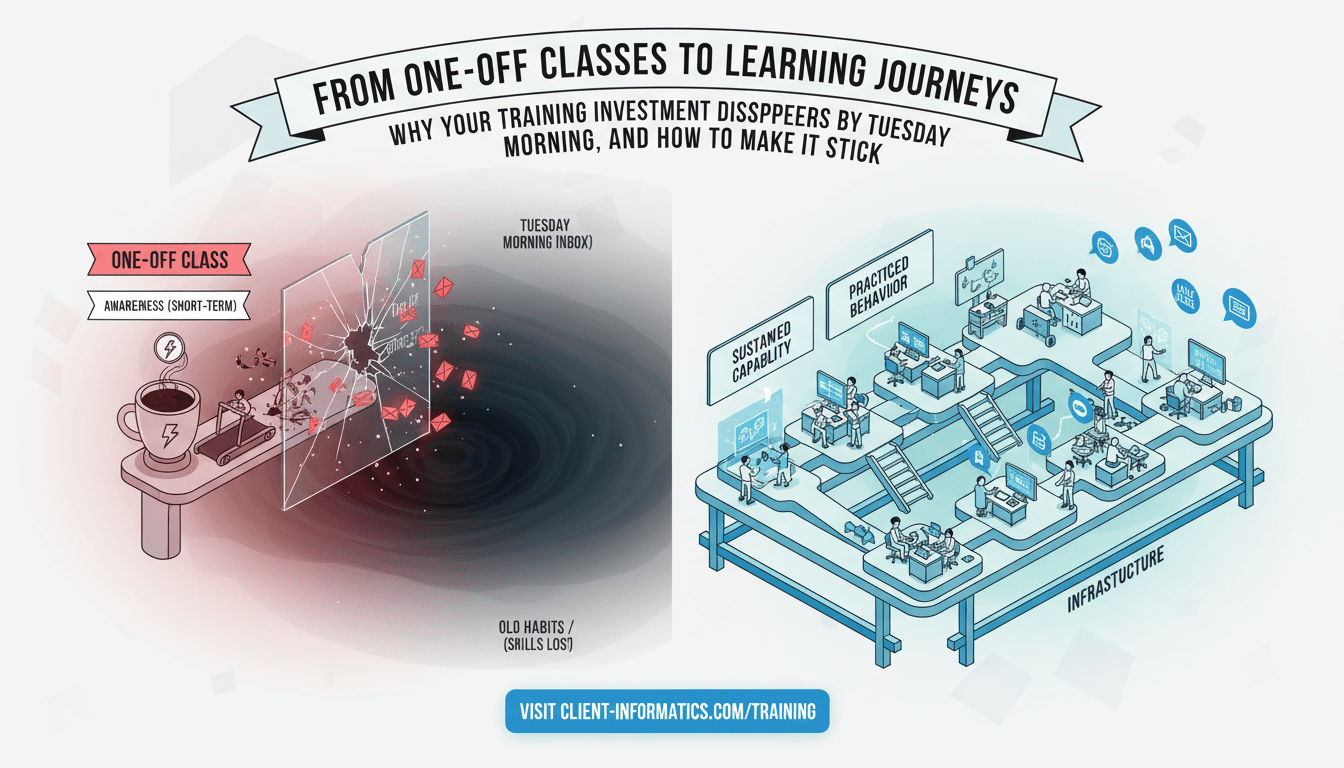
A one-off training class works a lot like a triple shot espresso on an empty stomach. For about 30 minutes after you drink it, you feel invincible. Your thinking is sharp, your energy is high, and you have total clarity about what needs to happen next. Then the caffeine metabolizes. The crash arrives. You end up more depleted than you were before you took the first sip.
That is what happens when training is delivered as a single event. It creates a burst of awareness, a temporary spike of enthusiasm and recognition that a better approach exists. But awareness is not capability. Knowing that a particular hammer exists does not mean you can build a house with it. Organizations routinely confuse these two things. They see strong post-session feedback, employees saying they loved the content and found it relevant, and they interpret that enthusiasm as proof that the training worked. It is a comfortable assumption, and it is almost always wrong.
Sustained capability is something entirely different. It means being able to execute a skill consistently under real conditions, when the inbox is overflowing, when the deadline is tomorrow, when three people need something from you at once. Capability requires that knowledge survive contact with pressure. It demands repeated application in messy, imperfect circumstances until the new behavior becomes reflexive rather than deliberate. A burst of awareness cannot produce that. Awareness lives in short-term memory. Capability lives in practiced behavior.
Why Getting Busy Erases Everything
The pattern that follows nearly every training event is predictable and well documented. People leave the session. They get busy. They fall back into old habits. That three-part sequence is a remarkably precise diagnosis of what goes wrong, and understanding the mechanics behind it is essential if you want to design something better.
When your employees leave the training room, they are stepping out of a protected environment. In that room, there were no angry clients, no looming quarterly targets, no Slack notifications pulling their attention in five directions at once. Their brains had the luxury of engaging deeply with new ideas. The moment they return to their desks, that luxury disappears.
Getting busy is not just a scheduling problem. It is a cognitive one. Stress consumes the same mental resources that learning requires. When the brain is overwhelmed by task volume, its executive function, the part responsible for consciously applying new frameworks and unfamiliar processes, gets bypassed. The brain shifts to autopilot. It hands control to the basal ganglia, the region where established habits live, because executing an old habit requires almost no active energy. You do not have to think about it. Even when the old habit is inefficient, even when you know a better way exists, the familiar path wins under pressure. Every time.
Think of it like navigating a new city. The training class hands you a map. You study it in a quiet room and memorize the main routes. You feel confident. But the next morning, you are late for work and traffic is heavy. Are you going to pull over, unfold the map, and trace a better route you have never driven? Of course not. You are going to take the street you already know, the one you have driven a hundred times, because you are stressed and it is familiar. The new route gets ignored, not because it was bad, but because you have not driven it enough for it to feel automatic.
That is the structural flaw of every one-off training class. It hands your people a map and then drops them into rush hour traffic alone, expecting them to navigate a route they have never practiced under real conditions. The map was fine. The problem was the absence of a guided first drive.
The Shift to Learning Journeys
The alternative is not more training. It is a fundamentally different architecture for how training is delivered. A learning journey builds skills over time through three connected phases. First, you introduce the concepts. Then you reinforce them. Then you tie them directly back to real work.
The first two phases are intuitive and most organizations already attempt some version of them. You hold an initial workshop. Maybe you follow up with a refresher or a quiz. But it is the third phase, tying the learning back to real work, that changes everything, and it is the phase that nearly everyone skips.
The natural objection is immediate and understandable. If your people are already drowning in urgent tasks, asking them to simultaneously practice a new, unfamiliar skill sounds like a recipe for missed deadlines and frustrated teams. In the traditional model, that objection was completely valid, because the real work and the learning were treated as two separate activities competing for the same limited hours.
The learning journey inverts that relationship. Instead of pulling employees away from their work to practice, it makes the work itself the practice environment. Consider a sales team learning a new client management system. Under the old model, they attend a Friday workshop, and by Monday they have abandoned the new tool for their familiar spreadsheets. Under a learning journey, the workshop still happens, and reinforcement follows. But the critical difference is what comes next. A manager tells the team that for their next three client calls, they will log the activity in the new system. The manager sits alongside, helping them navigate the interface during live conversations.
Nobody is left alone to figure out the map in rush hour traffic. The practice is woven into the deliverable. The expectation of speed is temporarily adjusted because the friction itself is the learning. When a team member clicks the wrong button mid-call, that moment of struggle is not a failure. It is the exact mechanism through which the new skill gets encoded into long-term memory. The discomfort is not a sign that the training is failing. It is a sign that the training is working.
Turning Stress into Curriculum
This approach does something remarkably counterintuitive. It takes the very thing that normally kills training, the stress and busyness of daily work, and repurposes it as the adhesive that makes the new skill stick. Instead of the employee concluding that they are too busy to practice, the structure dictates that being busy is how they practice.
There is no longer a choice between doing the job and learning the new skill. Learning the new skill becomes the method for doing the job. The capability is integrated into the environment that used to threaten it. The Tuesday morning inbox, which used to be the place where training went to die, becomes the place where training comes to life.
The ultimate goal is not just skill acquisition. It is lasting behavior change. That phrase carries real weight. It means more than passing an annual compliance test or memorizing a set of procedures. Behavior change means altering how a person instinctively responds to pressure. It means building a new habit so thoroughly that when stress reaches its peak, the new method is the one the brain reaches for automatically. You are not just teaching a concept. You are rewriting defaults.
This is why the multi-step structure of a learning journey matters so much. You cannot lecture someone out of a deeply embedded habit. Repetition under real conditions is the only mechanism that rewires automatic behavior. Every time your team member uses the new tool during an actual client interaction, the neural pathway for that behavior gets a little stronger. Every time the old spreadsheet stays closed, the old pathway gets a little weaker. Over weeks and months, the new route becomes the familiar one, and the old habit quietly atrophies.
What This Means for Your Organization
If your training investments keep evaporating by Tuesday morning, the problem is not your people and it is not the content. The problem is the container. A single event cannot overcome the cognitive forces that push every employee back toward their existing habits the moment real pressure arrives.
The organizations that get lasting value from their training budgets are the ones that have stopped treating learning as an event and started treating it as infrastructure. They build journeys that introduce, reinforce, and integrate, connecting every new concept to the daily work that their teams are already doing. They respect the biological reality of how humans adapt under stress, and they design their programs accordingly. Not through wishful thinking, but through deliberate structural choices about how new skills meet the reality of a workday.
The difference between organizations that get this right and those that do not is rarely about budget or talent. It is about whether the training was designed to survive the Tuesday morning inbox or simply to impress the people sitting in the Friday afternoon conference room.
Making that shift requires more than good intentions. It requires a deliberate redesign of how training connects to daily execution, from the initial needs assessment through to the weeks and months of on-the-job reinforcement that turn awareness into automatic capability. If you are ready to stop watching your training investments disappear and start building learning journeys that produce real, measurable behavior change, a conversation is a good place to start.