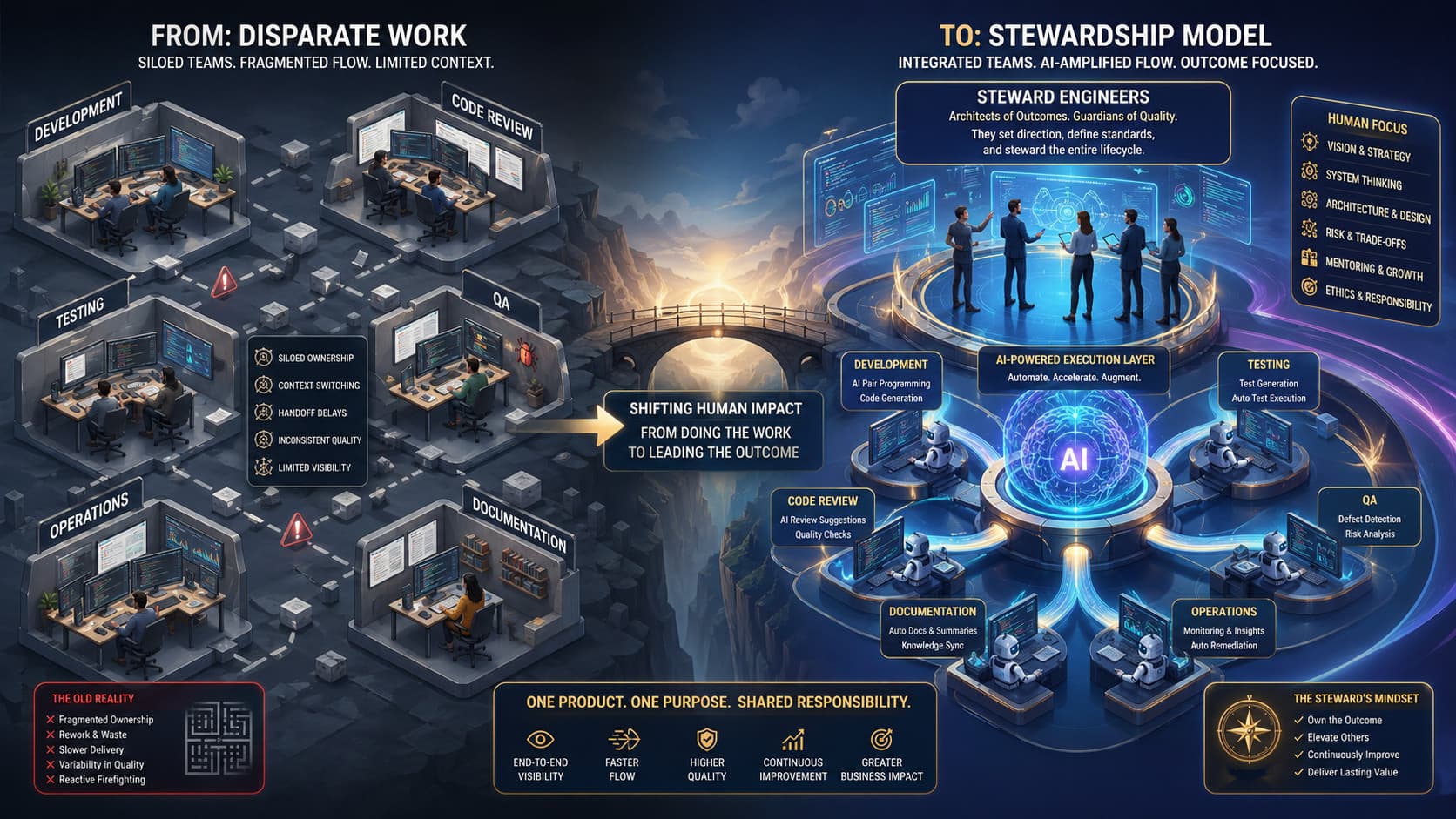
Picture a familiar product meeting. A team is deciding what a new feature should do, how it should appear to users, how admins should configure it, how the data should move, what edge cases matter, what security issues could break trust, and what training users will need before rollout. In the old model, that discussion usually fed a chain of handoffs. Product clarified the need. Design mapped the experience. Engineering implemented it. QA verified it. Training appeared near the end, once the system was already real enough to teach. That sequence made sense when the build itself was the bottleneck.
It makes less sense when the build can begin almost immediately.
AI has not merely added acceleration to software development. It has changed the logic of the process. When a system can generate implementation quickly, the scarce resource is no longer syntax. It is coherent direction. The work that matters most moves forward in the timeline and upward in abstraction. Someone still has to decide what should exist, what constraints matter, what good looks like, and how the result will actually be adopted once it ships.
That is why the shift from builder to steward matters. Software work is moving away from manual implementation as the primary marker of value and toward specification, evaluation, and operational judgment. The change is not cosmetic. It alters how teams are organized, how careers progress, and how value is created inside technical organizations.
The Self Referential Loop
The clearest sign of this transition is not a benchmark or a marketing slogan. It is the fact that AI systems are now participating in the creation of the very systems that produce software.
Anthropic has said that about 90% of the code in Claude Code is written by Claude itself, while company-wide figures were reported in the roughly 70% to 90% range depending on team and task. Boris Cherny, who leads Claude Code, has said that all of his own production code has been AI-written for months and that his time is now spent reviewing for safety and correctness and deciding what should be built next. OpenAI has likewise described GPT-5.3-Codex as instrumental in its own development, including analyzing logs, flagging failures, and suggesting fixes to build and training workflows, and OpenAI said the model runs 25% faster for Codex users.
That is more than a productivity upgrade. It is recursion. The software stack is beginning to refine itself from inside the loop rather than only through direct human implementation. Once a model can inspect failures, propose corrections, and assist in the improvement of its own tooling, the old distinction between tool and participant starts to blur.
The human role does not disappear in that loop. It changes altitude. Humans move away from line by line creation and toward higher-order decisions about requirements, standards, trust, and acceptable risk. In practical terms, the person who matters most is less often the person who can produce code the fastest and more often the person who can define what the system is trying to achieve and detect when the output only looks correct.
The implementation layer is being automated first, and that shifts human value toward guidance, verification, and intent.
The New Professional Mandate
That shift becomes concrete in the experience of people closest to the tools. Boris Cherny’s case is a clear signal, the engineer who built one of the most prominent AI coding systems is no longer spending his time typing syntax. That detail is striking not because it sounds futuristic, but because it reveals that one of the most technically credible people in the room is no longer spending his time typing syntax.
The work has not vanished. It has moved. If the engineer behind one of the most prominent AI coding systems is spending more time on specification, review, safety, and prioritization than on manual implementation, then those activities are no longer secondary to the profession. They are the profession.
This changes what strong technical contribution looks like. Architecture matters more because someone still has to define the shape of the system before the model fills it in. Product thinking matters more because the system can generate many possible implementations, but it cannot determine on its own which one deserves to exist. Quality control matters more because AI generated code can be fluent and fast while still being wrong in ways that are subtle, expensive, or unsafe.
In the older model, competence often revealed itself through visible output. A person wrote code, fixed bugs, improved performance, and gradually earned trust through execution. In the new model, output can be generated faster than it can be understood. That means competence is measured less by typing speed and more by the ability to define standards, supervise generated work, and catch failures that a model will not flag for itself.
This does not reduce the importance of technical depth. It raises the premium on a different form of depth. The strongest contributors are the ones who can reason across architecture, product intent, security, and failure modes at the same time. They are not replacing engineering with softer skills. They are relocating engineering around judgment.
The Economics of Better Effort Allocation
The efficiency story around GPT-5.3-Codex is easy to flatten into a headline. A common shorthand says the model uses about 93% fewer tokens on simpler tasks. That shorthand is rooted in OpenAI documentation for GPT-5-Codex, where the bottom 10% of employee turns, sorted by model generated tokens, used 93.7% fewer generated tokens than GPT-5, while harder turns consumed more effort because the model reasoned, edited, tested, and iterated longer. OpenAI's newer GPT-5.3-Codex announcement makes the broader claim that the model achieves state of the art benchmark performance while using fewer tokens than prior models and running 25% faster for Codex users.
What matters is not the percentage by itself. What matters is what the percentage implies about model behavior. The model is getting better at judging how much effort a task deserves.
Software work is uneven by nature. A file lookup, a narrow refactor, or a simple cleanup should not trigger the same degree of reasoning as a multi file debugging session or a difficult architecture change. If a model can remain lightweight on simple work and become more deliberate on hard work, then the economic gain is not just speed. It is calibrated effort.
That makes the value proposition more credible than the usual hype. Firms are not buying a universally cheap assistant that saves the same amount in every scenario. They are buying a system that can reduce friction on routine work without pretending that complexity has disappeared. In simple cases, the model stays lean. In difficult cases, it may inspect more files, call more tools, run more tests, and consume more resources because the task requires it.
This distinction matters operationally. The real savings come from removing unnecessary effort on easy work and redirecting human attention toward hard work. That is why the model begins to feel less like autocomplete and more like an adaptive operator inside the workflow.
It also changes team design. Routine implementation can move lower into the machine layer, while review, debugging judgment, exception handling, and prioritization move higher into the human layer. Teams that organize around that reality will have a throughput advantage over teams that still assume all work should flow through the same human heavy path. That is the bridge from tool efficiency to organizational redesign.
What Stewardship Actually Looks Like
Stewardship is not just a posture. It is an operating discipline.
The first movement happens before the build. Before an AI system writes anything useful, someone has to define the requirements, features, capabilities, user surfaces, admin surfaces, data model, integration points, and the build activities across phases or across sprints. In the older model, that work was often distributed across product managers, designers, architects, and technical leaders. In the new model, those activities still exist, but they need to operate with a unified direction because the builder responds best to unified direction rather than fragmented handoffs.
That is why stewardship should be understood as a function, not necessarily a single role. On smaller builds it may sit mostly with one operator who can integrate product, technical, and adoption concerns well. On larger efforts it will more likely be a small team with distinct specialties working as an integrated unit. The important point is not title consolidation. It is accountability consolidation. The AI builder needs clear intent and consolidated feedback, which means stewardship teams cannot reproduce the disconnected handoff structures of the old model.
The second movement happens during the build through evaluation. A steward does not personally read every line of generated code. That does not scale. Instead, the steward designs and runs an evaluation loop. One AI system may review generated code, another may test features against use cases, another may validate edge conditions, and another may examine security or policy concerns. The human role is to orchestrate those systems, interpret their output, reconcile contradictions, and turn the results into structured feedback for the system that is doing the building.
This is a meaningful change in working method. The steward becomes the conductor of multiple AI systems checking one another rather than the manual reviewer trying to inspect everything directly. The evaluation loop can iterate quickly, but the standard still has to come from somewhere. The steward defines that standard and decides when the output is good enough to move forward.
The third movement begins after the build and continues through operation and adoption. Stewardship extends into security architecture, monitoring and alerting, release discipline, documentation, user feedback loops, and the improvement cycles that emerge from real usage. These are judgment heavy functions. AI can support them, but it cannot own them because someone still has to decide what signals matter, what thresholds require intervention, what is a true pattern rather than an edge case, and what changes are worth the cost.
Training belongs inside this third movement on a parallel track. From the earliest production meetings, training stays informed, contributes from its position closest to eventual users, and builds the methodology and implementation plan in step with the product itself. As the system approaches go live, training moves to the front. That placement is not procedural courtesy. It is a recognition that adoption is not an afterthought attached to release. It is part of whether the release should be considered successful at all.
Seen this way, stewardship is not vague oversight. It is the integrated function that carries a system from definition through evaluation to operation and adoption.
The Workforce Shift
The labor market consequence of all this is not simple replacement. It is a redefinition of what counts as valuable contribution and of where in the process that contribution sits.
The most exposed workers are those whose role was built around execution as the primary source of value. That is not a criticism of their skill. It is a structural observation. If implementation becomes easier to generate, easier to revise, and cheaper to scale, then manual execution becomes less scarce and less central to how value is measured.
What rises in its place is harder to acquire quickly. Orchestration, systems thinking, governance, evaluation design, and alignment with business goals move closer to the center. Those capabilities have always mattered, but many people historically developed them after years of implementation work. They learned systems by building them, breaking them, maintaining them, and seeing what failed under pressure.
That is where the structural mismatch emerges. The apprenticeship path is being compressed while people are still on it. A junior engineer used to prove value through a progression of implementation tasks that gradually built intuition. A QA professional could learn product behavior through repetitive validation work. A trainer could enter later, once the product stabilized enough to teach. AI now absorbs parts of that developmental ladder before many workers have had enough time on it.
The result is not that opportunity collapses into a single elite steward role. Stewardship, understood correctly, creates multiple positions inside a function rather than one winner take all title. Product definition, evaluation orchestration, operational oversight, security review, documentation, and adoption support all remain meaningful work. But the shape of opportunity changes. The old linear path from syntax to seniority becomes less reliable, and workers across engineering, QA, support, and learning functions are pulled closer to judgment heavy work earlier than before.
This is especially difficult for entry level talent. Code generation makes it easier to produce output quickly, but output alone is becoming a weaker signal of competence. A beginner can generate code faster than ever and still not know whether it is secure, maintainable, or appropriate for the system around it. That pushes firms to reward people who can supervise AI output, not just invoke it.
The development path that produced engineers, QA professionals, and trainers under the old model was built around a clear assumption: implementation experience came first and judgment followed. That assumption no longer holds. The path itself needs to be redesigned around the work that now defines competence, including orchestration, framework design, signal interpretation, and stewardship team dynamics. Structure and syntax remain essential, particularly in security, monitoring, and alerting, but they are part of a broader curriculum rather than its foundation.
The harder problem is the cohort caught in the middle. Senior professionals already carry the depth to operate in the new model, and the next generation will enter a learning path designed for it. The people most exposed are those partway through the old path. They have built real capability in execution, but they have not yet accumulated the upper layer experience that the new model rewards. Their ladder is being rebuilt while they are still climbing it. That is where the real tension lies, and it is not a problem any individual or employer can solve alone.
Professional compression is the right way to think about this. The field does not disappear. But the route through it becomes less linear, less forgiving, and more dependent on a person's ability to operate inside a stewardship model rather than an execution only model.
Training as the Adoption Layer
A product that ships quickly and lands badly is not a success. It is a faster way to create confusion.
The faster software gets built, the easier it becomes for the gap between system capability and user capability to widen. New features can arrive before people understand the old ones. New interfaces can appear before workflows are absorbed. New automation can be technically impressive and still go underused because the people expected to rely on it were never brought along.
That is why training has to move upstream. It cannot remain a downstream service that activates near launch and explains decisions made elsewhere. In a stewardship model, training is part of how the product is defined, observed, and improved. It brings signals from the people closest to real use. It catches where terminology is unclear, where workflows conflict with habits, where support load is likely to spike, and where system capability will outrun human readiness.
The redefinition underway is not limited to engineers. Learning and development professionals are being repositioned too. In the older model, training often entered after construction. In the new model, training becomes a coequal part of adoption whose absence can turn a successful build into expensive shelf ware. That is a different theory of value, not a minor procedural adjustment.
A steward who treats training as a launch task is still thinking like a builder. A steward who understands that adoption is the metric that matters is working in the new model.
Embracing the Role of Steward
Software is entering a period in which human value is defined less by manual production and more by the ability to set direction, run evaluation loops, manage operational risk, and ensure that what ships is actually usable.
The practical question is where each role sits on that spectrum. For individual contributors, the move is to deliberately take on work in the upper layers, even on smaller projects, to start building stewardship judgment rather than waiting for a title change to make it official. For leaders, the move is to ask honestly whether the team structure still reflects the old handoff model or whether it is organized around the integrated stewardship function the new model requires. For both the underlying shift is the same, stop optimizing for output volume and start optimizing for the quality of direction and the reliability of evaluation.
The builders who adapt to that will do well. The stewards who understand that adoption is the real test will matter even more.