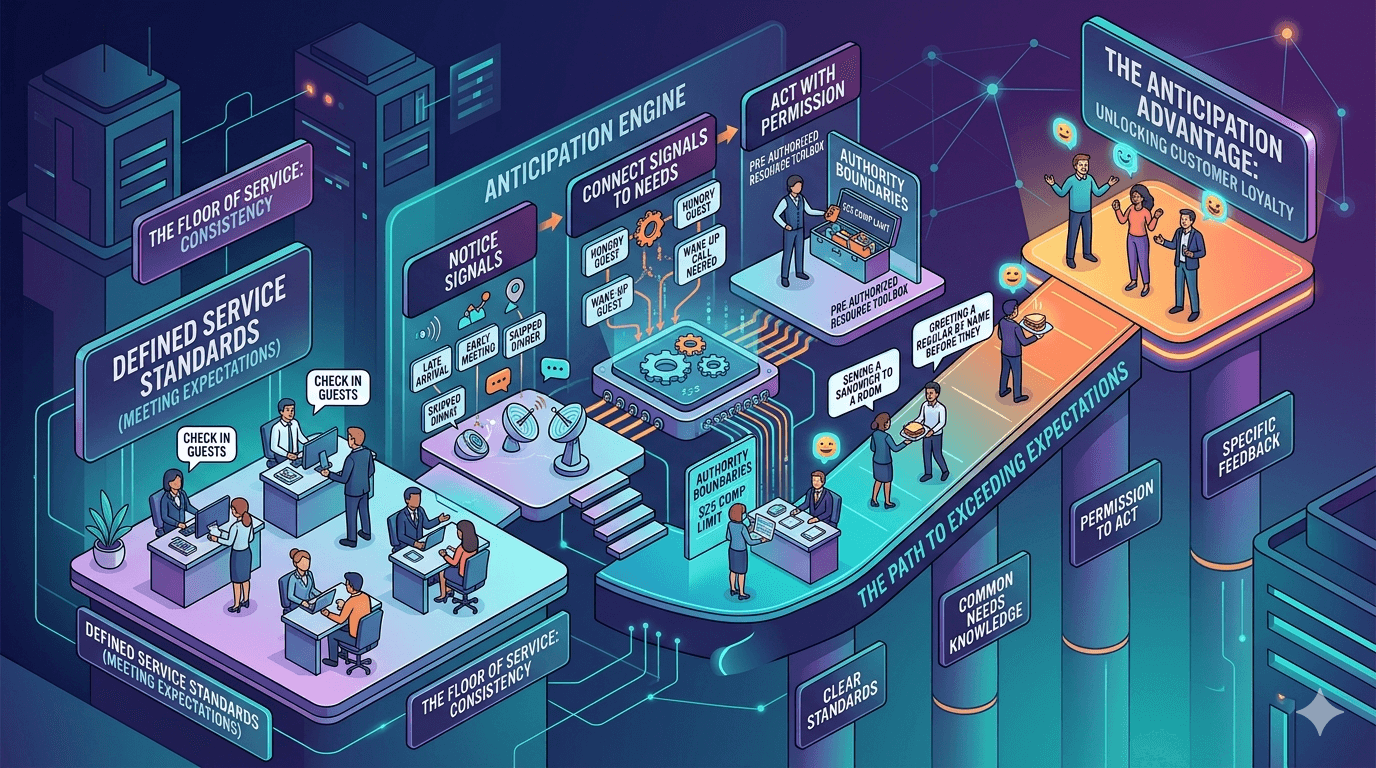
A guest checks into a hotel at 11 p.m. after a delayed flight. She mentions, almost in passing, that she has an early meeting and skipped dinner. The front desk agent could check her in, hand over a keycard, and wish her a good night. Instead, he tells her the kitchen closed at ten but he can have a sandwich and fruit sent up in fifteen minutes, and he sets a 6 a.m. wake-up call before she asks. She did not request either thing. She got both because someone listened to what she said and acted on what she meant.
That agent met no formal standard. No checklist required a late-night sandwich. He read the situation, predicted what she would need next, and moved before the need became a complaint. That is the gap between meeting expectations and exceeding them, and most service operations never close it.
The standard most teams stop at
Meeting expectations is a defined target. The customer wants a clean room, a correct order, a problem resolved without three transfers. Hit those marks and you have a satisfied customer. Satisfied customers leave neutral reviews and switch to a competitor the moment that competitor is cheaper or closer.
Exceeding expectations means doing something the customer did not ask for and did not expect. It requires reading a situation, predicting a need, and acting before the request arrives. This is harder to specify, harder to train, and harder to measure. So most organizations write detailed standards for the floor of service and leave the ceiling undefined. Staff learn exactly what they must do and almost nothing about what they could do.
The result is consistency without distinction. Every interaction lands at the standard and stops. Nothing goes wrong, and nothing stands out either.
Why anticipation is a trained skill, not a personality trait
The common excuse is that some people are naturally attentive and others are not, so you hire for it and hope. That explanation is wrong, and it lets training departments off the hook.
Anticipation breaks down into observable parts. First, the staff member has to notice a signal: a comment, a tone, a piece of context like the late flight or the early meeting. Second, they have to connect that signal to a likely need. Third, they have to know they are allowed to act, and they have to know what action is available. A new hire fails at every step not because they lack empathy but because nobody taught them what to listen for, what those signals usually mean, or what they have permission to do about it.
Consider the difference between two coffee shop baristas. One sees a regular order a large coffee every morning at 7:15 and rings it up. The other notices the same regular came in at 6:45 looking rushed, starts the order on sight, and has it ready before the customer reaches the register. The second barista is not kinder. She has pattern recognition that someone built through repetition, feedback, and explicit instruction to watch for the customer who is in a hurry.
You can train all three components. You teach signal recognition by cataloging the cues that actually matter in your environment. You teach the signal-to-need connection by walking through real examples until the link becomes automatic. You teach permission by setting clear boundaries on what staff can offer without escalating. None of this depends on hiring saints.
The components of a service team that anticipates
A team that consistently exceeds expectations runs on four things, and all four have to be present. Drop one and the whole thing reverts to the standard.
Clear standards come first, because you cannot exceed a target you have not defined. Staff need to know the floor cold so they have attention left over for the customer instead of spending it on remembering procedure. Anticipation is what happens once the basics are automatic.
Specific knowledge of common needs comes second. A hotel team should know that a late arrival often means a missed meal, that a guest with a wedding party will need early breakfast, that a business traveler values fast checkout over a friendly chat. This is not intuition. It is a documented set of patterns that experienced staff already carry in their heads and that training should pull out and teach directly.
Permission to act comes third. The agent who sent up the sandwich could only do that because someone decided front desk staff can authorize small comps without a manager. Teams without that authority default to the standard every time, because the standard is the only thing they are certain they are allowed to do. Define the boundary, fund it, and let people use it.
Feedback that names the behavior comes fourth. When a staff member anticipates well, the organization has to notice and say so specifically. Not "great job," but "you caught that she skipped dinner and acted on it, that is exactly the read we want." Vague praise reinforces nothing. Named behavior gets repeated.
What it costs and where it breaks
This is not free, and pretending otherwise is how these programs collapse.
Giving staff permission to act means accepting that some of them will act wrong. A barista will remake a drink nobody minded. An agent will comp a sandwich for a guest who would have been fine without one. If you punish the misses, staff stop taking the risk and retreat to the standard, and your investment in training evaporates. The cost of anticipation is a tolerance for small, well-intended errors, and you have to budget for it on purpose.
There is a speed cost too. Anticipating a need takes a few extra seconds of attention per interaction. In a high-volume operation, that adds up, and someone will argue that throughput matters more. Sometimes they are right. A drive-through at peak hour is not the place to slow down for personalization, and forcing it there produces friction, not delight. Pick the touchpoints where anticipation changes the relationship and leave the pure-transaction moments alone.
The biggest failure mode is scripting it. The instant you turn anticipation into a mandatory line, "Did you have a long trip today?" delivered flat to every guest, customers hear the machinery and the effect flips. Forced personalization reads as fake faster than no personalization at all. The skill has to stay a matter of judgment, which means you train the read and trust the staff member to decide when to use it.
Start with one touchpoint and one pattern
Do not roll out an anticipation program across every role at once. Pick a single high-contact touchpoint where a missed need genuinely costs you, the front desk at check-in, the barista at the register, the support agent on a renewal call.
For that one touchpoint, document the three or four most common unspoken needs your experienced staff already handle well. Ask them. They know. Write down the signal, the likely need, and the approved action for each one. Set the spending or authority boundary in plain numbers so nobody has to guess. Then train the new people on those specific patterns, watch them try, and give named feedback on what they catch and what they miss.
Run that for one quarter, measure repeat business and direct customer comments at that touchpoint, and decide whether to expand. The hotel did not become memorable because it trained a thousand behaviors. It became memorable because one agent knew that a late arrival who skipped dinner needs a sandwich, and someone gave him permission to send it up.