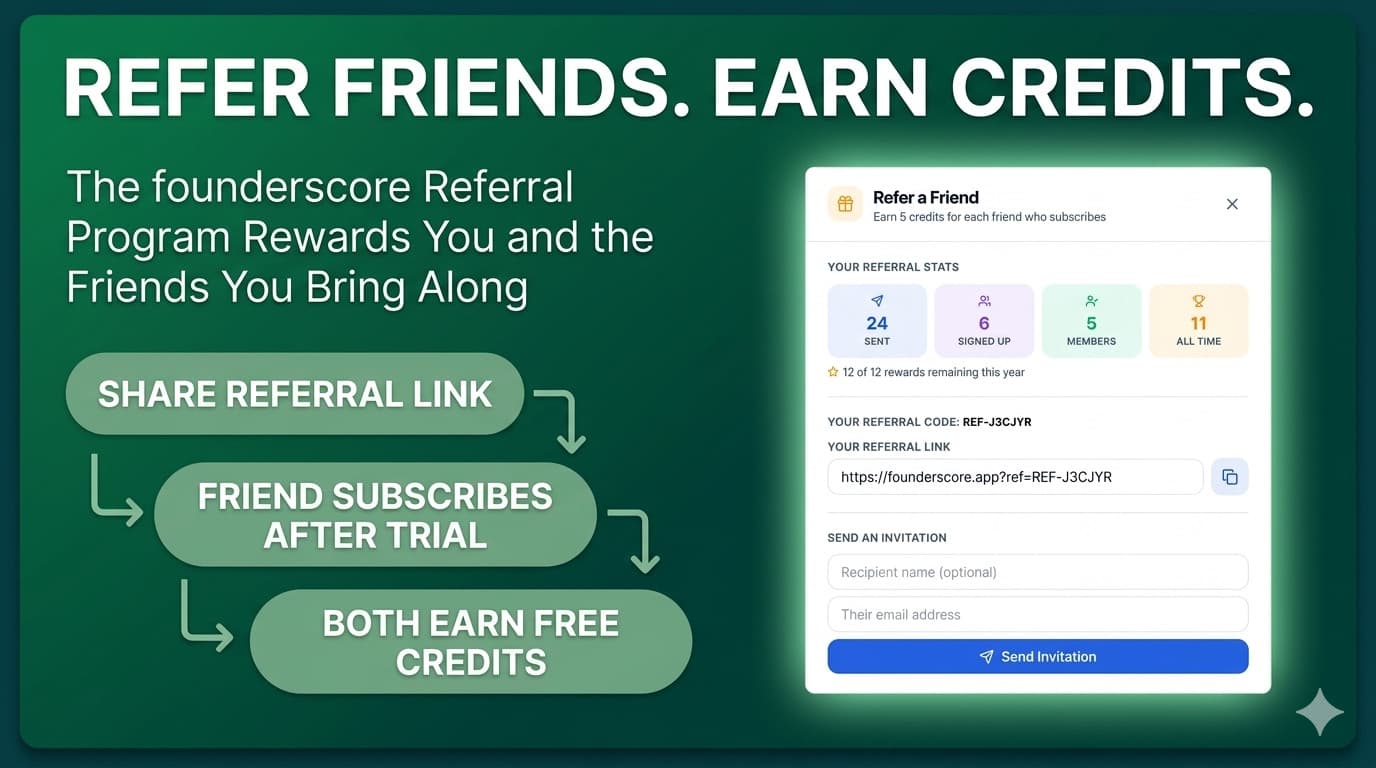
By the time you have run a few projects through founderscore, you have a clear sense of which features you rely on and how credits flow through the platform. This final article in the series covers two things that reward you for being an active member of the community: the referral program that puts free credits in your account when people you bring in subscribe, and the feature request system that gives you a direct line to influence what gets built next.
The Referral Program
The referral program is accessible from the account menu. Click the person icon in the header and look for the Send Referral option, identified by a gold gift icon. This feature is only available after your trial period ends.
Opening it reveals your unique referral code and a direct referral link. Here, the referrer can either copy their referral link to send or send the referral directly out of the system. Whether the referral was sent through the app or sent external to the system, the referral will be tracked after the referred user completes the sign up process and logs in.
What your referred friend receives
When someone signs up through your referral link converts to a paid plan after their trial, they receive:
-
15% off their first month on a monthly subscription, or 25% off their first year on an annual subscription
-
5 bonus credits deposited into their purchased credit bucket after the trial ends on their first paid invoice
The discount and bonus credits are a one-time reward tied to their first paid invoice.
What you receive
For every person you refer who completes the trial and converts to a paid plan, you receive 5 credits deposited into your purchased credit bucket. These credits never expire. They do not count against your monthly allocation and they do not reset. They accumulate as a permanent reserve you can draw on for any feature that costs credits.
The program is capped at 12 rewards per rolling 12-month period, for a maximum of 60 earned credits per year. That cap exists for a reason worth understanding: it keeps the program focused on genuine peer referrals rather than mass link sharing. Your 12 opportunities work best when they go to people who are actually building something and would get real value from the platform.
Tracking your referrals
The Send Referral modal includes a stats dashboard with four counters: Referrals Sent, Signed Up, Members, and All Time earned credits. Below the counters, a referral history list shows every person you have invited with a status badge indicating where they are in the flow: Sent, Signed Up, Converted, or Rewarded. If someone you invited has not yet completed signup, a Resend button lets you follow up without leaving the platform.
Best Practices for Referrals
The referral program rewards authenticity more than volume. A few approaches that work better than sharing a link broadly:
-
Refer the right people. The founders, makers, product managers, and career pivoters who are actively evaluating ideas or preparing to build are the ones who will get the most from founderscore and are most likely to convert. Sharing with someone who has no current project in mind rarely produces a conversion.
-
Share at the right moment. The most effective referrals happen when someone mentions a specific challenge: they have an idea they are not sure about, they are trying to figure out whether to build or buy, they are preparing to pitch and need a structured narrative. That is the moment when a referral has immediate, relevant context.
-
Be specific about what helped you. Generic enthusiasm for a tool rarely moves people. Telling someone that you ran your marketplace idea through the feasibility pipeline and the cold-start assessment surfaced a problem you had not considered, and it saved you from building the wrong thing, is a story worth listening to.
-
Do not oversell. founderscore gives an honest verdict. If you refer someone expecting to be told their idea is great and the system scores it in the 40s, that experience will not match what you promised. Set accurate expectations: the platform is rigorous, the verdicts are evidence-based, and a low score is useful information, not a failure.
Partner-Level Program
For accelerators, incubators, founder communities, and VC firms, founderscore offers a partner-level program that operates outside the standard referral mechanics. If you manage or work with a community of founders and want to discuss volume access, co-marketing arrangements, or group discount structures, reach out directly. The platform is designed to scale with communities, not just individuals.
The Feature Request and Roadmap System
Once you are an active subscriber, you have access to the feature request portal through two paths: the Roadmap link in the Help menu, or the Roadmap tab in the Help Center. Both require an active subscription. The gate is intentional: the roadmap input should come from people who are using the platform regularly and have formed genuine ideas about what might improve their experience.
Submitting recommendations
You can submit up to 3 feature recommendations per monthly billing cycle. Each submission requires a title and a description. Remember, a well-written recommendation with a clear problem statement and a specific proposed solution is far more likely to gain traction than a vague wish list item. Write it as if you are making a case to someone who needs to be convinced, because that is exactly what you are doing.
Voting
You receive 5 votes per monthly cycle to spend on other members’ recommendations. Votes reset at the start of each new cycle. You cannot vote on your own submissions.
The limit is worth sitting with. Five votes per month means you have to make real decisions about what matters most to you. The scarcity is the feature: it filters out casual upvoting and produces a signal that reflects genuine priorities across the user base. When a feature request accumulates a meaningful vote count under these constraints, it reflects real demand.
Each recommendation in the portal shows a vote count badge, the author name, a relative timestamp, and an expandable description. Status badges indicate where each item stands: Recommendations (submitted and under consideration), In Roadmap (planned for development), Completed (shipped), or Out of Scope (not being pursued).
How the system works in practice
The roadmap portal is not a guarantee that submitted features will be built. It is a structured way to surface what the community is asking for, prioritized by the people directly using the product. Features with strong vote counts and well-articulated problem statements have a clearer path to consideration than those without.
If a feature you care about is already in the portal, vote for it rather than submitting a duplicate. If it is not there, write the recommendation yourself and make the case clearly. Both actions contribute to the signal the development team uses when planning what to build next.
Closing the Loop
The referral program and the feature request system are two sides of the same coin: founderscore is more useful when more people are using it and contributing to its direction. Credits you earn through referrals extend your ability to run reports, iterate on ideas, and generate build documents. Votes you cast on feature requests shape the platform toward the capabilities you actually need.
The series started with validating an idea before building it. It ends with the same logic applied to the platform itself: the founders using it are the best source of signal for what it should become.
Ready to start your founderscore journey? A 7-day free trial is waiting with 3 credits included. No long-term commitment required. Run your first feasibility analysis, explore the sample projects, and see what an evidence-based verdict looks like for your idea.