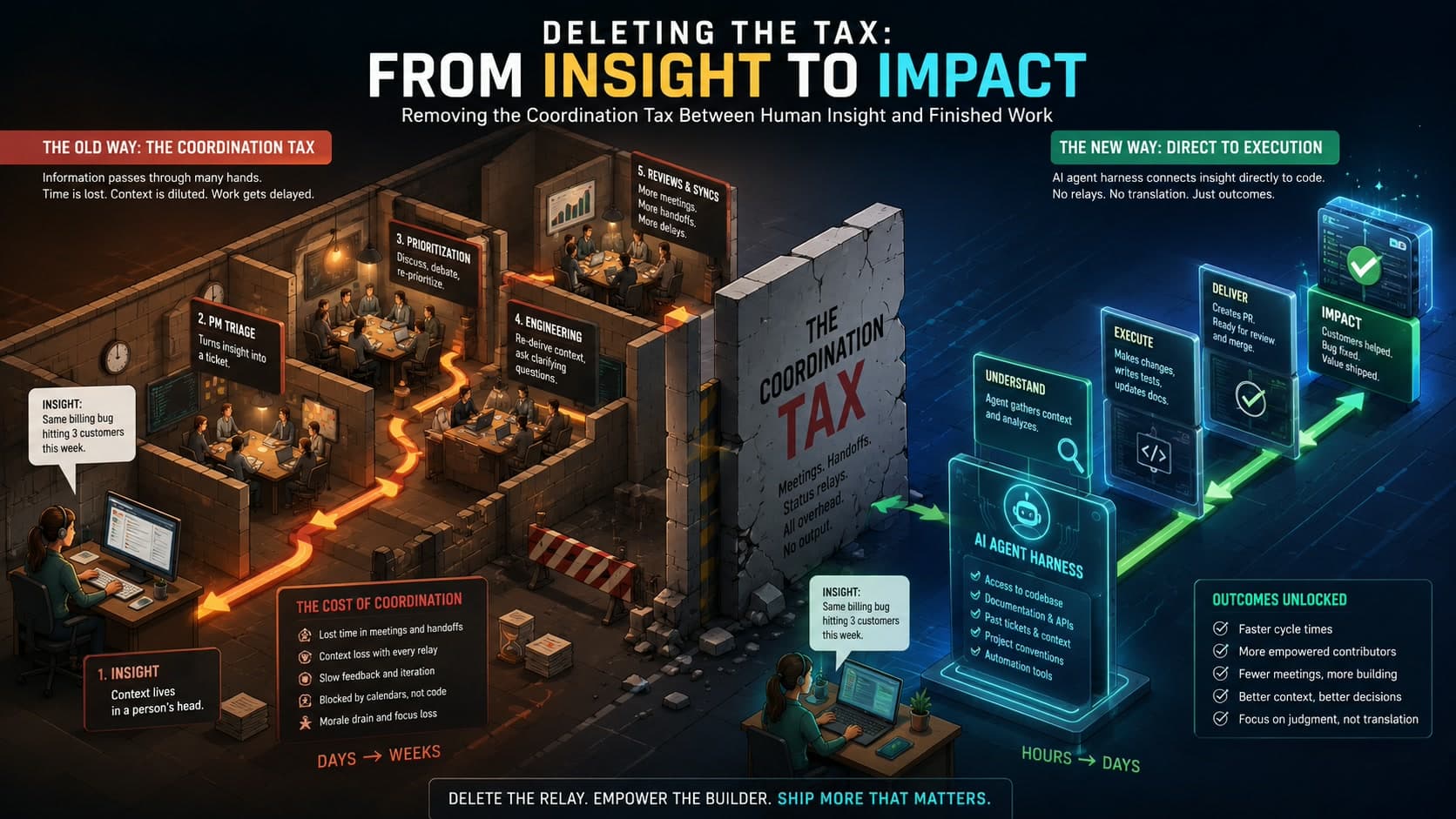
Maria runs product at a nine-person startup. Tuesday morning: standup at 9, a sync with design at 10, a 1:1 with the lead engineer at 11 to explain what design decided. By noon she still hasn't touched the actual spec. By the time an engineer writes the first line of code, the idea that started in her head on Monday has been retold four times by four different people, and it has lost a little precision at each handoff. Nobody in that chain was slacking. The meetings did exactly what they were built to do. They just weren't building the product.
The real job was never the work, it was the relay
Ask most operators what their calendar is for, and the honest answer isn't "building the product." It's syncing enough people's mental models that building the product becomes possible. A standup exists because five people don't automatically know what the other four did yesterday. A design review exists because the engineer's idea of done and the designer's idea of right live in two different heads. None of that produces the product. It produces alignment, which is a precondition for producing the product.
That's the coordination tax: the layer of meetings, tickets, handoff docs, and status updates that exists to move information between human brains that don't share context by default. It isn't laziness or bad management. It's the price of running an organization made of people who each hold a different, partial model of the system. A ten-person company pays this tax constantly. A thirty-person company pays it on nearly every decision, and the tax scales faster than headcount because every new person adds another node the information has to pass through before it reaches whoever writes the code.
Picture a thirty-person company shipping a single pricing change. Sales needs to weigh in on how it affects existing contracts. Support needs a heads up before customers start asking questions. Engineering needs the number changed in three places across the codebase. Finance needs to sign off on the revenue model. That's four meetings, or four Slack threads doing a meeting's job, before a single line of code changes. Every one of those conversations exists to point four private mental models at the same fact. None of them touch the code.
What an agent harness removes
An AI agent harness, Claude Code, Cursor's agent mode, or anything built on the same pattern, collapses the relay. Give it access to the codebase, the docs, and enough context to act, and the person who has the insight can hand it directly to the system that produces the output. No translator required in between.
Take Maria's support engineer instead of Maria. She notices the same billing bug three customers hit this week. In the old model, she files a ticket, a PM triages it next sprint, an engineer picks it up two weeks later and re-derives the context she already had. In the new model, she opens Claude Code with repo access, describes the pattern she's seeing, and gets a working patch and a pull request before lunch. She didn't relay the insight. She executed it.
The mechanism that makes this work is context, not intelligence. An agent with a CLAUDE.md file, API documentation, and read access to the last quarter's tickets knows more about a codebase's actual conventions than a new hire does after two weeks of onboarding. That context used to live in senior engineers' heads, and getting it out of their heads and into someone else's was the entire point of onboarding docs, pairing sessions, and architecture reviews. Write it down once for the agent, and everyone with access to that agent inherits the same context instantly, instead of waiting for a human to transfer it one conversation at a time.
That changes what roles exist for. Project managers spent their day converting vague requests into structured tickets. Tech leads reformatted requirements so juniors could follow them. Managers relayed status upward and not much else. All of that was translation work, and when the translation step disappears, so does the reason those roles were built that way. What's left is judgment: deciding what's worth building, checking whether the output is correct, setting direction when two good options conflict. The organization doesn't get smaller so much as it gets flatter around whoever holds context and judgment, instead of whoever was best at carrying messages between people.
What you give up when you delete a handoff
None of this is free, and the costs are specific, not abstract.
You lose forced review points. When an insight goes straight from a support engineer's head to a merged pull request, you also delete the moment where a second person would have caught a bad assumption before it shipped. Fewer eyes see the work before it's live.
You expose skill mismatch. A vague PM ticket used to get cleaned up by an engineer who knew how to ask the right clarifying questions. An agent doesn't clean up a vague prompt the same way. The organization now depends on individual clarity of thought, not on a translator absorbing someone else's fuzziness before it reaches production.
You don't remove coordination that was never about syncing understanding in the first place. Two teams sharing a database schema still have to negotiate who owns what, and so does a compliance sign-off on a regulated workflow, or an architecture decision that touches five downstream services. None of that goes away because it isn't a relay problem. It's a conflicting-ownership problem, and conflicting ownership still needs humans to negotiate it.
You can also create a new bottleneck if you're not careful. Move review responsibility onto two senior engineers without changing anything else, and they become the choke point the old relay used to spread across five people. Deleting the tax only works if the people left holding judgment have the bandwidth to exercise it.
And you strand people whose value was built entirely on being the relay. A manager whose job was reformatting requirements for a team that no longer needs reformatting has to move up into judgment work or become the bottleneck the process was designed to eliminate.
Where to cut first
Pull your calendar from the last two weeks and sort every recurring meeting into one of two piles: decisions, where multiple people's authority has to weigh in before something moves forward, and syncs, where the only purpose is making sure everyone has the same information. The sync pile is the coordination tax. That's what gets deleted first.
For each sync meeting, give the person who currently reports information direct access to the system that acts on it, along with the same context bundle that used to require the meeting to explain: the docs, the codebase, the customer data. If your support team currently escalates bug reports through a ticket queue, give a senior support engineer an agent harness with repo access and let the pattern-to-patch loop happen directly.
Run this as a two-week trial before making it permanent. Track one number: time from someone noticing a problem to a fix landing in production. If that number drops without a corresponding spike in reverted changes or customer-facing bugs, the meeting you deleted was pure tax. If bugs start slipping through, you cut too close to a decision point and need to add a review gate back, not restore the whole meeting.
Keep a review gate, but narrow it. Don't gate everything, gate production-critical changes and anything that crosses team boundaries. That's a small fraction of total output, and it's the fraction where a second set of eyes earns its cost.
Move the people who used to run the deleted meetings into that review layer, or into the judgment calls that are still genuinely hard: prioritization, tradeoff decisions, conflicting requirements between teams. If a role disappears entirely once you remove the meeting it was built around, that role was never doing the work. It was doing the relay, and you just deleted the relay.
The nine-person startup that gives its senior support engineer direct access to Claude Code and the production codebase isn't skipping a step by accident. It found out that the four-person relay from Monday's idea to Tuesday's code was never adding information, only delay. Cut the relay, then build the org chart around whoever is left holding the judgment.