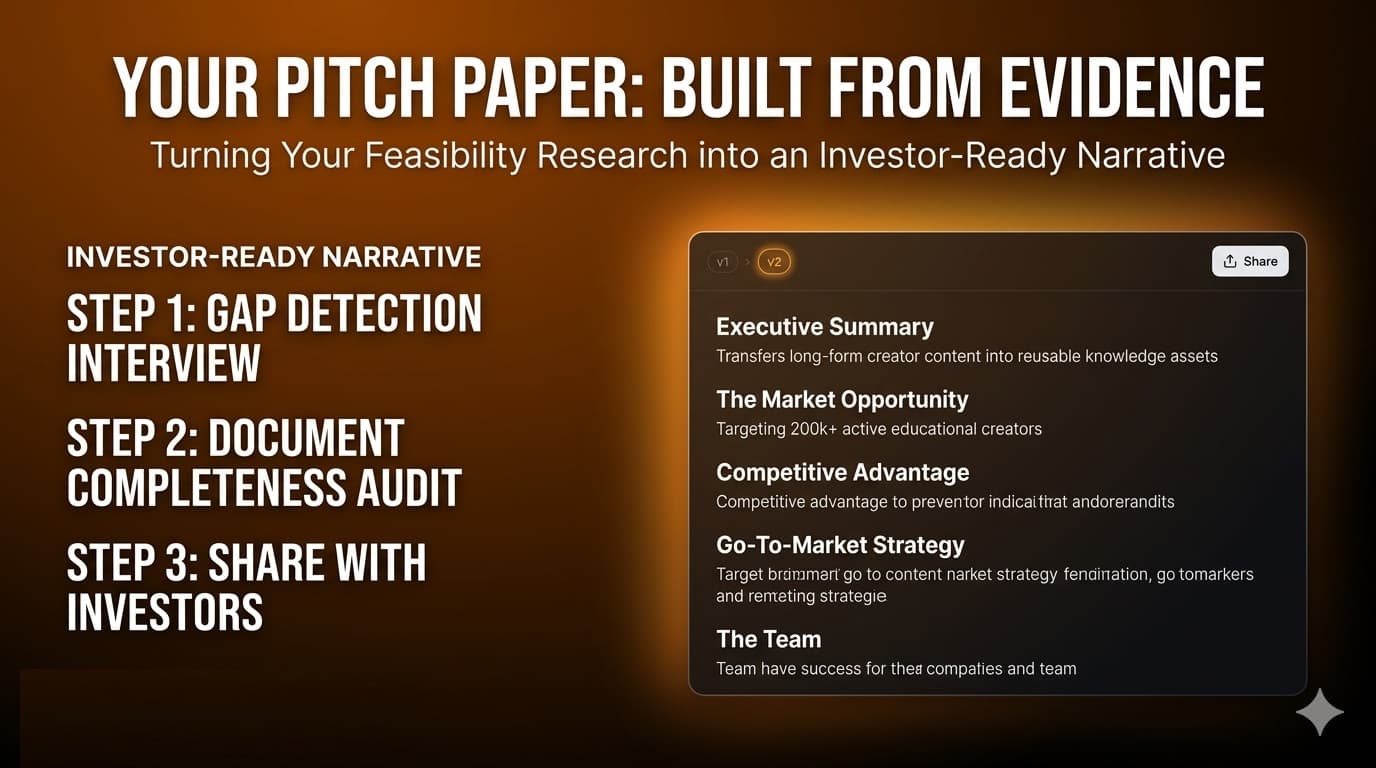
You have validated your idea. You iterated on the Feasibility Report until it achieved a level where you are now confident to move on to the next step. You know the market exists, the timing is right, and you have a credible path to build it. Now you need capital to make it happen.
This is where many founders freeze. Having data that proves your idea works is one thing. Translating that data into a narrative that moves an investor to write a check requires a completely different vocabulary.
The founderscore Pitch Paper is designed to bridge that gap.
This Feature Is Not for Everyone
Before going further, the positioning matters. The Pitch Paper is an entirely optional feature. If you are bootstrapping, still validating your core concept, or simply not pursuing external investment, you can skip it entirely. It exists specifically for founders seeking financial backing from angels, VCs, or strategic investors.
The platform enforces this sequencing: a completed Feasibility Report must exist before the Pitch Paper can be generated. That constraint is intentional. The Feasibility Report is your foundation. The Pitch Paper builds on top of it.
Think of the difference this way. The Feasibility Report takes a flashlight to your idea and tells you whether the foundation is sound. The Pitch Paper is the narrative that makes an investor want to fund the build. Different audience, different purpose, different vocabulary.
Investors do not buy blueprints. They buy future returns. The Pitch Paper must answer the harder questions: will this generate significantly more than it consumes, and are you the right person to execute it?
The Gap Detection Protocol
Before the interview begins, the system runs a silent audit of your Feasibility Report against a 14-item Gap Detection Protocol. This is the checklist that venture capital due diligence is built around. The AI reads your report and identifies which of these items are present, which are partial, and which are missing entirely:
-
Founder and team background and domain credibility
-
“Why now” — a specific timing driver or market unlock
-
Primary GTM channel and customer acquisition strategy
-
Capital requirement and current funding stage
-
TAM with a credible source
-
Revenue model clarity: pricing, tiers, unit economics
-
Named design partners, LOIs, or early users
-
Competitive moat — what makes this hard to copy
-
Regulatory or compliance exposure
-
Technology dependencies or build risk specifics
-
Geographic launch scope and expansion plan
-
Team size and key hires needed to ship MVP
-
Runway and timeline to first revenue
-
Founder’s personal motivation or stake in the problem
Rather than presenting you with all 14 gaps at once, the system ranks them by potential investor impact and surfaces only the three to five highest-priority holes specific to your report. This triage is what makes the interview focused rather than exhausting.
The Interview
The Pitch Paper interview runs up to 10 questions, compared to 20 for the Feasibility Report. Each question addresses one specific gap. One follow-up per answer is allowed to deepen the signal. The interview ends when the AI has gathered sufficient information or reaches question 10.
If you answer “I don’t know” on a question, the system does not leave a blank that works against the document. It generates two or three concrete, project-specific options to choose from based on the context of your idea. For a B2B tool targeting a specific industry, it might suggest direct outbound, channel partnerships, or community-led growth. You choose one and the interview continues.
When the interview ends, the transcript is synthesized into a structured addendum and presented on a review screen. You can edit it before approving. Approving appends the addendum to your project description and starts generation. Skipping starts generation with what you already have.
The Generation Pipeline
Generation runs a multi-phase extraction and writing pipeline. Parallel extraction agents each focus on a distinct dimension of your pitch: the problem and market signal, the competitive landscape, the business model and go-to-market, and the risk and execution profile. Each agent reads your project description, the latest Feasibility Report, and interview transcript through its own lens, pulling the relevant evidence for its section.
The extracted material feeds into a compilation stage that produces a standardized document structure. That structure is not arbitrary. When an analyst at a venture firm is reviewing their fiftieth pitch of the week, they need to know exactly where to find your customer acquisition strategy and your unit economics. Standardized formatting means their cognitive load is spent evaluating the quality of your business case, not hunting for the numbers.
The output is an unnumbered Executive Summary followed by 10 sections:
-
The Problem
-
The Market Opportunity
-
Your Solution
-
Your Go-to-Market
-
Business Model and Unit Economics
-
Competitive Advantage
-
The Team and Execution
-
Use of Capital
-
Traction and Validation
-
Vision and Long-Term
Generating the founderscore Pitch Paper costs one credit.
## The Document Completeness Audit
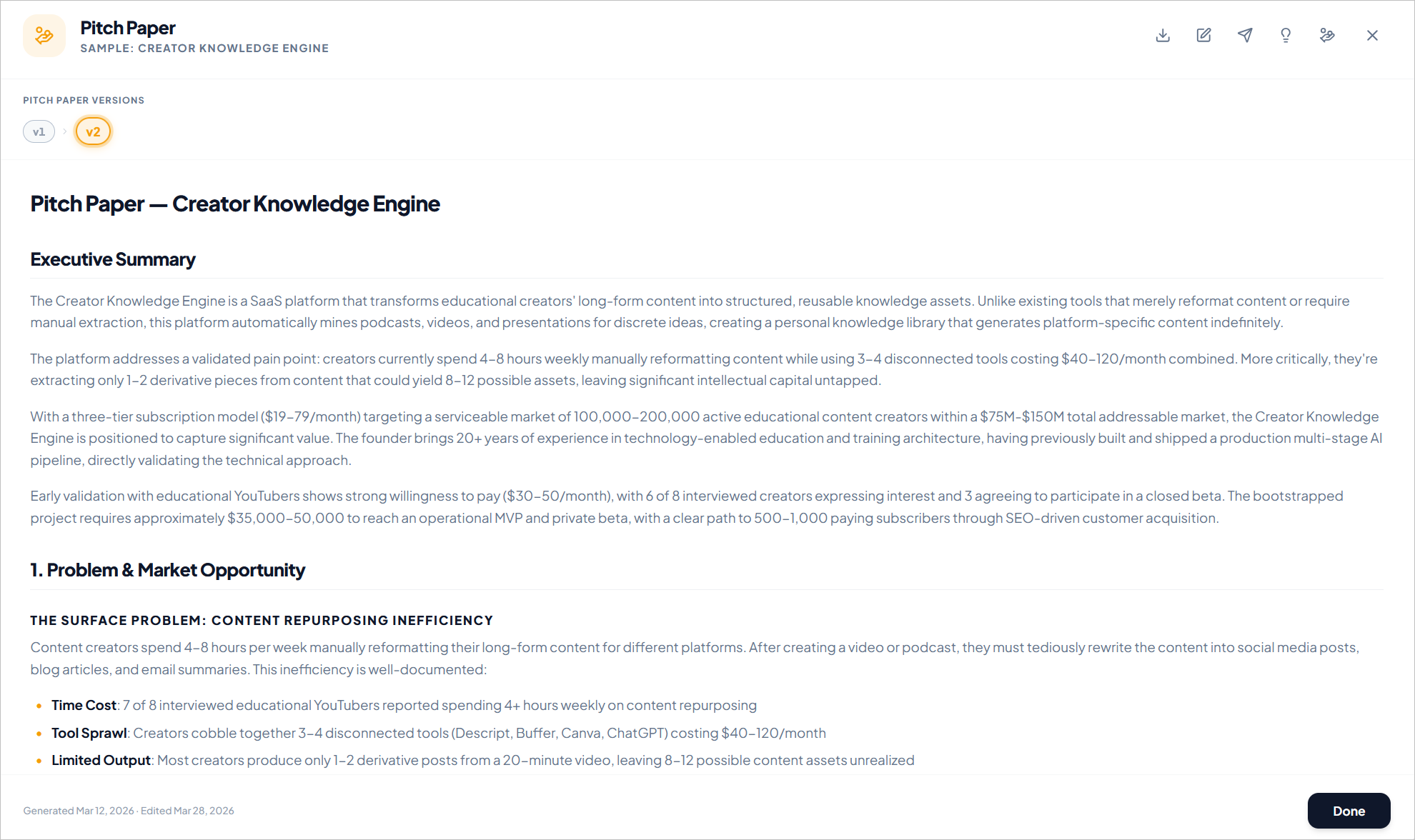
Within the completed Pitch Paper, a lightbulb icon in the report header opens the Document Completeness Audit panel. This is where the platform’s honesty shows up again.
The audit scores your generated document against all 14 items from the Gap Detection Protocol. Every item receives one of three statuses: covered, partial, or missing. Alongside the scoring, a Readiness Assessment paragraph is provided with actionable notes on every partial or missing item.
Human nature makes founders blind to gaps in their own writing. The completeness audit provides the objective read-through your pitch needs before it lands in front of someone who will not be generous about what is missing.
Improving the Document
If the audit surfaces partial or missing items, that is not a reason to start over. It is the input for the next improvement cycle.
Running an improvement interview costs one additional credit. The AI reads the Document Insights from the previous version, identifies every partial and missing item, and asks hyper-targeted questions focused only on those specific weaknesses. Items already marked as covered are left alone entirely.
The improvement pipeline does not rewrite the full document. It drafts updates only for the sections tied to gaps, stitches them back in, and runs a fresh completeness audit on the result. Each improvement cycle produces an updated version of the document with a new audit. The process repeats until the document reflects the full strength of your position.
A Pitch Paper versions tracker displays all versions in the report view. You can click any version to read it in full.
What the Audit Is Really Doing
The 14-item Gap Detection Protocol is not a proprietary invention. It reflects the actual checklist that investors use to evaluate early-stage opportunities. The audit is telling you, before you walk into a room, which answers you cannot yet give.
Founders who go into investor meetings without being able to answer the “why now” question, or who cannot cite a credible TAM source, or who have not thought through their unit economics, lose those meetings. Not because their idea is bad, but because they are not yet prepared to speak the investor’s language.
The Pitch Paper process is preparation, made systematic.
How to Use the Pitch Paper Once It Is Ready
The document can be downloaded as Markdown or as a formatted PDF, or emailed directly from the platform to up to 20 recipients.
One clarification worth making explicit: the Pitch Paper is not a replacement for a pitch deck. Founders frequently blur these. The Pitch Paper is your comprehensive, evidence-backed business narrative. Your pitch deck, the slides you present in a meeting, should serve as visual support for that narrative. The big TAM chart and the bold revenue projections belong on slides. The Pitch Paper is the document you leave behind for the analysts to verify your unit economics and due diligence claims after the meeting.
Use the Pitch Paper to win confidence. Use the deck to capture attention. They serve different purposes and should be built accordingly.
Ready to build your investor narrative? founderscore offers a 7-day free trial with 3 credits included. One credit covers a complete Feasibility Report and another covers your first Pitch Paper generation. No long-term commitment required.