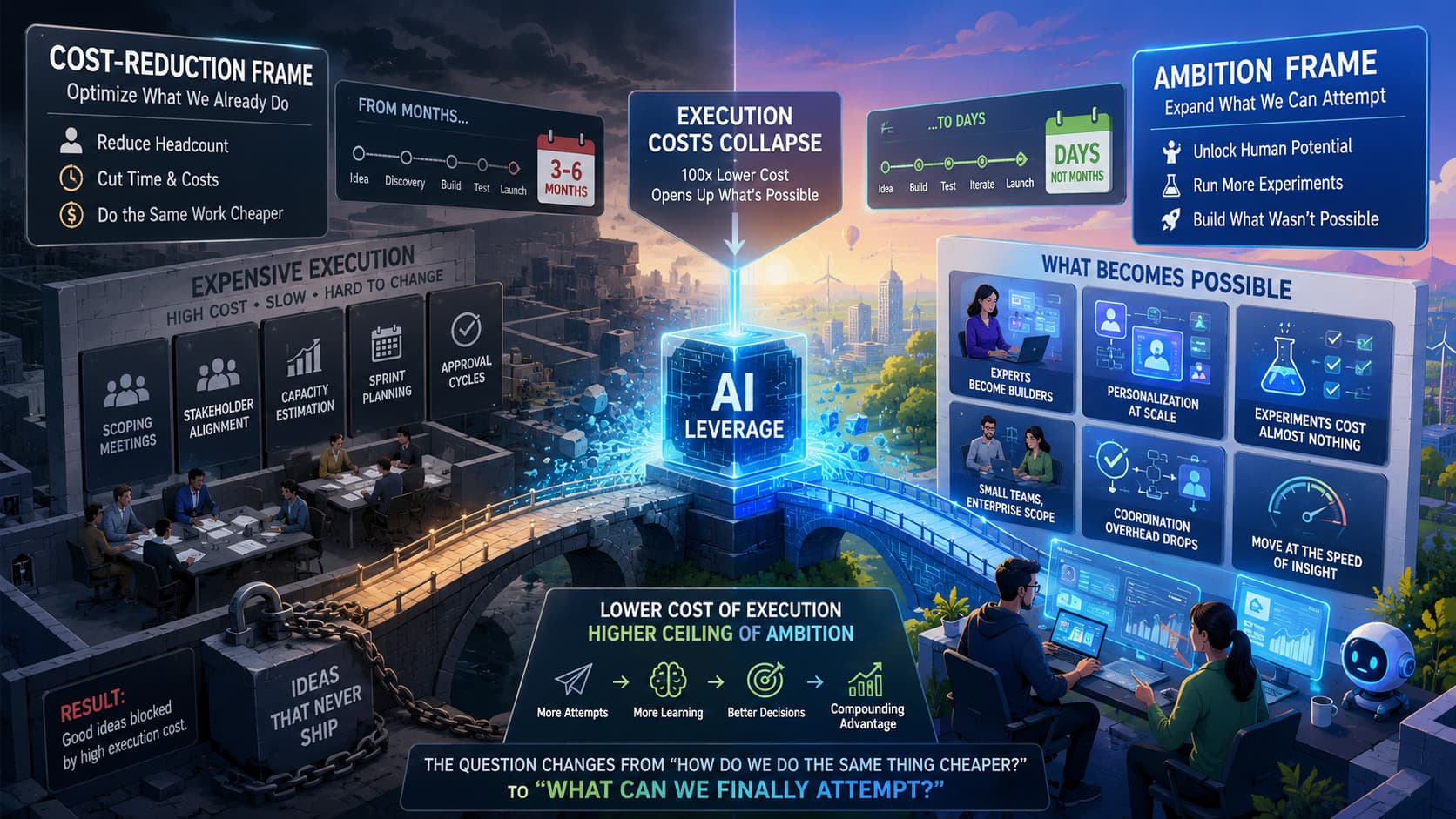
A product team at a mid-sized SaaS company spent three weeks getting approval to build a feature that, once greenlit, took four days to ship. The delay was not technical. Nobody was blocked on architecture or tooling. The delay was organizational. Scoping meetings, sprint planning, stakeholder alignment, capacity estimation. The machinery designed to manage expensive execution kicked in as it always had, because nobody had updated their priors about what execution actually costs now.
That gap, between what is possible and what organizations are willing to attempt, is where most AI value gets left on the table.
The Frame Shapes the Question
When AI drops the cost of doing by 100x, the conversation shifts from "how do we reduce headcount" to "what can we finally attempt."
Companies started taking AI seriously in 2023 and 2024, most reached for the same frame: cost reduction, headcount rationalization, and efficiency gains. The reasoning made sense from where they were standing. AI could automate repetitive tasks, reduce support tickets, cut time spent on first drafts. Real savings. Measurable.
But cost reduction is a maintenance frame. It asks: how do we do what we already do for less? It does not ask whether the thing worth doing has changed. And when execution costs drop by two orders of magnitude, the thing worth doing almost certainly changes.
The organizations stuck in the cost frame are optimizing an old problem. They are getting faster at writing the same documents, not reconsidering what to write. They are reducing meeting time, not asking which decisions now make sense to run as cheap experiments rather than expensive deliberations. The frame sets the ceiling, and they have picked a low one.
What Actually Changes When Execution Gets Cheap
When a task that cost $50,000 in time and labor costs $500, you do not just do the same task more cheaply. You do tasks that were never worth doing before. Six things shift in ways that matter for operators and builders.
Experts become builders. A domain expert who understood exactly what tool they needed but could not code it now can. A regulatory analyst who spent years explaining requirements to engineers can now prototype the compliance checker herself. The translation layer between knowing and building collapses. This is not about replacing engineers. It removes the coordination bottleneck that kept subject-matter expertise from reaching products directly.
Personalization at scale becomes tractable. Serving ten thousand users with ten thousand slightly different experiences was impossible at human labor rates. It becomes feasible when the marginal cost of generating a tailored output approaches zero. The insurance company that sends one form letter to everyone sends it because customization at scale was too expensive, not because the form letter actually works. That constraint is gone.
Experiments cost almost nothing. When running a test required building, staffing, and measuring a full feature, most ideas never made it to the starting line. The bar was justified by cost. Now the bar needs recalibration. Cheap tests mean more signal, faster. Teams that run ten experiments a quarter and teams that run one are operating in fundamentally different information environments. The first team learns faster, compounds faster, and makes fewer large irreversible bets based on insufficient data.
Small teams can operate at enterprise scope. A two-person team with the right AI infrastructure can now generate, distribute, and iterate on content, support, and product at volumes that required departments a few years ago. This is not a small edge. It is a structural advantage for builders who recognize it and use it.
Coordination overhead drops when execution is fast. Approval cycles, sprint planning, and capacity estimation exist because committing to expensive work requires careful judgment. When work is cheap and reversible, the overhead of deciding whether to start often costs more than just starting. Organizations that redesign their decision-making around cheap execution will outpace those still running expensive-work processes on cheap-work problems.
Companies can move at the speed of insight. The bottleneck in most organizations is not generating good ideas. It is the lag between a good idea and a working version of that idea in front of a user. When that lag compresses from months to days, the feedback loop tightens, the iteration cycles multiply, and the organization begins learning at a rate that compounds.
What the Cost Frame Gets Wrong
The cost frame is not wrong about savings. It is wrong about which savings matter.
Reducing headcount by automating tasks optimizes the current configuration of the organization. It makes the current product cheaper to run. But it does not expand what the organization can attempt. It does not change the ceiling.
Worse, it can actively prevent the ambition frame from taking hold. When the primary narrative is job displacement, the people who would benefit most from AI leverage, the domain experts who could become builders, the analysts who could run their own experiments, become resistant rather than capable. The organizational culture orients around defense rather than possibility.
That is the real cost of the cost frame. Not that the savings are wrong, but that pursuing them as the primary objective crowds out the question that matters more: what is now possible that was not possible before?
The tradeoff is not cost savings versus ambition. Companies can capture both. The tradeoff is in which one governs strategy. Organizations that use AI to defend existing margins will protect those margins for a while. Organizations that use AI to expand what they can attempt will build capabilities their competitors are not building, because their competitors are busy optimizing the old model.
Start With One Attempt That Was Previously Too Expensive
The path into the ambition frame is concrete, not philosophical. You do not need a new AI strategy or a transformation program. You need one example.
Pick one thing your team wanted to do in the last twelve months and did not, because it was too expensive to execute. Not impossible. Just expensive enough that it did not make the cut. A personalization layer. A faster feedback loop with customers. A tool an internal expert needed but could not justify the engineering time. A test that required too much setup to be worth running.
Run it now. Use the current tools. Give it two weeks. Not to prove a concept. To get a real result in front of a real user.
That result changes the conversation more than any strategy document. It gives people a concrete reference for what cheap execution actually feels like, what it produces, and what becomes worth attempting next. The frame shifts when the evidence arrives. Give your team the evidence.