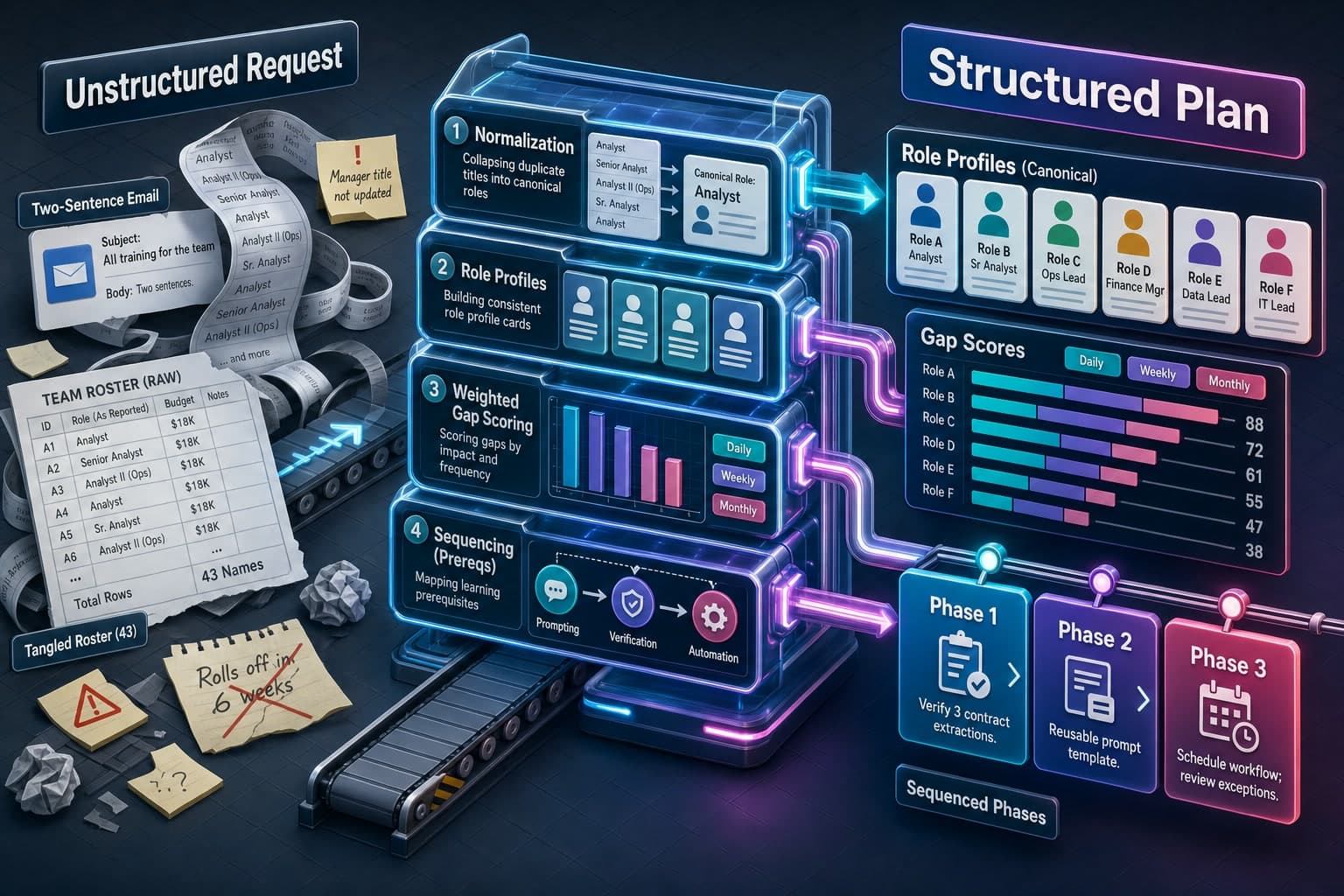
A director of operations forwards a request on a Tuesday morning. Subject line: "AI training for the team." The body runs two sentences. Attached is a roster of 43 names, job titles, and a budget of $18,000. Three titles read "Analyst." Two read "Senior Analyst." One reads "Analyst II (Ops)." Nobody has written down what any of those people should be able to do differently in ninety days.
The standard response is a course list. Someone opens the catalog, filters on "AI," and sends back twelve titles with completion estimates. The director approves it because it looks like movement. Six weeks later, 43 people have watched an hour of video on prompt engineering, the completion dashboard reads 87 percent, and the weekly reporting process runs exactly the way it ran in March.
The request is never the requirement
"Get the team up to speed on AI" is not a training requirement. It is a symptom sentence. Buried inside it sit four decisions nobody made: which people, which capabilities, at what depth, in what order.
Miss any one of those and the plan fails in a predictable way. Skip the people question and you buy 43 seats for a capability that 9 people use. Skip depth and you teach awareness to a team that needed applied practice, or you drop a four-week build track on someone who needed forty minutes of orientation. Skip order and you put "design an internal agent workflow" in week two, in front of people who cannot yet tell a confident wrong answer from a correct one.
This keeps happening for a practical reason. Writing the requirement by hand takes a skilled L&D person about three days per department: interviews, role mapping, a skills baseline, then a sequencing pass. Most teams do not have three days, so they buy the catalog and hope.
That gap is the job a recommendation engine exists to do. Not picking courses. Turning an unstructured request into a structured requirement, then into a sequence.
What the engine does between the email and the plan
The first move is normalization. Free text and a roster go in, canonical role profiles come out. "Analyst," "Senior Analyst," and "Analyst II (Ops)" collapse into one role with a seniority attribute, because those three people do the same work with different review authority. A roster of 43 becomes 6 role profiles, and everything downstream operates on the 6.
The exceptions are where this gets messy. One name belongs to a contractor who rolls off in six weeks. Two others still read "Analyst" because nobody updated the HRIS after they started managing people. Somebody has to catch those by hand before the engine sees the file, or the error rides through every calculation that follows and comes back out the other end looking like a recommendation.
Each profile carries target capabilities with a proficiency level attached. Four levels cover most cases: awareness, working, applied, able to teach it. An operations analyst needs applied proficiency on structured prompting and document extraction, working proficiency on output verification, and awareness on model selection and token cost. The finance manager who reviews that analyst's work needs verification at applied and prompting at awareness. Same tool, different depth, different plan.
Then gap scoring. Current proficiency comes from an assessment, a manager rating, or prior verified work. The gap is target minus current, and the engine weights it by how often that capability shows up in the role's week. The weighting is what protects the budget. A two-level gap on something an analyst touches daily outranks a three-level gap on something quarterly. Without frequency weighting, the engine recommends the biggest gaps, which are usually the least relevant ones.
Sequencing runs on a prerequisite graph. Capabilities carry edges: verification before automation, prompting before agent design, data hygiene before anything that writes to a system of record. The engine sorts the remaining gaps topologically and rejects any order that breaks an edge. A course catalog cannot do this, because a catalog is a flat list with no opinion about order.
Phasing is where the plan meets the calendar. The engine cuts the ordered gap list against declared capacity. Three hours a week for eight weeks is 24 hours of learning time. Call it 16 once meetings and month-end close take their cut. A plan that assumes 40 hours dies in week five. Each phase gets one stated behavior change and one check at the end, and the check is a piece of real work reviewed against a rubric rather than a quiz.
The output is a plan per role. Phase 1: the analyst extracts structured data from vendor contracts and verifies three of them against the source documents. Phase 2: the analyst builds a reusable prompt template another analyst can run without instruction. Phase 3: the analyst hands one recurring extraction task to a scheduled workflow and reviews the exceptions. Every phase names an artifact somebody can look at.
Where these systems break
Taxonomy depth costs maintenance. A 400-node skill taxonomy produces sharp recommendations and goes stale in roughly six months, because the tools move and nobody owns the update. A 40-node taxonomy stays current and produces plans that read like everyone else's plan. Choose the coarse one and budget for a human editing pass on every output.
Self-assessment costs accuracy. A self-rating takes 5 minutes per person and lands wrong in both directions, since confident people overrate and capable people underrate. A real skills assessment takes 45 minutes per person, gives you a baseline you can trust, and cuts participation the moment it feels like a performance review. Assess the 8 to 10 highest-frequency capabilities and let people self-rate the rest.
Personalization costs the cohort. Per-person plans fit better and quietly destroy the thing that makes training hold, which is 12 people fighting the same problem in the same week. Per-role plans keep a shared vocabulary and let a manager run one conversation instead of 43. The price is that a few people sit through material they already know.
Catalog coupling costs honesty. An engine recommends only what it can see. Point it at one vendor library and it produces a plan shaped like that library, and the shape looks justified because the gap scores behind it are real. Require the engine to emit unmatched gaps as a named list. That list is the most useful part of the output, because it tells you what to build or buy next, and it is usually short. Nobody sells a course on checking model output against your own contract templates. That one is forty minutes of your best analyst sharing a screen.
Start with the role profiles, not the software
Write the role profile layer before you evaluate a single engine. Six to ten canonical roles. Eight to twelve target capabilities per role. One of four proficiency levels on each capability, plus a frequency tag: daily, weekly, monthly, quarterly. Two people can draft that in two days by pulling job descriptions, then correcting them against what three managers say their teams do on a Wednesday.
That artifact is the input every engine needs, and no vendor can produce it for you, because it encodes how your work is divided. Hand a good profile layer to a mediocre engine and you get a usable plan. Hand a spreadsheet of job titles to an excellent engine and you get a catalog dump with better formatting.
Then run one narrow pilot. One role. One cohort of 8 to 12 people. One six-week phase. One measured behavior with a number before and a number after: average hours to close the monthly vendor reconciliation, or the percentage of AI-assisted drafts that clear review without rework. If the engine's plan moves that number, and building the same plan by hand would have taken three days, you have your answer. If the number holds flat, open the profile layer before you blame the engine. Nine times out of ten the target proficiency was set too high, or the frequency tags were guesses nobody checked with a manager.
The director's email is not going to improve. Next quarter it will say "get the team up to speed on agents" and the roster will carry 51 names. The role profiles are what turn that sentence into a plan in an afternoon instead of a week. The engine sorts and sequences what you give it. It cannot decide what your analysts are supposed to be able to do, and it will never tell you that it is guessing. Write the profiles first, then go shopping.